
They were more than radio hosts; they were family. They helped make us who we are today.
There was a time when you didn’t need to look at the radio dial to know which station you were listening to. All you needed was the voice coming through the speaker.
Whether it was the kitchen radio while Mom prepared breakfast, the dashboard of the family car, or a transistor radio tucked beneath a pillow, those voices were as familiar as the neighbors next door.
We didn’t have streaming services or podcasts. We had stations like WKEE, WGNT, WAMX, WTCR, WRVC, and WEMM.
And we had something today’s broadcasting industry seems too willing to surrender. We had personalities.
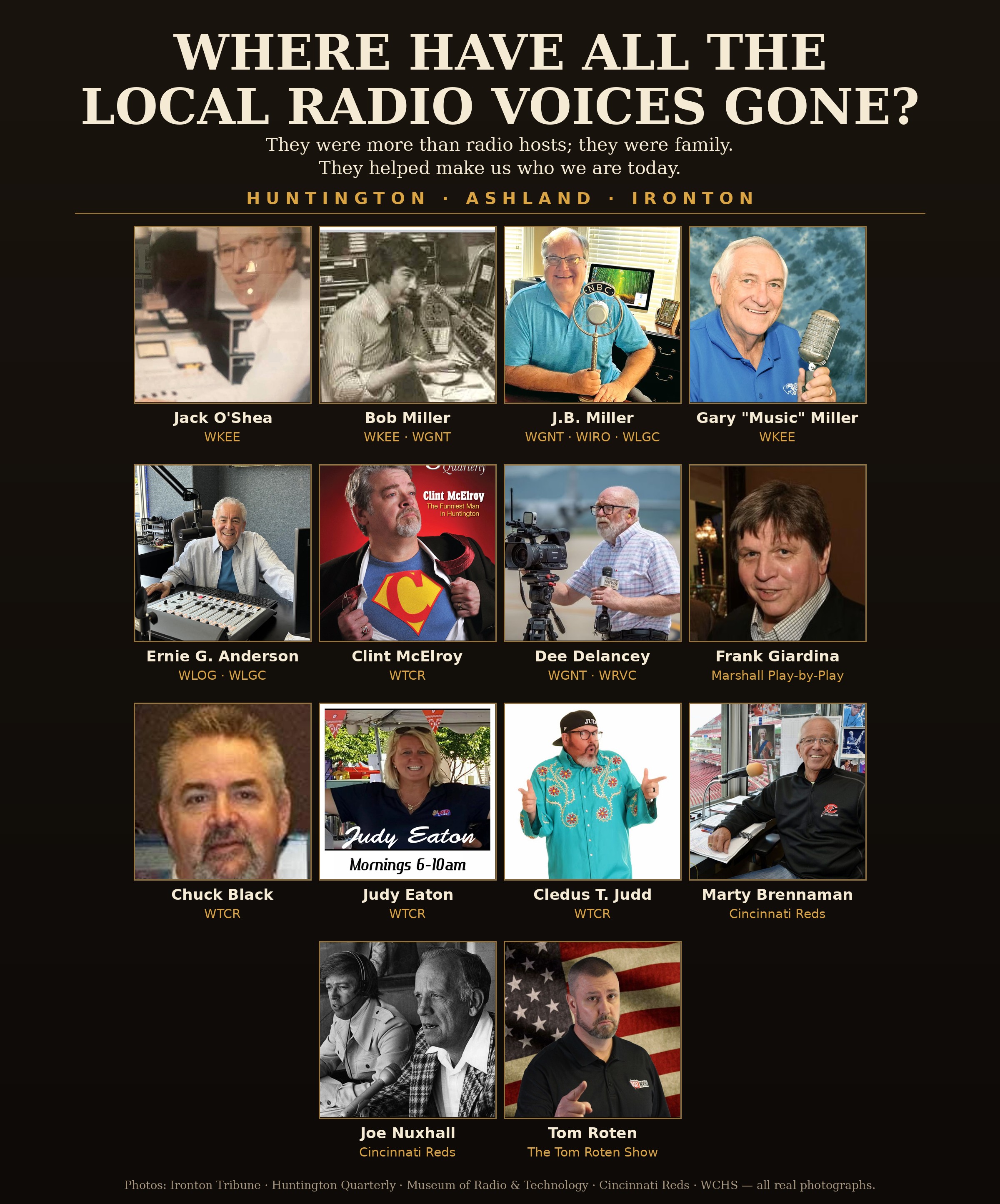
For those of us who grew up in the Huntington-Ashland-Ironton area, names like Jack O’Shea, Bob Miller, J.B. Miller, and Gary “Music” Miller bring back memories of an era.
There was Rod Grant, Ernie G. Anderson and his late-night trivia program, along with Jimmy Mack, Clint McElroy, Jim Jablonski, Dee Delancey, Frank Giardina, Dave Z, Brian “Doc of Rock” Atkins, Scott Hesson, Chuck Black, Judy Eaton, Jesse James, Dave McClain and of course, Cletus T. Judd.
These weren’t simply announcers filling airtime between commercials. They were entertainers, storytellers, newsmen, and friends. They knew the communities they served because they lived in them. They announced school closings on snowy mornings, promoted community fundraisers, and occasionally made us laugh when we needed it most.
They were part of the soundtrack of our lives. Their voices marked the passing of our days, becoming familiar companions through childhood, adulthood, and the changing seasons of life.
Radio also meant summer evenings listening to Marty Brennaman and Joe Nuxhall describe another Cincinnati Reds game, or Friday nights when local high school football team seemed like the most important thing in the world.
Those weren’t simply broadcasts. They were shared experiences. Somewhere along the way, the business of radio began to change.
Corporate consolidation, automation, and syndicated programming gradually replaced the local personalities who once distinguished one station from another.
In 2009, Gary “Music” Miller’s 31-year career at WKEE ended during corporate layoffs. In 2023, Judy Eaton departed WTCR after 33 years, another casualty of corporate cutbacks.
These departures remind us that decades of loyalty and community recognition can be outweighed by a corporate balance sheet.
More recently, another familiar Tri-State voice reached a similar crossroads.
I learned that Total Media will no longer carry The Tom Roten Morning Show, replacing locally produced talk programming with nationally syndicated alternatives.
For more than 25 years, Tom has been a recognizable conservative voice in the Tri-State, earning the nickname “The Straight Shooter” and developing a loyal audience known as the “Roten Army.”
His familiar expressions, including “I’m just looking for a little consistency” and “The truth is still the truth, even if nobody believes it. A lie is still a lie, even if everybody believes it,” became reflections of the convictions that defined his broadcasting career.
I’ve enjoyed the privilege of guest-hosting his program and experiencing firsthand the connection between a local broadcaster and the listener. But Tom’s story is only the latest example of a much larger transformation.
The economics of broadcasting have changed. Radio competes with streaming services, podcasts, social media, and countless other sources of information.
Nationally syndicated programming may be less expensive, and many national personalities are talented. But what happens when every station begins to sound like every other station? What happens when the voices discussing our communities no longer live in them?
There’s a fundamental difference between delivering programming to an audience and building a relationship with one. The great local broadcasters understood that distinction.
They didn’t simply play records, read headlines, or offer opinions. They became part of our lives, creating something technology cannot manufacture – loyalty.
Radio’s greatest asset was never simply the transmitter, the tower, or the frequency assigned by the Federal Communications Commission. It was the familiar voice coming through the speaker that made us laugh, kept us informed and accompanied us through difficult times.
Technology has given us more ways to listen than ever before. But we’re losing something far more personal.
The voices that once made radio feel like home. And when local radio loses those voices, it risks losing the people who made it successful.
Its listeners.

