A STRATEGIC PLAN TO RESTORE AFFORDABLE AMERICAN BEEF
Strengthening Domestic Cattle Production, Protecting American Ranchers, Expanding Competition, and Preserving Food Safety
October 19, 2026
The Honorable Brooke L. Rollins
Secretary of Agriculture
United States Department of Agriculture
1400 Independence Avenue, S.W.
Washington, DC 20250
RE: Policy Recommendations to Strengthen America’s Beef Supply and Improve Consumer Affordability
Dear Secretary Rollins:
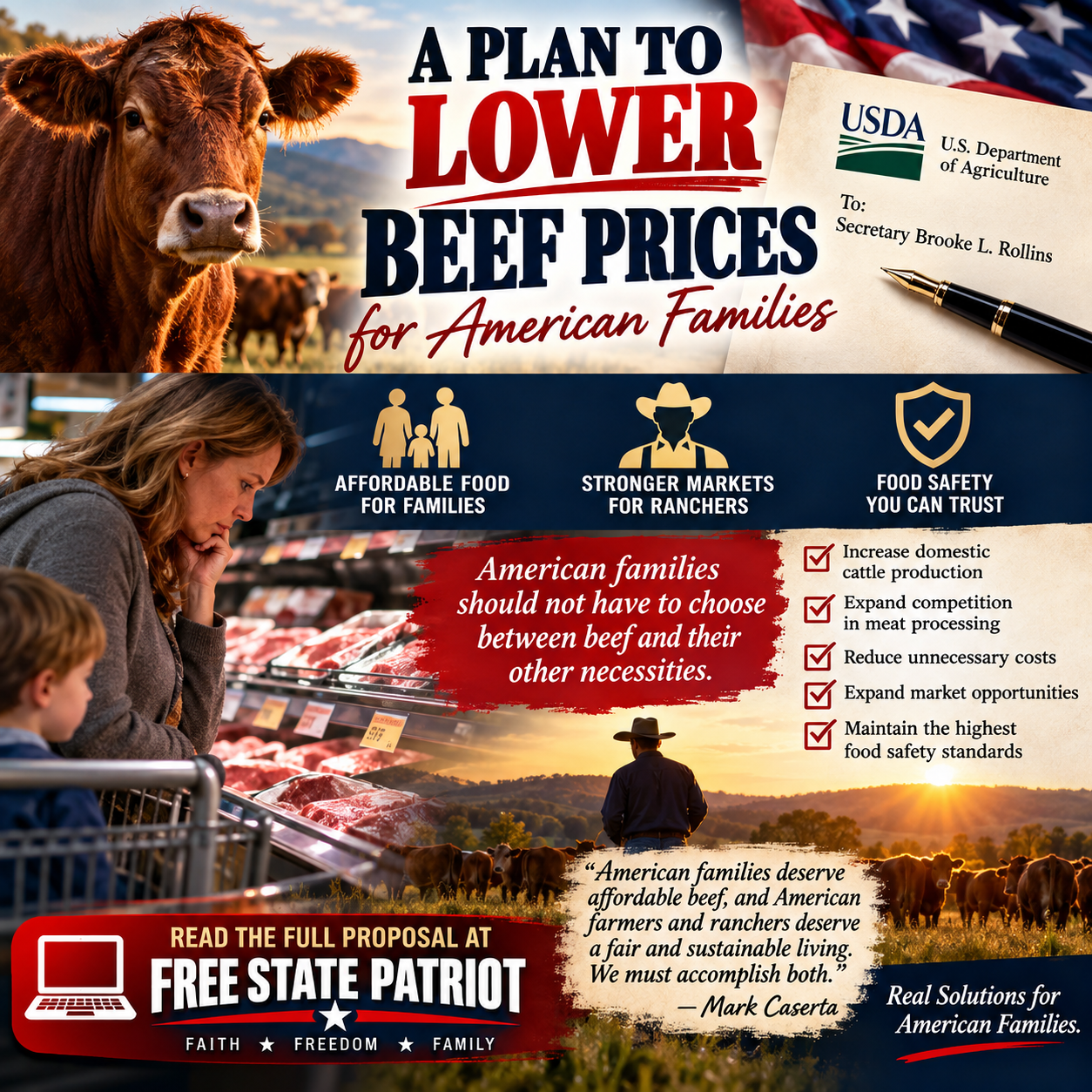
I am writing to submit a series of policy recommendations designed to address the rising cost of beef for American families while strengthening domestic cattle production, protecting American farmers and ranchers, encouraging fair competition, and maintaining the highest standards of food safety.
American consumers should not have to choose between affordable beef and supporting the hardworking farmers and ranchers who produce it.
I recognize and appreciate the Department’s ongoing efforts, including its Plan to Fortify the American Beef Industry, the Strengthening Processing for U.S. Ranchers (SPUR) Program, and the Ranchers First Initiative.
My recommendations are intended to complement these efforts, identify opportunities for additional action, and establish measurable objectives for both producer sustainability and consumer affordability.
EXECUTIVE SUMMARY
America’s beef industry faces a fundamental challenge: historically limited cattle supplies, following years of drought, herd liquidation, rising production expenses, and other economic pressures, have contributed to elevated consumer prices.
According to USDA’s National Agricultural Statistics Service, the United States began 2026 with approximately 86.2 million cattle and calves, including 27.6 million beef cows, a decline of 1% from the previous year.
Rebuilding domestic cattle inventories is essential. However, herd rebuilding requires time and may temporarily restrict slaughter supplies as producers retain breeding animals.
Therefore, a successful national strategy must address three separate objectives:
- Short-term affordability: Reduce avoidable production and distribution costs, improve market access, and strengthen consumer purchasing options.
- Medium-term competitiveness: Improve processing efficiency, strengthen competition, and support independent producers.
- Long-term sustainability: Rebuild America’s cattle herd, strengthen domestic food security, and improve resilience against future droughts and animal disease.
I respectfully submit the following recommendations for consideration.
1. ACCELERATE DOMESTIC CATTLE HERD RECOVERY
Drought conditions, high input costs, and financial uncertainty have contributed to reductions in the national cattle herd.
American ranchers need the financial confidence and operating resources necessary to rebuild.
Recommended actions:
- Expand targeted drought-recovery assistance for qualified cattle producers.
- Evaluate temporary tax incentives for retaining replacement heifers and rebuilding breeding herds.
- Increase access to affordable financing for herd expansion, pasture restoration, and water infrastructure.
- Support forage development, grazing improvements, and drought-resistant agricultural practices.
- Coordinate existing USDA risk-management programs to better protect producers undertaking herd expansion.
These initiatives should prioritize working American cattle producers, particularly family-owned and independent operations.
Expected result: A stronger domestic breeding herd, increased future beef production, and improved resistance to supply disruptions.
Important consideration: Herd rebuilding is a long-term solution and should not be represented as an immediate reduction in retail beef prices.
2. STRENGTHEN COMPETITION IN MEAT PROCESSING
Concentration in the beef-processing industry remains a legitimate concern for both producers and consumers.
USDA research has documented that the four largest meatpacking firms account for approximately 85% of steer and heifer purchases.
This degree of concentration raises important questions about producer bargaining power, market access, price discovery, and the resilience of the nation’s beef supply chain.
Recommended actions:
- Strengthen enforcement of existing competition laws through cooperation among USDA, the Department of Justice, and the Federal Trade Commission, within their respective authorities.
- Increase transparency in cattle purchasing practices and price reporting.
- Examine contractual arrangements that may improperly restrict competition.
- Continue supporting independent and regional processing operations.
- Evaluate the effectiveness of the SPUR Program and other processing initiatives.
- Prioritize maintaining viable existing processing facilities while supporting additional capacity where economically justified.
Additional processing facilities alone cannot resolve a shortage of market-ready cattle. However, a more competitive processing industry can create additional marketing opportunities for ranchers and improve supply-chain resilience.
Expected result: More competitive cattle markets, increased producer options, improved transparency, and greater potential for efficient beef pricing.
3. REDUCE PRODUCTION, FEED, AND TRANSPORTATION COSTS
The cost of producing beef ultimately influences the economic sustainability of American cattle operations.
Feed, forage, fuel, equipment, labor, veterinary care, and transportation are significant expenses.
Recommended actions:
- Expand targeted feed assistance during officially recognized drought emergencies.
- Evaluate transportation assistance for producers in regions facing unusually high livestock-shipping costs.
- Examine temporary, narrowly targeted tax relief or credits where measurable producer benefits can be demonstrated.
- Support improved domestic feed-grain production and distribution efficiency.
- Review regulatory requirements that impose unnecessary costs without providing meaningful safety or environmental benefits.
- Require evaluation of whether federal cost-relief programs actually improve producer viability and consumer affordability.
Any subsidies or tax incentives should be temporary, transparent, and subject to performance review.
Expected result: Reduced financial pressure on domestic cattle producers and improved capacity to sustain and expand production.
4. EXPAND DIRECT-TO-CONSUMER AND REGIONAL BEEF MARKETS
American families increasingly seek opportunities to purchase beef directly from local farms and ranches.
Direct marketing can create additional income opportunities for producers and give consumers more purchasing choices.
However, small-scale processing, packaging, refrigeration, and transportation can create additional costs. Therefore, direct sales should be encouraged as a competitive alternative rather than presented as a guaranteed source of lower prices.
Recommended actions:
- Expand technical assistance for farms developing direct-to-consumer marketing programs.
- Support mobile slaughter and processing facilities that meet applicable federal or state inspection requirements.
- Improve access to inspected regional processing facilities.
- Help smaller producers develop cooperative marketing and distribution arrangements.
- Simplify unnecessary administrative barriers while preserving essential inspection and food-safety requirements.
- Improve consumer education regarding local beef purchasing, bulk purchases, and freezer-beef programs.
Expected result: More purchasing choices for consumers, additional market opportunities for ranchers, and stronger regional agricultural economies.
5. PROTECT AMERICAN BEEF IDENTITY THROUGH ACCURATE LABELING
American consumers deserve truthful and transparent information about the origin of the beef they purchase.
The USDA’s strengthened voluntary “Product of USA” labeling requirements, effective January 1, 2026, represent an important improvement.
Under the new standard, qualifying beef must originate from animals born, raised, slaughtered, and processed in the United States.
Nevertheless, voluntary labeling does not resolve every question surrounding country-of-origin transparency.
Recommended actions:
- Ensure consistent enforcement of the new voluntary American-origin labeling standards.
- Measure consumer awareness and industry compliance.
- Examine the feasibility of mandatory country-of-origin labeling for beef.
- Evaluate the legal and trade implications of any proposed mandatory labeling requirements.
- Support truthful identification of American-raised beef without unnecessarily restricting lawful imports.
Domestic cattle production should be encouraged through competitive advantages, reliable infrastructure, fair markets, and consumer confidence.
Import restrictions that reduce available beef supplies could unintentionally increase retail prices and should be evaluated carefully.
Expected result: Improved consumer confidence, fairer recognition of American producers, and stronger incentives for domestic production.
6. IMPROVE CATTLE HEALTH AND PREVENT PRODUCTION LOSSES
Animal disease, preventable mortality, reproductive problems, and inadequate veterinary access can reduce the productivity of American cattle operations.
A healthy national herd is essential to long-term food affordability and agricultural security.
Recommended actions:
- Strengthen USDA veterinary disease-surveillance and response capabilities.
- Improve access to veterinary services in underserved rural communities.
- Support appropriate vaccination, biosecurity, and herd-health programs.
- Expand practical livestock traceability systems that support rapid disease identification and containment.
- Assist smaller producers with the cost of adopting effective animal-health technology.
- Improve coordination among federal agencies, state veterinarians, and cattle producers.
Special attention should be given to emerging disease threats that could disrupt domestic cattle production or interstate livestock movement.
Expected result: Reduced preventable livestock losses, improved productivity, and greater stability in the nation’s beef supply.
7. PRESERVE FOOD SAFETY WHILE REDUCING UNNECESSARY ADMINISTRATIVE COSTS
Food safety must remain nonnegotiable.
American consumers must have confidence that beef entering the marketplace meets rigorous inspection and sanitation requirements.
At the same time, smaller processors and producers should not face avoidable administrative expenses that provide little additional public-health benefit.
Recommended actions:
- Simplify duplicative paperwork and reporting requirements.
- Expand secure electronic recordkeeping and inspection-support systems.
- Provide technical assistance to small processors seeking compliance with federal inspection requirements.
- Support grants or financing for sanitation, refrigeration, traceability, and food-safety technology.
- Improve coordination between federal and state inspection programs where legally permissible.
- Maintain essential inspection, testing, sanitation, and enforcement standards.
Expected result: More efficient compliance, stronger food-safety systems, and reduced unnecessary operating expenses.
8. ESTABLISH A NATIONAL BEEF AFFORDABILITY AND PRODUCTION SCORECARD
Government initiatives should be evaluated by measurable results rather than announcements or appropriated dollars alone.
I recommend that USDA publish a publicly accessible annual scorecard tracking:
- Total U.S. cattle inventory and beef-cow inventory.
- Annual calf production and domestic beef output.
- Average retail beef prices and inflation-adjusted price trends.
- Cattle producer profitability and major input costs.
- Regional processing capacity, utilization, and competition.
- Producer access to independent and regional processors.
- Progress of federally funded herd-rebuilding and processing initiatives.
- Beef import and export volumes.
- Food-safety outcomes and significant animal-disease threats.
The scorecard should distinguish between changes resulting from government programs and those driven by weather, cattle cycles, consumer demand, trade, and other market conditions.
Expected result: Greater transparency, improved accountability, and a measurable basis for determining whether federal policy is strengthening American agriculture and improving consumer affordability.
RECOMMENDED IMPLEMENTATION PRIORITIES
First 12 months — Immediate and near-term actions
- Evaluate and strengthen existing meatpacking competition enforcement.
- Improve market transparency and cattle-price reporting.
- Identify opportunities to reduce unnecessary administrative and transportation costs.
- Support viable regional processing operations.
- Expand access to direct-marketing assistance.
- Establish the national beef affordability scorecard.
Years 1–3 — Medium-term actions
- Evaluate and expand successful processing initiatives.
- Improve veterinary access and livestock disease prevention.
- Support producer cooperatives and regional distribution networks.
- Implement targeted drought-recovery and herd-rebuilding assistance.
- Evaluate consumer and producer outcomes from labeling policies.
Years 3–5 and beyond — Long-term objectives
- Achieve sustainable growth in domestic breeding-herd capacity.
- Improve resilience to drought and animal disease.
- Strengthen the economic viability of independent American cattle operations.
- Expand competitive domestic beef production.
- Establish a more resilient and affordable national beef supply.
REQUEST FOR USDA ACTION
I respectfully request that the Department of Agriculture:
- Review these recommendations in conjunction with its existing beef-industry initiatives.
- Identify which recommendations can be implemented under current USDA authority and which would require congressional legislation or interagency action.
- Evaluate opportunities to accelerate measurable results from existing programs.
- Consider establishing or expanding public reporting on beef affordability, production, and competition.
- Provide feedback regarding additional actions that could strengthen domestic production while improving affordability for American families.
CONCLUSION
America’s cattle ranchers and American consumers should not be placed on opposite sides of the same economic challenge.
Our nation needs a healthy, profitable domestic cattle industry. We also need families to be able to purchase nutritious, high-quality beef at reasonable prices.
These goals are not mutually exclusive.
A national strategy that encourages herd rebuilding, protects fair competition, reduces unnecessary costs, expands marketing opportunities, and maintains strong food-safety standards can serve the interests of both producers and consumers.
No single policy will reverse years of declining cattle inventories or immediately restore lower retail prices.
However, coordinated action, guided by measurable outcomes and responsible use of taxpayer resources, can help establish the conditions necessary for a stronger and more affordable American beef industry.
I appreciate your consideration of these recommendations and your service to American agriculture.
Respectfully,
Mark Caserta
Writer and Publisher, Free State Patriot
Huntington, West Virginia
304-444-7216
Faith • Freedom • Family