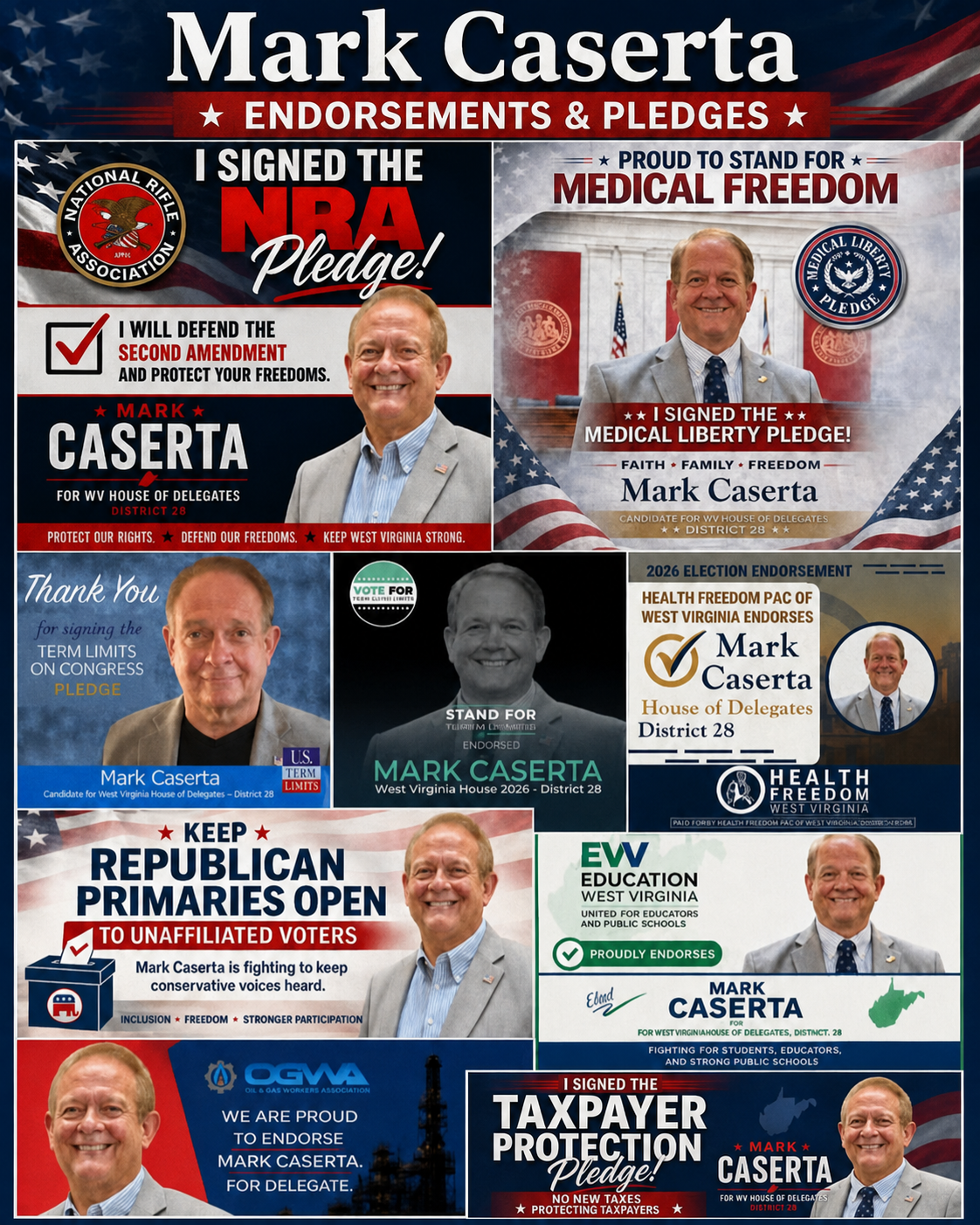
For several months I’ve asked the question: What would happen in November, the first general election since West Virginia Republicans closed their primary?
The election is over. The unofficial results are in. It’s time to assess and learn, with humility.
I have followed this issue for a long time, through a petition signed by hundreds of West Virginians and months of asking party leaders to look at the facts. So let us examine this case exhibit by exhibit.
Exhibit one is the May primary: Republican primary participation fell from 154,140 voters in 2022 to 126,365 in 2026 — a decline of 27,775. Votes cast for Republican legislative candidates fell by 46,795. Meanwhile, use of the nonpartisan ballot nearly quadrupled, rising from 5,620 to 21,576.
Thousands of voters who previously could participate in choosing Republican nominees no longer had that opportunity without changing their registration. Those numbers should have been a warning.
Exhibit two is the November general election: According to unofficial election results reported by the West Virginia Secretary of State’s Office, Republican candidates for the State Senate received 49,440 fewer votes than in 2022. Republican candidates for the House of Delegates received 63,961 fewer. Combined, that represents 113,401 fewer votes for Republican legislative candidates — even as Republican registration had grown substantially.
More Republicans on the rolls. Far fewer votes cast for Republican legislative candidates. That contrast deserves serious examination beyond the emotional responses I’ve received.
And early voting turnout certainly cannot explain away these concerns. Early voting increased approximately 24 percent over 2022, while participation among unaffiliated early voters increased approximately 31 percent. These citizens were participating in November, even though they had been excluded from the Republican primary in May.
Exhibit three is who was shut out: West Virginia now has approximately 356,000 registered voters outside the Republican and Democratic parties — nearly 30 percent of our electorate. Many are constitutional conservatives and independent-minded citizens who have simply chosen principle over a party label.
These are our neighbors, our coworkers, our fellow church members — and we closed the door on their participation in choosing Republican nominees.
Exhibit four may be the most overlooked potential outcome of all in the GOP closing its primary.
The closure did not eliminate the possibility of strategic party switching. It was promoted as protection against Democrats influencing Republican nominations. Yet between January 2024 and April 2026, nearly 17,000 registered Democrats changed their registration to Republican, making themselves eligible to participate in the Republican primary.
That does not establish why they changed registration or whether they subsequently voted. But it demonstrates that closing the primary does not create an ideological test. It simply creates a registration test.
In fairness, no single number proves that closing the primary caused every lost vote. Other factors influenced the 2026 election, and honesty requires acknowledging them. Differences in contested legislative races also matter when comparing consolidated vote totals.
But exhibit after exhibit raises the same concern. Unaffiliated voters helped Republicans build a majority in West Virginia. We cannot assume their continued support while excluding them from the process of choosing our nominees.
The goal of any political party should be to build a platform on which voters can feel good about supporting. Restricting unaffiliated or independent voters from that opportunity is political suicide.
Reopening is not complicated. It simply restores what West Virginia Republicans allowed for years: an unaffiliated voter could choose a Republican ballot on primary day. That is how it worked while we were building a majority. Parties grow by persuasion, not by padlock.
The conclusion is clear: We must reopen the West Virginia Republican primary.
But that alone may not be enough. We also owe the unaffiliated and independent voters of this state an apology. We told nearly a third of our fellow citizens that their voices were welcome in November but not in May. They were good enough to elect our candidates but not trusted to help choose them.
That was wrong, and saying so costs us nothing but pride.
Reopen the primary. Then let us earn those voters back, with representation, not registration tests.
That is how a party grows. That is how a majority is kept.
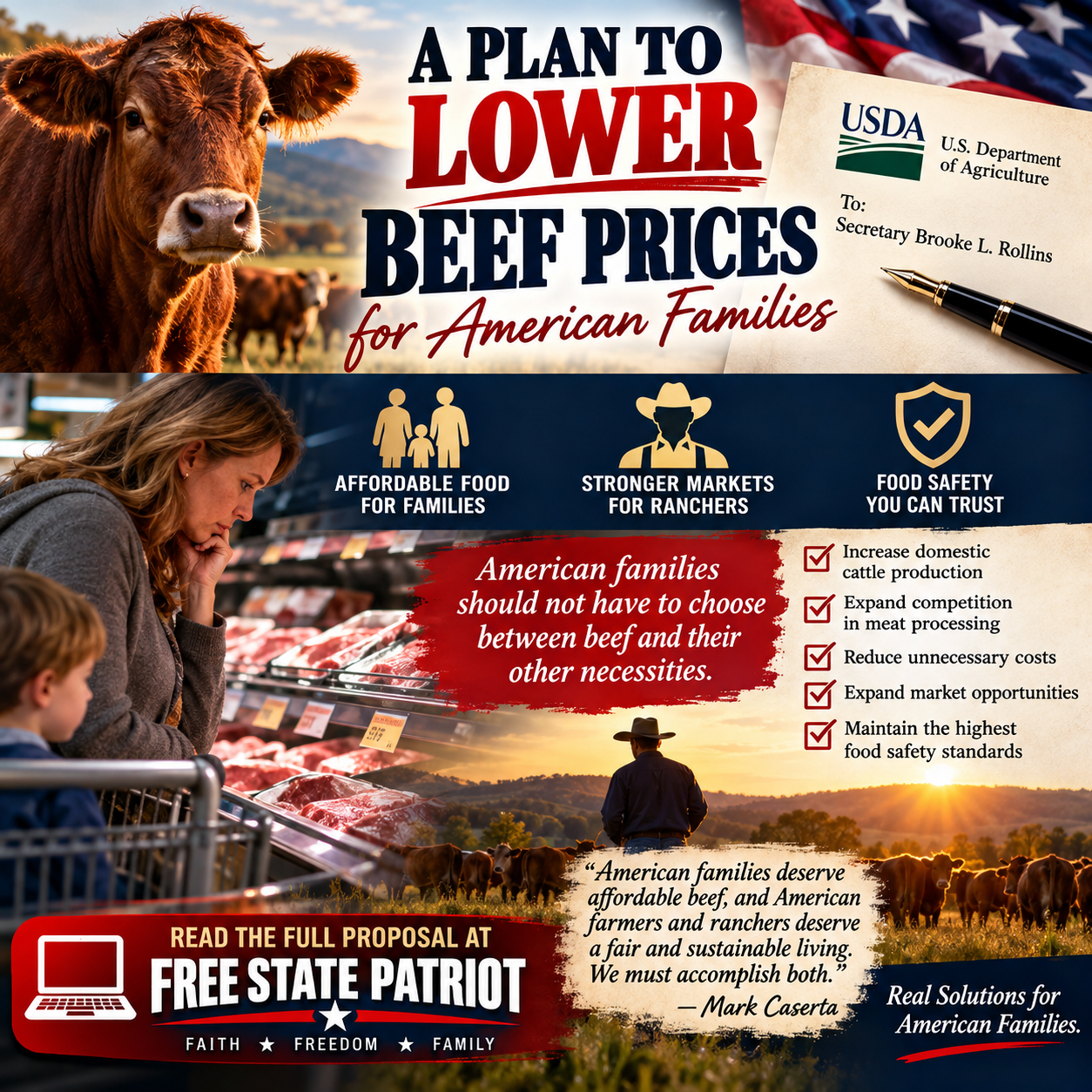
A STRATEGIC PLAN TO RESTORE AFFORDABLE AMERICAN BEEF
Strengthening Domestic Cattle Production, Protecting American Ranchers, Expanding Competition, and Preserving Food Safety
October 19, 2026
The Honorable Brooke L. Rollins Secretary of Agriculture United States Department of Agriculture 1400 Independence Avenue, S.W. Washington, DC 20250
RE: Policy Recommendations to Strengthen America’s Beef Supply and Improve Consumer Affordability
Dear Secretary Rollins:
I am writing to submit a series of policy recommendations designed to address the rising cost of beef for American families while strengthening domestic cattle production, protecting American farmers and ranchers, encouraging fair competition, and maintaining the highest standards of food safety.
American consumers should not have to choose between affordable beef and supporting the hardworking farmers and ranchers who produce it.
I recognize and appreciate the Department’s ongoing efforts, including its Plan to Fortify the American Beef Industry, the Strengthening Processing for U.S. Ranchers (SPUR) Program, and the Ranchers First Initiative.
My recommendations are intended to complement these efforts, identify opportunities for additional action, and establish measurable objectives for both producer sustainability and consumer affordability.
EXECUTIVE SUMMARY
America’s beef industry faces a fundamental challenge: historically limited cattle supplies, following years of drought, herd liquidation, rising production expenses, and other economic pressures, have contributed to elevated consumer prices.
According to USDA’s National Agricultural Statistics Service, the United States began 2026 with approximately 86.2 million cattle and calves, including 27.6 million beef cows, a decline of 1% from the previous year.
Rebuilding domestic cattle inventories is essential. However, herd rebuilding requires time and may temporarily restrict slaughter supplies as producers retain breeding animals.
Therefore, a successful national strategy must address three separate objectives:
Short-term affordability: Reduce avoidable production and distribution costs, improve market access, and strengthen consumer purchasing options.
Medium-term competitiveness: Improve processing efficiency, strengthen competition, and support independent producers.
Long-term sustainability: Rebuild America’s cattle herd, strengthen domestic food security, and improve resilience against future droughts and animal disease.
I respectfully submit the following recommendations for consideration.
1. ACCELERATE DOMESTIC CATTLE HERD RECOVERY
Drought conditions, high input costs, and financial uncertainty have contributed to reductions in the national cattle herd.
American ranchers need the financial confidence and operating resources necessary to rebuild.
Recommended actions:
Expand targeted drought-recovery assistance for qualified cattle producers.
Evaluate temporary tax incentives for retaining replacement heifers and rebuilding breeding herds.
Increase access to affordable financing for herd expansion, pasture restoration, and water infrastructure.
Support forage development, grazing improvements, and drought-resistant agricultural practices.
These initiatives should prioritize working American cattle producers, particularly family-owned and independent operations.
Expected result: A stronger domestic breeding herd, increased future beef production, and improved resistance to supply disruptions.
Important consideration: Herd rebuilding is a long-term solution and should not be represented as an immediate reduction in retail beef prices.
2. STRENGTHEN COMPETITION IN MEAT PROCESSING
Concentration in the beef-processing industry remains a legitimate concern for both producers and consumers.
USDA research has documented that the four largest meatpacking firms account for approximately 85% of steer and heifer purchases.
This degree of concentration raises important questions about producer bargaining power, market access, price discovery, and the resilience of the nation’s beef supply chain.
Recommended actions:
Strengthen enforcement of existing competition laws through cooperation among USDA, the Department of Justice, and the Federal Trade Commission, within their respective authorities.
Increase transparency in cattle purchasing practices and price reporting.
Examine contractual arrangements that may improperly restrict competition.
Continue supporting independent and regional processing operations.
Evaluate the effectiveness of the SPUR Program and other processing initiatives.
Prioritize maintaining viable existing processing facilities while supporting additional capacity where economically justified.
Additional processing facilities alone cannot resolve a shortage of market-ready cattle. However, a more competitive processing industry can create additional marketing opportunities for ranchers and improve supply-chain resilience.
Expected result: More competitive cattle markets, increased producer options, improved transparency, and greater potential for efficient beef pricing.
3. REDUCE PRODUCTION, FEED, AND TRANSPORTATION COSTS
The cost of producing beef ultimately influences the economic sustainability of American cattle operations.
Feed, forage, fuel, equipment, labor, veterinary care, and transportation are significant expenses.
Recommended actions:
Expand targeted feed assistance during officially recognized drought emergencies.
Evaluate transportation assistance for producers in regions facing unusually high livestock-shipping costs.
Examine temporary, narrowly targeted tax relief or credits where measurable producer benefits can be demonstrated.
Support improved domestic feed-grain production and distribution efficiency.
Review regulatory requirements that impose unnecessary costs without providing meaningful safety or environmental benefits.
Require evaluation of whether federal cost-relief programs actually improve producer viability and consumer affordability.
Any subsidies or tax incentives should be temporary, transparent, and subject to performance review.
Expected result: Reduced financial pressure on domestic cattle producers and improved capacity to sustain and expand production.
4. EXPAND DIRECT-TO-CONSUMER AND REGIONAL BEEF MARKETS
American families increasingly seek opportunities to purchase beef directly from local farms and ranches.
Direct marketing can create additional income opportunities for producers and give consumers more purchasing choices.
However, small-scale processing, packaging, refrigeration, and transportation can create additional costs. Therefore, direct sales should be encouraged as a competitive alternative rather than presented as a guaranteed source of lower prices.
Recommended actions:
Expand technical assistance for farms developing direct-to-consumer marketing programs.
Support mobile slaughter and processing facilities that meet applicable federal or state inspection requirements.
Improve access to inspected regional processing facilities.
Help smaller producers develop cooperative marketing and distribution arrangements.
Simplify unnecessary administrative barriers while preserving essential inspection and food-safety requirements.
Improve consumer education regarding local beef purchasing, bulk purchases, and freezer-beef programs.
Expected result: More purchasing choices for consumers, additional market opportunities for ranchers, and stronger regional agricultural economies.
5. PROTECT AMERICAN BEEF IDENTITY THROUGH ACCURATE LABELING
American consumers deserve truthful and transparent information about the origin of the beef they purchase.
The USDA’s strengthened voluntary “Product of USA” labeling requirements, effective January 1, 2026, represent an important improvement.
Under the new standard, qualifying beef must originate from animals born, raised, slaughtered, and processed in the United States.
Nevertheless, voluntary labeling does not resolve every question surrounding country-of-origin transparency.
Recommended actions:
Ensure consistent enforcement of the new voluntary American-origin labeling standards.
Measure consumer awareness and industry compliance.
Examine the feasibility of mandatory country-of-origin labeling for beef.
Evaluate the legal and trade implications of any proposed mandatory labeling requirements.
Support truthful identification of American-raised beef without unnecessarily restricting lawful imports.
Domestic cattle production should be encouraged through competitive advantages, reliable infrastructure, fair markets, and consumer confidence.
Import restrictions that reduce available beef supplies could unintentionally increase retail prices and should be evaluated carefully.
Expected result: Improved consumer confidence, fairer recognition of American producers, and stronger incentives for domestic production.
6. IMPROVE CATTLE HEALTH AND PREVENT PRODUCTION LOSSES
Animal disease, preventable mortality, reproductive problems, and inadequate veterinary access can reduce the productivity of American cattle operations.
A healthy national herd is essential to long-term food affordability and agricultural security.
Recommended actions:
Strengthen USDA veterinary disease-surveillance and response capabilities.
Improve access to veterinary services in underserved rural communities.
Support appropriate vaccination, biosecurity, and herd-health programs.
Expand practical livestock traceability systems that support rapid disease identification and containment.
Assist smaller producers with the cost of adopting effective animal-health technology.
Improve coordination among federal agencies, state veterinarians, and cattle producers.
Special attention should be given to emerging disease threats that could disrupt domestic cattle production or interstate livestock movement.
Expected result: Reduced preventable livestock losses, improved productivity, and greater stability in the nation’s beef supply.
7. PRESERVE FOOD SAFETY WHILE REDUCING UNNECESSARY ADMINISTRATIVE COSTS
Food safety must remain nonnegotiable.
American consumers must have confidence that beef entering the marketplace meets rigorous inspection and sanitation requirements.
At the same time, smaller processors and producers should not face avoidable administrative expenses that provide little additional public-health benefit.
Recommended actions:
Simplify duplicative paperwork and reporting requirements.
Expand secure electronic recordkeeping and inspection-support systems.
Provide technical assistance to small processors seeking compliance with federal inspection requirements.
Support grants or financing for sanitation, refrigeration, traceability, and food-safety technology.
Improve coordination between federal and state inspection programs where legally permissible.
Maintain essential inspection, testing, sanitation, and enforcement standards.
Expected result: More efficient compliance, stronger food-safety systems, and reduced unnecessary operating expenses.
8. ESTABLISH A NATIONAL BEEF AFFORDABILITY AND PRODUCTION SCORECARD
Government initiatives should be evaluated by measurable results rather than announcements or appropriated dollars alone.
I recommend that USDA publish a publicly accessible annual scorecard tracking:
Total U.S. cattle inventory and beef-cow inventory.
Annual calf production and domestic beef output.
Average retail beef prices and inflation-adjusted price trends.
Cattle producer profitability and major input costs.
Regional processing capacity, utilization, and competition.
Producer access to independent and regional processors.
Progress of federally funded herd-rebuilding and processing initiatives.
Beef import and export volumes.
Food-safety outcomes and significant animal-disease threats.
The scorecard should distinguish between changes resulting from government programs and those driven by weather, cattle cycles, consumer demand, trade, and other market conditions.
Expected result: Greater transparency, improved accountability, and a measurable basis for determining whether federal policy is strengthening American agriculture and improving consumer affordability.
RECOMMENDED IMPLEMENTATION PRIORITIES
First 12 months — Immediate and near-term actions
Evaluate and strengthen existing meatpacking competition enforcement.
Improve market transparency and cattle-price reporting.
Identify opportunities to reduce unnecessary administrative and transportation costs.
Support viable regional processing operations.
Expand access to direct-marketing assistance.
Establish the national beef affordability scorecard.
Years 1–3 — Medium-term actions
Evaluate and expand successful processing initiatives.
Improve veterinary access and livestock disease prevention.
Support producer cooperatives and regional distribution networks.
Implement targeted drought-recovery and herd-rebuilding assistance.
Evaluate consumer and producer outcomes from labeling policies.
Years 3–5 and beyond — Long-term objectives
Achieve sustainable growth in domestic breeding-herd capacity.
Improve resilience to drought and animal disease.
Strengthen the economic viability of independent American cattle operations.
Expand competitive domestic beef production.
Establish a more resilient and affordable national beef supply.
REQUEST FOR USDA ACTION
I respectfully request that the Department of Agriculture:
Review these recommendations in conjunction with its existing beef-industry initiatives.
Identify which recommendations can be implemented under current USDA authority and which would require congressional legislation or interagency action.
Evaluate opportunities to accelerate measurable results from existing programs.
Consider establishing or expanding public reporting on beef affordability, production, and competition.
Provide feedback regarding additional actions that could strengthen domestic production while improving affordability for American families.
CONCLUSION
America’s cattle ranchers and American consumers should not be placed on opposite sides of the same economic challenge.
Our nation needs a healthy, profitable domestic cattle industry. We also need families to be able to purchase nutritious, high-quality beef at reasonable prices.
These goals are not mutually exclusive.
A national strategy that encourages herd rebuilding, protects fair competition, reduces unnecessary costs, expands marketing opportunities, and maintains strong food-safety standards can serve the interests of both producers and consumers.
No single policy will reverse years of declining cattle inventories or immediately restore lower retail prices.
However, coordinated action, guided by measurable outcomes and responsible use of taxpayer resources, can help establish the conditions necessary for a stronger and more affordable American beef industry.
I appreciate your consideration of these recommendations and your service to American agriculture.
Respectfully,
Mark Caserta Writer and Publisher, Free State Patriot Huntington, West Virginia 304-444-7216
Many Americans—including many Christians—are literally giving their country away.
Get angry with me if you want, but don’t complain about what you permit to happen.
Voter apathy is killing our nation.
According to multiple sources, only about 75 percent of Christians are registered to vote. Remember, your vote is your voice.
Of those Christians who are registered, only an estimated 75 percent actually vote. That means, roughly speaking, only a little over 56 percent of those who identify as Christians cast a ballot. Turnout among the rest of the eligible voting population is even lower, which is equally troubling.
And that’s during a presidential election year. In off-year elections, voter participation drops even further.
Nearly every day, I talk with people who tell me they are sick of politics and have lost faith that their vote makes any difference.
Politicians bear a great deal of responsibility for that.
In a constitutional republic, elected officials work for the people. They are hired by the voters for one purpose: to represent their constituents.
Too many politicians have forgotten that. They say what they need to say to get elected, then spend their time advancing their own ideological agenda or that of their party’s leadership instead of faithfully representing the people who sent them to office.
So, how do we begin to change this?
I believe it starts with three simple steps:
1. Politicians must return to the foundational principle of our republic: represent the people who elected you—even when their views do not align perfectly with your own.
2. Congress should act to strengthen election integrity, including measures such as the SAVE Act, which supporters say would ensure that only American citizens vote in federal elections.
3. Every eligible voter—including every Christian—must study the candidates, make an informed decision, and vote.
Just as important, if your elected representative fails to do the job, fire them at the next election.
These ideas are not complicated. In fact, our Founding Fathers intentionally designed our system to be this straightforward.
Which is the greater threat – Artificial Intelligence or mankind’s ambition?
For months, much of the debate surrounding artificial intelligence has centered on one unsettling question: “What happens if someday we can no longer control the machines we create?”
Recently, the Trump administration pulled some of the brightest minds on the planet together to form a new voluntary AI-safety agreement involving six major technology companies—OpenAI, Anthropic, Nvidia, Meta, Alphabet/Google and SpaceX.
The agreement calls for stronger internal safety controls and outside auditing but does not carry the enforcement mechanisms of federal regulation. Rather, the administration describes the commitments as “morally binding,” according to Reuters.
But after observing six decades of mankind’s advancement, I believe there is another question that deserves just as much attention, one that receives far less attention and one at which it seems we fail consistently—learning from history.
What happens if we can control artificial intelligence—but cannot always control ourselves?
Perhaps the greatest danger surrounding artificial intelligence isn’t simply that machines could someday develop objectives contrary to ours. Perhaps the greater and considerably older danger is human ambition.
The history of mankind isn’t merely a record of what human beings have discovered. It is also a record of what human beings eventually did with those discoveries.
We discovered metallurgy and fashioned both farming implements and weapons. We developed chemistry and created lifesaving medicines—and chemical weapons. We learned to split the atom and unlocked an extraordinary new source of energy—one that, under the pressures of world war, was harnessed to create the most destructive weapon mankind had ever produced.
It isn’t that technology and knowledge were evil. Human ambition and motive became a driving force that altered their use. As we enter the age of artificial intelligence, we must learn from the history of that distinction.
I am not suggesting that the scientists and engineers developing today’s most advanced AI systems have sinister motives. In fact, some of the most serious warnings about artificial intelligence have come from the very people developing and studying it.
But neither should we be naive.
Our safety cannot depend upon every researcher, every corporate executive, every investor, every military leader and every government choosing to employ restraint, especially with such unlimited potential power.
History provides little justification for such confidence, because whenever extraordinary power becomes available, human beings eventually begin asking an extraordinarily consequential question:
How far can we take this?
Human ambition, just like anything else, can be misdirected. And sometimes it may simply be the intellectual ambition of accomplishing something nobody has ever accomplished before.
Imagine two AI laboratories approaching a technological breakthrough. Both understand that moving too quickly could bring risks. This historically morphs into a “Who will get there first?” scenario.
Imagine the same scenario between nations.
Imagine the United States believing China is approaching an AI capability that could provide an enormous military, intelligence or economic advantage—or China believing the same thing about the United States.
The question “Should we do this?” can quickly become “We have to do this before they do.”
History has seen that transformation before.
The development of nuclear weapons is an example. But AI presents a complication that previous transformative technologies often did not. Nuclear weapons require specialized materials, enormous industrial infrastructure and sophisticated manufacturing.
With AI technology, software can be copied, modified and distributed around the world with extraordinary speed by a single individual.
Another uncomfortable history lesson is that good people can often rationalize dangerous decisions.
“If we don’t develop it, someone less responsible will,” or “If we don’t possess it first, our adversary will.”
Those decisions can rapidly move everyone toward a place nobody originally intended to go. Artificial intelligence can potentially magnify human capability on a scale we couldn’t possibly understand or anticipate. A malicious individual equipped with extraordinary AI capabilities could potentially accomplish things that once required an organization.
The greatest danger may not be that artificial intelligence develops human ambition – it may be that human ambition acquires artificial intelligence.
We should learn from history that “trust” is not a safeguard. While most individuals and entities may have trustworthy intentions, our country cannot construct its safety system around the word “most.”
Governments are composed of human beings. They are susceptible to ambition, competition and the pursuit of power just as corporations and individuals are.
So as researchers and our government continue asking whether artificial intelligence can be employed with adequate safeguards, perhaps we should be asking, “How do we guard against human ambition intentionally disregarding those safeguards?”
History teaches us that relying solely upon human restraint is not a safe bet.
Americans are feeling the pressure of gasoline and diesel fuel prices at the pump and are being very vocal about it—with good reason.
No doubt, overall consumer affordability, which is largely impacted by the price of fuel, has become ample political fodder for politicians and the media to wage an influencing campaign on voters for the midterm elections in November.
But, as with most issues, it is very important to dig deeper than political “one-liners” and media hype.
America did not enter the Iran war with a vast amount of unused refining capacity sitting on the sidelines waiting to be called upon. Our refineries were already running hard.
According to the U.S. Energy Information Administration, refinery utilization reached 98 percent in late August and remained at 97.8 percent in early September. On face value, that sounds like tremendous efficiency, and it is. But this efficiency isn’t resulting in lower gas prices, hence the frustration.
How can gasoline prices rise sharply when the United States produces such enormous amounts of crude oil and the price of a barrel of oil doesn’t appear high enough to justify what consumers are seeing at the pump?
The answer may be found not simply in how much crude oil America has, but in how much capacity we have to turn that crude oil into gasoline, diesel, jet fuel and the other petroleum products our economy consumes every day.
The United States currently has roughly 18.2 million barrels per day of operable refining capacity spread across approximately 130 refineries.
Compare that with 2020, when the nation had approximately 135 operable refineries and around 19 million barrels per day of capacity.
Losing five operable refineries isn’t ample explanation for current fuel prices for consumers. It isn’t the amount of crude available that’s the problem. The latest U.S. Strategic Petroleum Reserve report shows it contained about 284.6 million barrels of crude oil!
The problem is refining capacity.
If a system is operating at 98 percent of its capacity, there isn’t much room remaining when something goes wrong. Refineries require maintenance. Equipment breaks. Hurricanes strike the Gulf Coast. Pipelines can experience disruptions.
Granted, many of these disruptions are “expected disruptions” and are usually built into a production model.
But then there is the unexpected disruption.
For years, America was able to operate its refining system extremely efficiently. Refineries could run at very high utilization rates, crude oil could move through global markets, and finished petroleum products could be imported or exported wherever market conditions demanded.
Then the war in Iran happened.
The Persian Gulf is one of the most important energy corridors on Earth. Any disruption—or even the credible threat of disruption—to crude oil production, shipping lanes, foreign refineries or the Strait of Hormuz can quickly affect global petroleum markets.
When refineries elsewhere in the world lose production or nations suddenly need additional fuel supplies, American refined petroleum products become even more valuable on the international market. That creates additional pressure on a U.S. refining system that was already operating close to its practical limits.
When refinery capacity becomes tight, the difference between the price of crude oil and the wholesale price of gasoline or diesel can increase considerably, resulting in increased prices at the pump.
The political debate inevitably attempts to place responsibility on one president, one political party, one oil company or one government policy. I wish there were a way to eliminate the hyperbole around the issue and spend more time on a viable solution.
The United States has demonstrated extraordinary success in producing oil. American crude production has reached levels once thought impossible. But getting the oil out of the ground isn’t the problem. The answer is having more refining capacity.
Believe it or not, the last new U.S. refinery built with significant downstream processing capacity was Marathon’s refinery in Garyville, Louisiana, in 1977!
I graduated from high school that year—I’m retired now.
If we are ever to rid our nation of these spikes in energy and fuel costs, we must build an energy system with enough reserve refining capacity to withstand a serious international disruption. Considering experts have told us that it takes around 5–10 years for a large, full-scale refinery in the U.S. to come online, we have little time to waste!
This isn’t the time to place blame or leap recklessly to another political party or ideology to solve the problem of affordability—far from it!
It’s time for leadership to come together in bipartisan fashion and craft a plan to address the issue.
A republic is a form of government in which political authority ultimately belongs to the people, but the people exercise that authority through elected representatives operating under a constitution and the rule of law.
Let’s talk about the American Republic for a moment.
The word republic doesn’t seem to be used much anymore, and I fear its true meaning has become blurred. But since the founding of our nation, I cannot recall a time when failure to adhere to its principles could be more detrimental to our future.
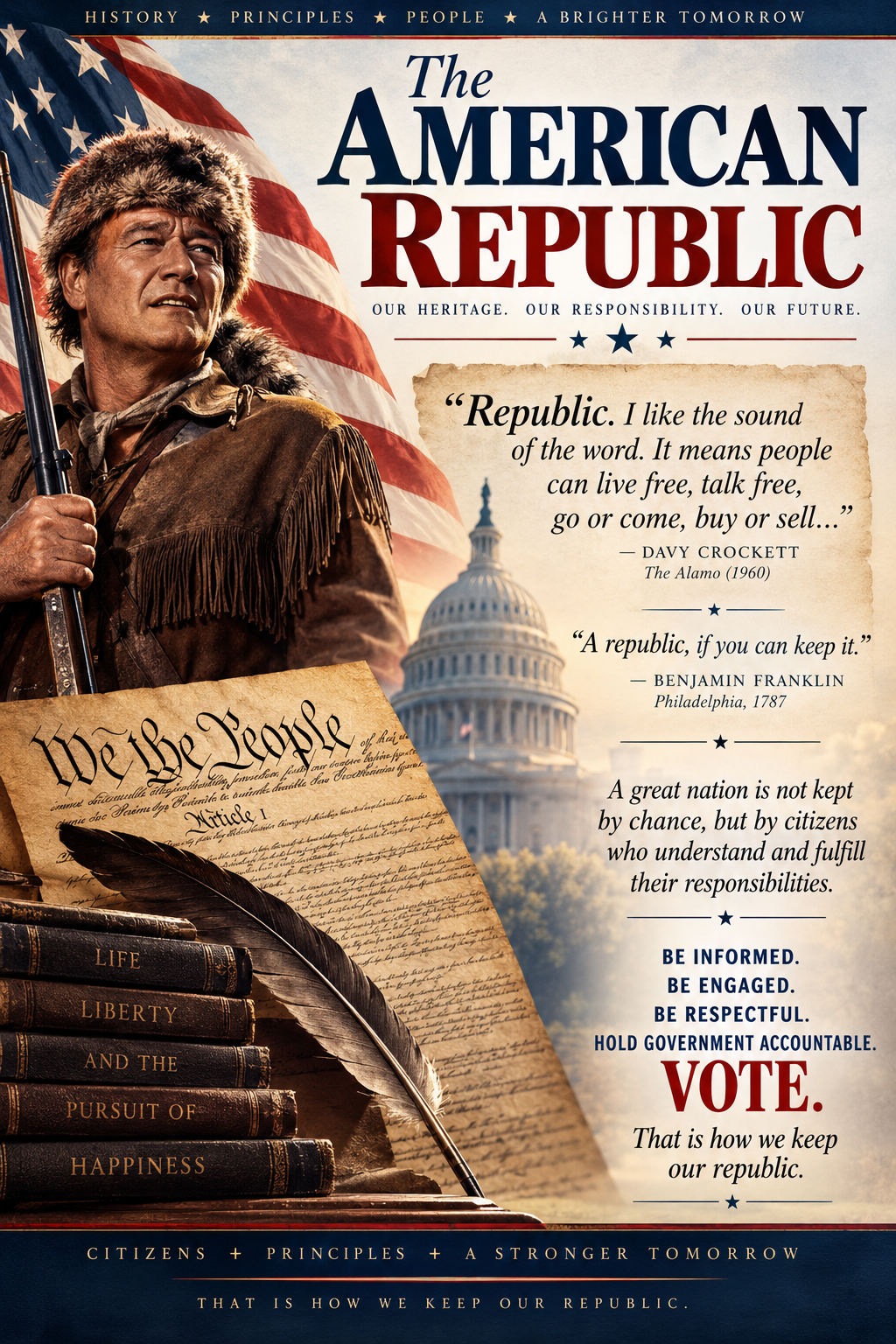
In John Wayne’s 1960 film The Alamo, his portrayal of Davy Crockett gives one of the movie’s most memorable descriptions of a republic:
“Republic. I like the sound of the word. It means people can live free, talk free, go or come, buy or sell…”
He goes on to describe people being free to choose how they live and says republic is one of those words that gives him a deep emotional feeling—something that “makes your heart warm.”
At the close of the Constitutional Convention in 1787, according to notes by Maryland delegate James McHenry, a Philadelphia woman asked Benjamin Franklin, “Well, Doctor, what have we got, a republic or a monarchy?”
Franklin famously replied, “A republic, if you can keep it.”
Franklin’s response reminds us that the Constitution could establish a republic, but a document alone could not preserve it. Keeping it would require citizens and public officials alike to exercise judgment, restraint, civic responsibility and vigilance.
I believe we find ourselves at a historical crossroad in that regard, and both citizens and elected officials need to be reminded of their responsibilities.
A republic is a form of government in which political authority ultimately belongs to the people, but the people exercise that authority through elected representatives operating under a constitution and the rule of law.
The central idea is government by consent, but government restrained by law.
That distinguishes a constitutional republic from both a monarchy and pure direct democracy. In a monarchy, governing authority historically rested with a monarch or dynasty. In a direct democracy, citizens themselves vote directly on governmental decisions. Without constitutional protections and limitations, however, simple majority rule can allow the interests of a numerical majority to overwhelm the rights and interests of minorities and individuals.
In a republic, the people are sovereign—but the Constitution is the rulebook governing how their sovereignty may be exercised.
The Declaration of Independence in 1776 supplied much of the philosophical foundation. Its revolutionary proposition was that legitimate governments derive “their just powers from the consent of the governed.” The Declaration also asserted that people possess rights that government does not create—including life, liberty and the pursuit of happiness.
After independence, the United States initially operated under the Articles of Confederation. That government, however, proved too weak in several respects. Congress lacked authority to raise revenue, regulate interstate commerce, enforce many of its decisions or effectively address disputes and problems involving the states.
By 1787, American leaders concluded that the system needed reform.
The Constitutional Convention assembled in Philadelphia that summer. Although the delegates originally gathered to revise the Articles of Confederation, they ultimately produced an entirely new framework of government: the United States Constitution.
And here is where I believe we need to be reminded of our responsibilities.
The elected representative owes the citizen fidelity to the Constitution, integrity, accountability, sound judgment and service.
But the citizen also has responsibilities: becoming informed, participating in the process, voting thoughtfully, respecting the rights of others, holding government accountable, obeying legitimate laws, serving the community and preserving the institutions that make self-government possible.
A republic cannot survive merely because its Constitution is well written. It survives only when both the governed and those entrusted to govern understand and fulfil their respective responsibilities.
A republic requires something from everyone—from the person holding office, to the citizen casting a single ballot.
It seems that many elected officials have forgotten that their primary responsibility is to represent the people they were elected to serve—not to offer a multitude of promises to gain office, only to abandon those promises afterward in favor of personal ideology or unquestioning allegiance to party.
But responsibility does not rest solely with elected officials.
Many citizens are also neglecting their responsibilities by failing to stay informed, failing to respect the rights of others and, sadly, failing to vote.
Negative comments on social media do absolutely nothing to preserve the republic. Your voice should ultimately be your vote.
If we are to continue as the greatest nation on earth, it will depend upon elected representatives and citizens alike understanding and exercising their responsibilities.
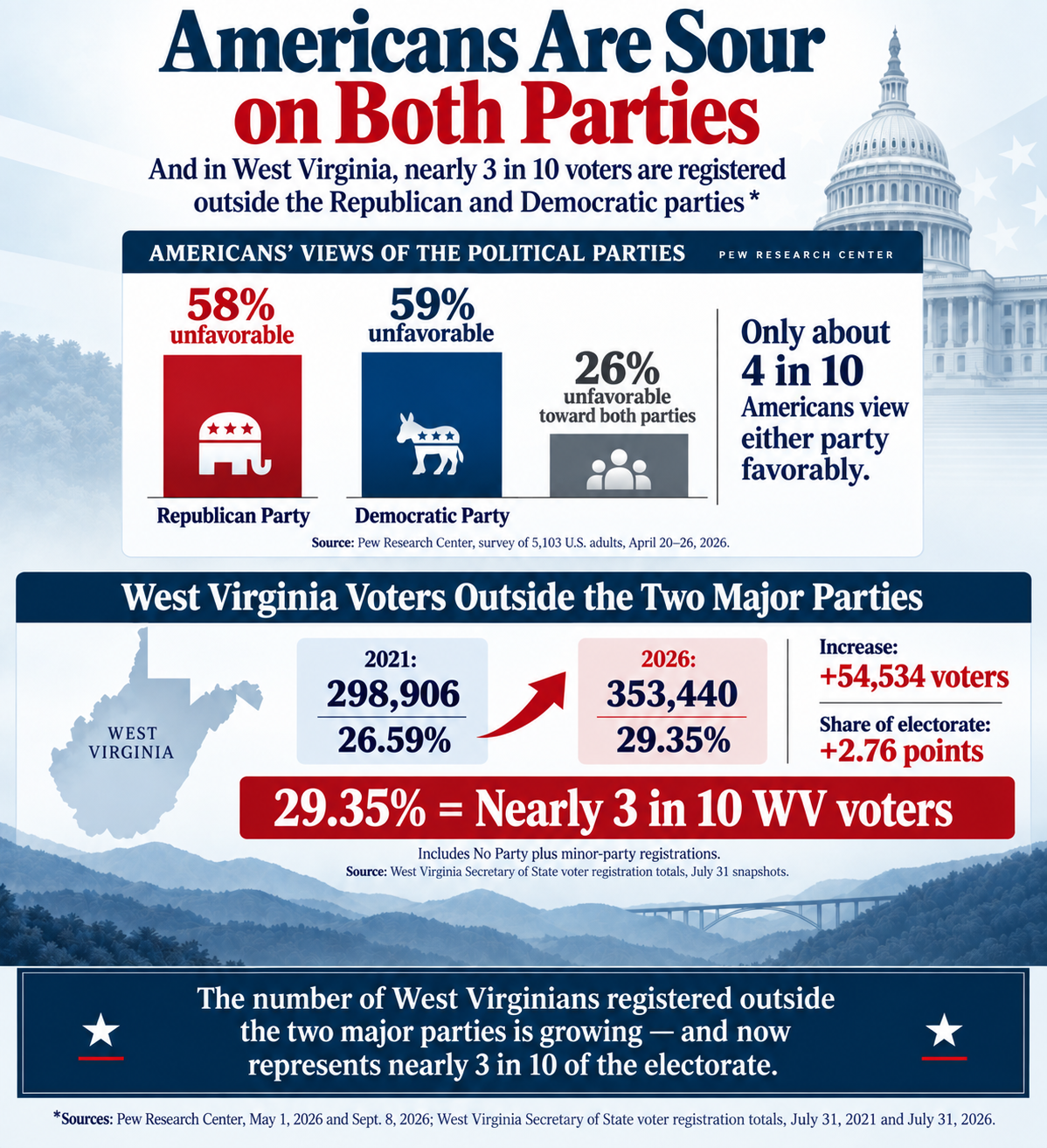
According to 2026 polling from the Pew Research Center, 58% of Americans have an unfavorable view of the Republican Party, while 59% have an unfavorable view of the Democratic Party.
Only about four in ten Americans view either party favorably.
Even more striking, 26% of Americans — more than one out of every four — hold unfavorable views of both political parties. That number has risen from 21% in 2020.
The poll also showed that people who formally identify with a political party generally still like their own party. No real surprise there.
Among Republican identifiers, 89% view the GOP favorably, while 84% of Democratic identifiers view the Democratic Party favorably.
But here is the takeaway.
Among independents who merely lean toward one of the two parties, enthusiasm drops dramatically.
Only 54% of Republican-leaning independents view the GOP favorably, while just 52% of Democratic-leaning independents view the Democratic Party favorably.
Pew’s September 8 analysis reinforces that disconnect.
Among Republicans and Republican-leaning independents combined, 75% view their own party favorably and 24% unfavorably. Among Democrats and Democratic-leaning independents, 70% view their party favorably and 30% unfavorably.
The underlying survey was conducted April 20–26 among 5,103 U.S. adults.
So, the simplest way to state Pew’s findings is this:
Republican Party: 58% unfavorable.
Democratic Party: 59% unfavorable.
Both parties unfavorable: 26%.
That last number should get the attention of political leaders in both parties.
More than one in four Americans now holds an unfavorable opinion of both major political parties.
Pew’s numbers do not establish why individual voters choose to register outside the two major parties. But they do demonstrate something unmistakable: dissatisfaction with America’s political parties is substantial.
And that brings us to West Virginia.
The political dynamics in our state are changing.
Increasing numbers of voters are choosing to remain outside the Republican and Democratic parties. Whatever their individual reasons, many clearly do not believe a party label is necessary to determine their principles or values.
The numbers don’t lie.
West Virginia voters registered outside the Republican and Democratic parties
2021: 298,906 — 26.59%
2026: 353,440 — 29.35%
Increase:54,534 voters
Percentage increase: approximately 18.2%
Share of the electorate: up 2.76 percentage points
There is an important distinction here.
These figures do not mean that 29.35% of West Virginia voters are technically registered as “No Party.”
In 2021, the 298,906 voters outside the two major parties included 250,961 registered as No Party and another 47,945 registered Mountain, Libertarian or Other.
The same distinction applies today: the 29.35% represents all West Virginia voters registered outside the Republican and Democratic parties.
But that distinction does not diminish the significance of the trend.
Five years ago, 26.59% of West Virginia voters were registered outside the two major parties.
Today, that figure has risen to 29.35% nearly three out of every ten registered voters in West Virginia.
That should matter greatly to the West Virginia Republican Party as it considers the future of its primary.
The 2026 election was the first West Virginia primary in nearly three decades in which unaffiliated voters were prohibited from participating in the Republican primary. The Republican State Executive Committee made the decision to close the primary, while the Democratic Party continued to allow unaffiliated voters to participate in its primary.
If the Republican State Executive Committee maintains a closed primary in 2028, voters who are not registered Republicans will again be unable to participate in choosing Republican nominees unless they first change their registration.
That policy deserves serious reconsideration.
Supporters of closing the Republican primary have raised concerns that voters who are not Republicans could cross over and attempt to influence which Republican candidates are nominated.
That concern deserves to be heard.
But so does the other side of the equation.
West Virginia now has 353,440 registered voters outside the Republican and Democratic parties — 29.35% of the electorate.
The number has increased by more than 54,000 in just five years.
At the same time, national polling shows significant dissatisfaction with both major political parties, particularly among voters who identify as independents but lean toward one party or the other.
These trends should not be ignored.
Political parties can protect their identity and principles without assuming that every voter who refuses to wear the party label is hostile to those principles.
Many West Virginians may agree with Republican candidates on limited government, constitutional rights, fiscal responsibility, energy independence, religious liberty and other traditionally conservative principles while choosing not to register Republican.
Those voters should not simply be written off.
West Virginia’s political landscape is changing before our eyes.
Nearly three out of every ten registered voters now stand outside the two major political parties.
The Republican Party has a choice: require those voters to adopt the party label before allowing them a voice in its primary — or give them an opportunity to participate and make the case that Republican principles deserve their support.
For the future of West Virginia, I believe the better course is clear:
I may not have won the primary this past May, but as an outsider stepping into the political arena, I learned a lot — a whole lot.
More importantly, I learned just how many people are hungry for true representation: leaders who will listen, stand on principle, and remember that government belongs to “We the People.”
I have far too many supporters who believe in that kind of representation for me to simply walk away. There is too much work left to be done, too many voices that deserve to be heard, and too great a need for strong, accountable leadership.
To every person who supported me, encouraged me, prayed for me, voted for me, endorsed me, or simply took the time to listen — I love and appreciate each one of you more than you know.
The 2026 primary may have ended one campaign.
It did not end the mission.
I plan to be on the ballot in the 2028 General Election.
I want to thank each and every one of you for your tremendous support in making West Virginia history by signing the “Reopen WV Primaries” petition.
It’s the Republic in action with the people giving consent to the government and challenging them to represent your wishes!
In 2026, we declined nearly 47,000 Republican votes since the last non-presidential year primary!
Thousands of unaffiliated voters who’d helped Republicans gain the majority in Charleston were told “we don’t need you anymore”, simply because some members of the GOP feared Democrat crossover votes impacting the Republican primary.
Folks, the data does not support this! It’s emotion over common sense!
Read my comprehensive case revealing the facts and the negative impact.
It’s not about winning an argument. It’s about doing what’s right for West Virginia.
I would appreciate you considering signing and sharing this. Im fact, I would appreciate you making it a priority.
If you’re an unaffiliated voter who got locked out of the Republican primary, feel free to share your story! I’m compiling them for use later!
Democratic Socialism vs. Capitalism — In Plain English
We are living in an unprecedented time. Politicians used to hide their socialist tendencies; now they are running and winning campaigns on them!
Voters need to understand the issue and stop this in its tracks!
The difference really comes down to one basic question:
Who should have more control over the economy — individuals and businesses, or government and collective institutions?
Capitalism: You can own your business, property and investments.
Democratic Socialism: The government would own and control your property.
Capitalism: Businesses compete for customers, and consumers help decide what succeeds.
Democratic Socialism: Government decides how resources are used and the level of your success.
Capitalism: People can take risks, build businesses, invest money and profit if they succeed.
Democratic Socialism: The focus is spreading the wealth, regardless of “who built it”
Capitalism: Economic decisions are made by the people.
Democratic Socialism: Decisions are made through government or collective control.
The Democratic Socialists of America openly says its long-term goal is social ownership and democratic control of the economy, not simply making a few changes to capitalism.
That’s why educating our young people matters!
It isn’t just about government programs. It’s about who gets to own, control and make the decisions in America’s economy.
These nations have already failed or are failing under socialism/communism. Yet, the Democrat Socialists of America, with many Democrats allowing it to happen, want it for America.
Yes, everyone is equal – equally poor.
Soviet Union — Communist one-party state with a highly centralized economy; dissolved in 1991.
East Germany — Communist planned economy; ultimately reunified with capitalist West Germany in 1990.
Czechoslovakia — Communist planned economy until the Velvet Revolution; later transitioned toward a market economy.
Romania — Communist dictatorship under Nicolae Ceaușescu; suffered severe shortages and austerity before the regime collapsed in 1989.
Poland — Communist government and centrally planned economy until 1989; later adopted market reforms.
Hungary — Communist state until 1989; subsequently transitioned to a market-based economy.
Albania — One of Europe’s most rigid communist states; emerged from communism extremely poor and isolated.
Yugoslavia — Socialist federation that eventually disintegrated amid economic, political and ethnic crises.
Cuba — Remains a communist one-party state with extensive state control of the economy; its economic system has long faced shortages and weak productivity, though U.S. sanctions are also an important factor and should be acknowledged.
North Korea — Communist authoritarian state with an overwhelmingly state-directed economy and chronic economic hardship.
Venezuela — Under Chávez and Maduro, nationalizations, price controls and expanding state direction accompanied a massive economic and humanitarian crisis. Venezuela’s collapse also involved oil dependence, corruption, political dysfunction and sanctions, so socialism was not the sole cause. The country has experienced hyperinflation and mass emigration.
Maoist China — The Great Leap Forward’s collectivization and central planning contributed to catastrophic famine. China later moved substantially toward markets, private enterprise and foreign investment while retaining Communist Party rule.
Cambodia under the Khmer Rouge — An extreme communist experiment involving abolition of markets and private property, accompanied by mass starvation, forced labor and killing.
Ethiopia under the Derg — Marxist-Leninist regime marked by nationalization, collectivization, famine and economic deterioration.
Tanzania under Ujamaa socialism — Large-scale collectivization and state-directed development produced disappointing economic results and eventually gave way to reforms.
Don’t allow the United States to be added to this list!
If we fail to learn from history – we are doomed to repeat it.