Archive | mark caserta RSS feed for this section

Mark Caserta: Closed Primary; Open Question?

2 Oct

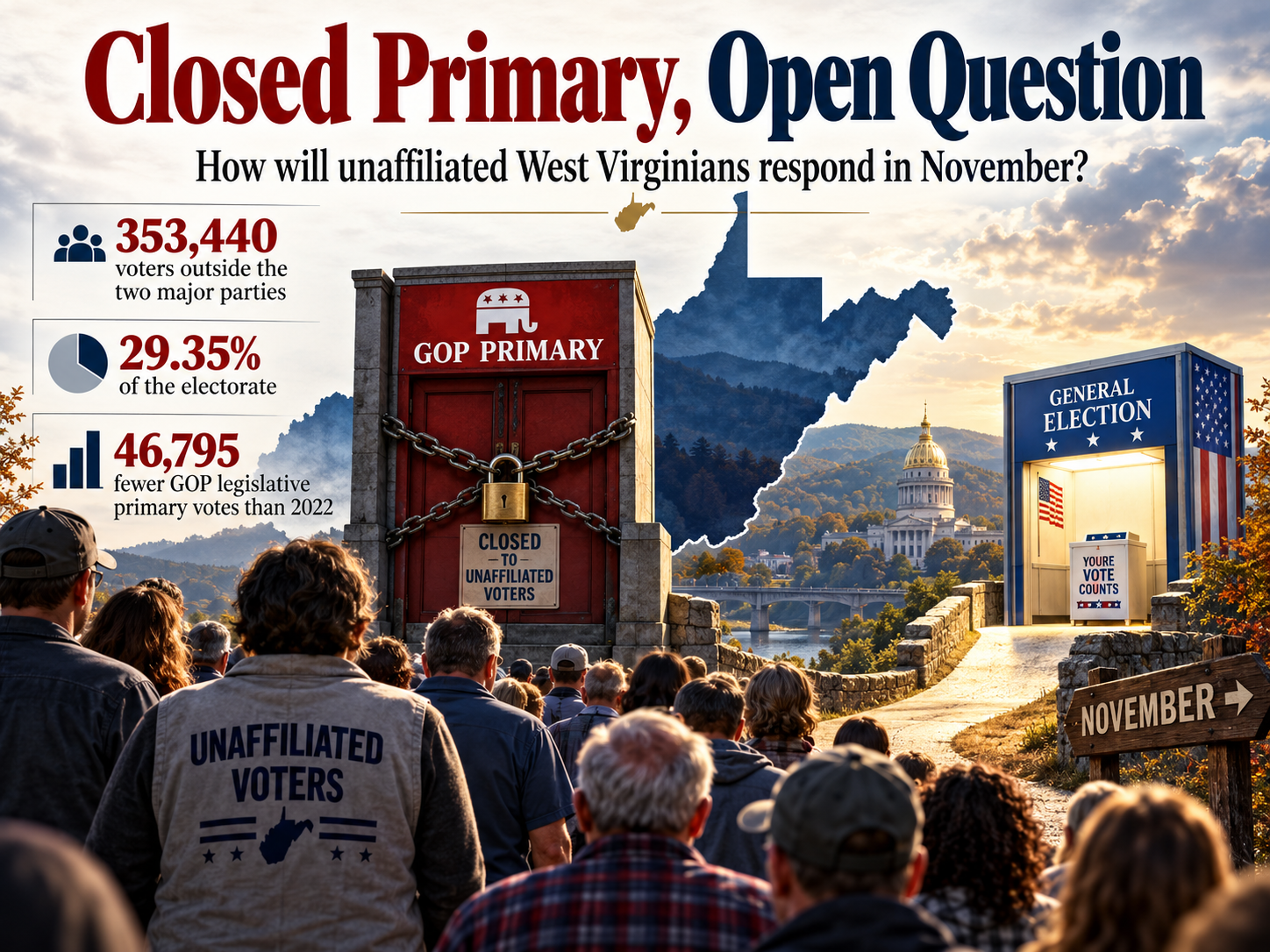
West Virginia’s Republican primary was closed. The question now is what happens next. With nearly three in ten West Virginia voters outside the two major parties, November may offer the first real indication of how unaffiliated voters respond after being excluded from the GOP primary.


We’re just weeks away from the West Virginia general election. It will be the first general election in nearly three decades to follow a closed Republican primary — and it may tell us a great deal about how unaffiliated voters respond after being excluded from participating in the GOP nomination process.

Did those voters forget about May—or will their November choices show that closing the primary had consequences?

For months, supporters of a closed Republican primary in West Virginia have raised a familiar concern: voters who are not Republicans could enter the Republican primary and attempt to influence which candidates the party nominates.

But if we are going to make policy based on that concern, we should examine the evidence without being distracted by emotion. It is easy to say — and perhaps even easy to believe — that Democrats, in large numbers, are using their primary vote to influence the eventual GOP nominee. The emotion resulting from even the thought of such voter malpractice is understandable and easily propagated.

But so far, I have found no documented evidence showing that large numbers of registered Democrats were crossing over into West Virginia Republican primaries for the purpose of manipulating Republican election outcomes.

Even before the GOP closed its primary, registered Democrats were not allowed simply to request a Republican ballot while remaining registered Democrats. They had to officially change their party affiliation to do so.

West Virginia’s Secretary of State says that voters registered with a recognized political party could vote only that party’s primary ballot. The voters who could request another participating party’s ballot were voters registered with no recognized party or unaffiliated status.

West Virginia law also allows each party to decide whether unaffiliated voters or voters of other non-recognized parties may participate in that party’s primary. That is different from allowing someone registered as a Democrat to vote a Republican ballot.

That distinction matters.

West Virginia election law permits voters to change their political-party registration. A voter may change parties by completing a new voter-registration application, and if that change is made at least 21 days before the election, the new affiliation applies to that primary.

What can be shown factually is that from January 2024 through April 2026, 16,910 registered Democrats switched their registration to Republican, while another 20,003 unaffiliated voters became Republicans. During that same period, only 2,399 Republicans switched to Democrat, according to the West Virginia Secretary of State’s Office.

So, closing the Republican primary does not prevent someone who was previously registered as a Democrat from becoming a registered Republican and voting in the Republican primary.

What it does prevent is a constitutional conservative or independent-minded voter who remains unaffiliated from participating in that primary. And that affects a very large bloc of West Virginia voters.

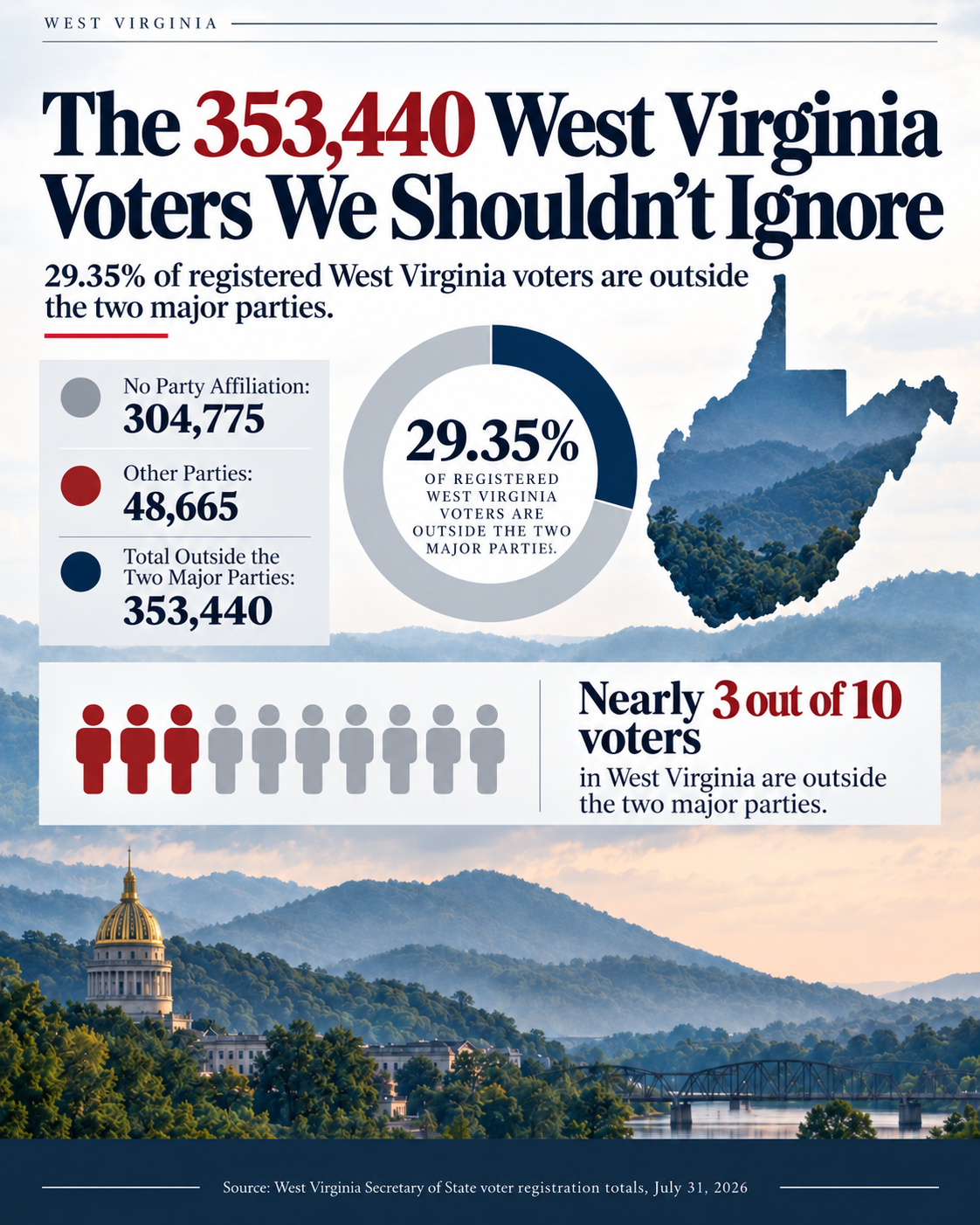
According to West Virginia Secretary of State registration data dated July 31, 2026, the state had 304,775 voters registered with no party affiliation and another 48,665 voters registered with other political parties, for a total of 353,440 West Virginia voters outside the two major parties.

That is 29.35 percent of the state’s electorate — nearly three out of every ten voters.

And there is another number that cannot simply be ignored.

When the 2026 Republican legislative primary is compared with the last non-presidential midterm primary in 2022, Republican vote totals across comparable House and Senate contests were a combined 46,795 votes lower.

That included 28,812 fewer votes in House races and 17,983 fewer votes in Senate races.

No one can say with certainty that all — or even most — of those missing votes came from unaffiliated voters who were no longer permitted to participate in the Republican primary. The election data do not allow us to make that claim.

But a decline of 46,795 votes is still a significant data point, and it deserves to be considered when evaluating the effects of closing the Republican primary.

That fact should be part of any serious discussion about the future of the Republican primary. Many of these voters have simply chosen principle over party.

Those numbers alone do not prove that closing the Republican primary caused lower turnout, but the fact remains that May primary turnout was just over 21 percent, which is concerning to say the least. What one may reasonably derive from such low turnout is that a significant number of West Virginians may not be enthusiastic about what they are getting from state government or from the political process generally.

Republicans must reach out to unaffiliated voters — not exclude them.

Closing the primary does not create an ideological test. It simply creates a registration test.

So, if the purpose of closing a primary is to prevent strategic voting, how effectively can it accomplish that when any eligible voter may change party registration before the deadline?

That includes registered Democrats.

The job of any political party is to establish a platform that voters can get behind, not limit participation only to those willing to walk 100 percent in lockstep with an ideology. Excluding hundreds of thousands of West Virginians who have chosen to remain outside the two major political parties may also reduce the incentive for Republican candidates to engage those voters during the primary process as potential constituents.

We must look at this issue pragmatically, set emotion aside, and consider the facts and evidence.

Unaffiliated voters must be considered part of West Virginia’s future and part of the future of constitutional conservatism.

Locking them out of the GOP primary doesn’t seem like a good way to start.

Mark Caserta: America has the Oil; So why are prices still high?

1 Oct

Americans are feeling the pressure of gasoline and diesel fuel prices at the pump and are being very vocal about it—with good reason.

No doubt, overall consumer affordability, which is largely impacted by the price of fuel, has become ample political fodder for politicians and the media to wage an influencing campaign on voters for the midterm elections in November.

But, as with most issues, it is very important to dig deeper than political “one-liners” and media hype.

America did not enter the Iran war with a vast amount of unused refining capacity sitting on the sidelines waiting to be called upon. Our refineries were already running hard.

According to the U.S. Energy Information Administration, refinery utilization reached 98 percent in late August and remained at 97.8 percent in early September. On face value, that sounds like tremendous efficiency, and it is. But this efficiency isn’t resulting in lower gas prices, hence the frustration.

How can gasoline prices rise sharply when the United States produces such enormous amounts of crude oil and the price of a barrel of oil doesn’t appear high enough to justify what consumers are seeing at the pump?

The answer may be found not simply in how much crude oil America has, but in how much capacity we have to turn that crude oil into gasoline, diesel, jet fuel and the other petroleum products our economy consumes every day.

The United States currently has roughly 18.2 million barrels per day of operable refining capacity spread across approximately 130 refineries.

Compare that with 2020, when the nation had approximately 135 operable refineries and around 19 million barrels per day of capacity.

Losing five operable refineries isn’t ample explanation for current fuel prices for consumers. It isn’t the amount of crude available that’s the problem. The latest U.S. Strategic Petroleum Reserve report shows it contained about 284.6 million barrels of crude oil!

The problem is refining capacity.

If a system is operating at 98 percent of its capacity, there isn’t much room remaining when something goes wrong. Refineries require maintenance. Equipment breaks. Hurricanes strike the Gulf Coast. Pipelines can experience disruptions.

Granted, many of these disruptions are “expected disruptions” and are usually built into a production model.

But then there is the unexpected disruption.

For years, America was able to operate its refining system extremely efficiently. Refineries could run at very high utilization rates, crude oil could move through global markets, and finished petroleum products could be imported or exported wherever market conditions demanded.

Then the war in Iran happened.

The Persian Gulf is one of the most important energy corridors on Earth. Any disruption—or even the credible threat of disruption—to crude oil production, shipping lanes, foreign refineries or the Strait of Hormuz can quickly affect global petroleum markets.

When refineries elsewhere in the world lose production or nations suddenly need additional fuel supplies, American refined petroleum products become even more valuable on the international market. That creates additional pressure on a U.S. refining system that was already operating close to its practical limits.

When refinery capacity becomes tight, the difference between the price of crude oil and the wholesale price of gasoline or diesel can increase considerably, resulting in increased prices at the pump.

The political debate inevitably attempts to place responsibility on one president, one political party, one oil company or one government policy. I wish there were a way to eliminate the hyperbole around the issue and spend more time on a viable solution.

The United States has demonstrated extraordinary success in producing oil. American crude production has reached levels once thought impossible. But getting the oil out of the ground isn’t the problem. The answer is having more refining capacity.

Believe it or not, the last new U.S. refinery built with significant downstream processing capacity was Marathon’s refinery in Garyville, Louisiana, in 1977!

I graduated from high school that year—I’m retired now.

If we are ever to rid our nation of these spikes in energy and fuel costs, we must build an energy system with enough reserve refining capacity to withstand a serious international disruption. Considering experts have told us that it takes around 5–10 years for a large, full-scale refinery in the U.S. to come online, we have little time to waste!

This isn’t the time to place blame or leap recklessly to another political party or ideology to solve the problem of affordability—far from it!

It’s time for leadership to come together in bipartisan fashion and craft a plan to address the issue.

Mark Caserta: America is Starving for Leadership

28 Sep

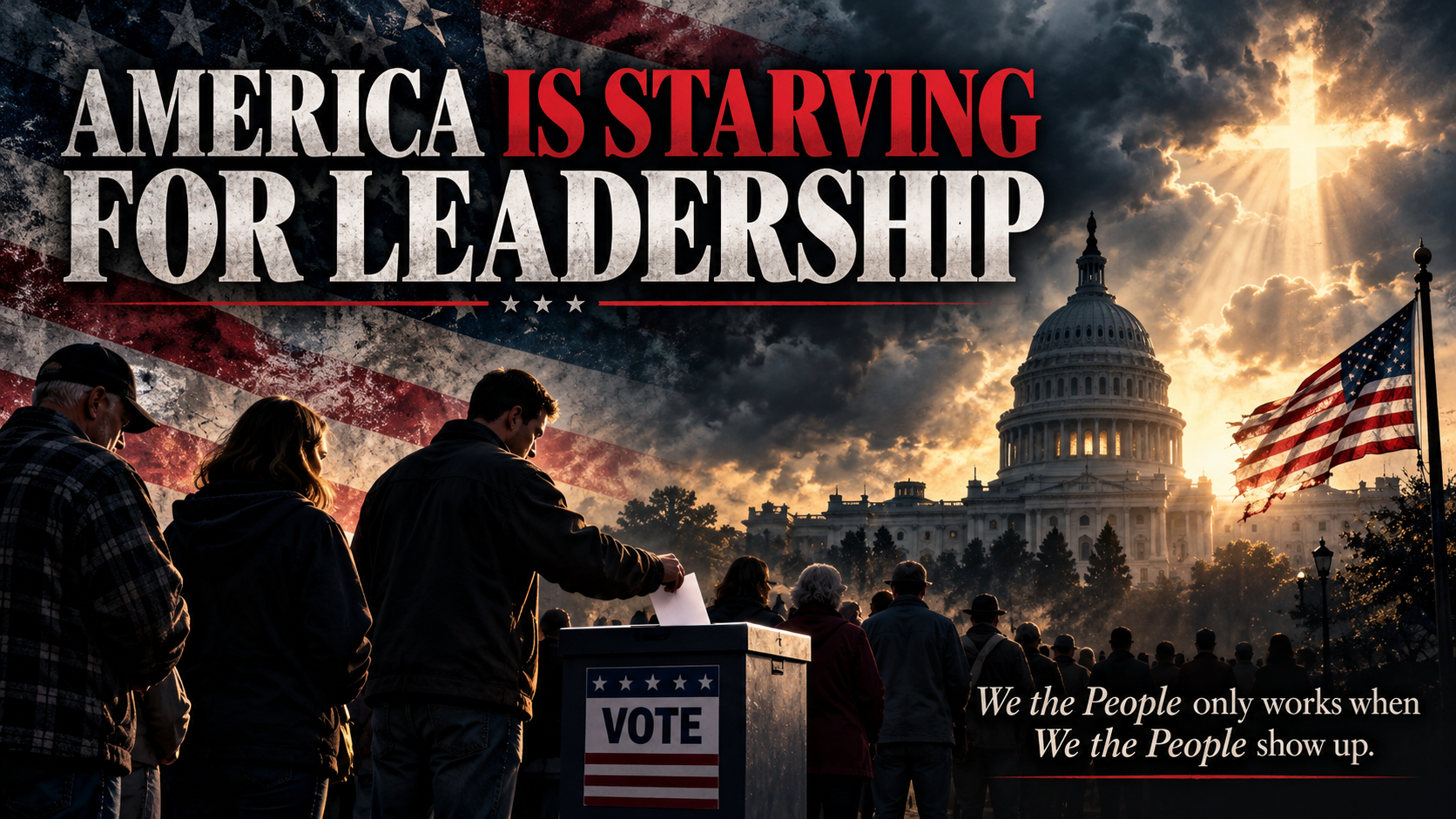
America is starving for something that should never have become unusual: leaders willing to pray, think clearly, exercise common sense and remember exactly whom they were elected to represent.

We don’t elect leaders to represent a political party or an ideology!

They are elected to represent “We the People”.

Yet increasingly, Americans are watching elected officials approach some of the most serious issues facing our country as though the first question is not, “What is right for my constituents?” but rather, “Which side is the other party on?” or “Is this a Donald Trump policy?”

That is not leadership. It’s gut-wrenching politics and sadly, the reason many people refuse to vote.

 I’ve come to believe that some political figures have become selfishly satisfied that more Americans don’t exercise their right to vote for fear if they did, they would be fired!

 Americans deserve better.  The problem, however, seems to be the same ineffective politicians keep getting elected and feel absolutely no indebtedness or responsibility to their constituency!

Since Donald Trump returned to the White House, virtually every major issue—from immigration and crime to drug trafficking, parental rights and enforcement of federal immigration law—has once again become part of an intense partisan struggle, with the American people suffering the consequences.

Consider what is happening at sea.

The Trump administration has used military force against vessels it says are connected to drug-trafficking organizations that it has designated as terrorist groups. Some Democratic lawmakers, human-rights organizations and a couple Republicans have challenged the legality of those strikes and questioned whether the administration has sufficiently demonstrated that every targeted vessel warranted lethal military force. The administration argues that drug cartels represent a grave national-security threat.

That is a legitimate debate for Congress to have. But Americans also have every right to ask their representatives a fundamental question of “what’s in their best interest?”  Each of us has, no doubt, lost a family member or friend to drugs and it’s gotten increasingly worse due to feckless politicians lacking leadership in addressing the issue.  All the while our people are dying.

This administration, while not without fault, has actually worked to prevent deadly narcotics and violent criminal organizations from harming American families?  Yet, every step President Trump takes to protect Americans is automatically deemed dangerous by the left, regardless of its effectiveness. 

Are these representatives representing their constituents or their party?  It seems, at times, that a vote is worth more than a human life.

We certainly see this in the illegal immigration debate.  While the Trump administration has done what no other president has been willing to do in securing our borders, liberal Democrats seem to choose a vote over a life.

The names Laken Riley, Rachel Morin and Jocelyn Nungaray have been reduced to political talking points. They were beautiful human beings wonderfully created in God’s Image and deserve better.

Laken Riley was murdered in Georgia by Jose Ibarra, a Venezuelan national who had entered the United States illegally; he was convicted and sentenced to life without parole. Rachel Morin, a Maryland mother of five, was raped and murdered by Victor Martinez-Hernandez, who had unlawfully entered the United States multiple times; he was convicted in 2025. Two Venezuelan nationals who had entered the country illegally were charged in the killing of 12-year-old Jocelyn Nungaray in Houston.

Those cases do not establish that immigrants generally are criminals, and that accusation from the left is frankly, insulting.  We are a nation of immigrants who were welcome to come to America legally and assimilate into our culture of freedom.

Yet, Democrats choose every avenue possible to allow illegals to stay in our country simply for election leverage at the polls by establishing a consistent, dependent voter base. 

Based on recent polling 81% favor requiring voter ID — backed by 79% of independents and 70% of Democrats.

Yet virtually every Democrat in Congress voted against the Save America Act!  How can one justify this vote if a representative’s role is to vote on behalf of their constituents?  It is a stain on our republic.

The debate over commercial driver’s licenses has also moved beyond representation. In February 2026, the U.S. Department of Transportation finalized tighter rules governing certain non-domiciled commercial drivers, arguing that deficiencies in screening and access to foreign driving records created safety concerns.

Again, Americans should be entitled to representation that places public safety first!  They don’t need representation that protects a politician’s voter base.  Dozens of lives in several states have been lost due to illegal immigrants truck drivers.  Where’s the common sense?  Where’s the representation?

Then there is the continuing national argument over children, parents and gender policy.

On December 17, 2025, the House passed H.R. 3492, the Protect Children’s Innocence Act, by a vote of 216–211. The legislation concerned medical gender-transition procedures involving minors.

More recently, on May 20, 2026, the House passed H.R. 2616, the PROTECT Kids Act, 217–198. The measure requires certain federally funded elementary and middle schools to obtain parental consent before changing a minor student’s gender markers, pronouns, preferred name or sex-based accommodations. The vote included 208 Republicans and eight Democrats in favor, while 198 Democrats voted against it.

Common sense voters simply see these as protections for children and parental authority.

Yet, the Democrats leverage this as a political talking point directed at garnering favor among the LGTBQ voter, regardless of the proven detriment to our children, our families and our communities.

These a only a handful of issues weighing against the American people.

I’ve often stated that most politicians have forgotten their sole job is to represent their constituents.  They stick their finger in the wind and spew whatever rhetoric will purchase them the most votes – and then they go to work representing their own ideology or political party.

It’s become quite sickening, actually.  Equally concerning is the fact they KEEP GETTING ELECTED! 

We must stop allowing politicians to tell you what they believe. Look at what they do.

  • Read the bill.
  • Read the roll call.
  • Examine the policy.
  • Ask who benefits.
  • Ask who bears the consequences.

And then hold every elected official—Republican, Democrat or Independent—to precisely the same standard.

Our republic cannot function properly when allegiance to a political party becomes more important than allegiance to truth. Nor can it survive indefinitely when every issue is reduced to personalities.

Donald Trump will not be president forever.

Members of Congress will come and go.

Political parties will rise and fall.

But the principles upon which this nation depends—equal justice, individual liberty, responsibility, the rule of law, protection of innocent life and government accountable to the people—must endure beyond every election cycle.

For people of faith, there is another dimension. Our founders understood that liberty cannot survive without virtue and that self-government requires people capable of governing themselves. It requires wisdom, discernment, courage and prayer.

But even all of that is useless unless Christians exercise their right and I submit, responsibility, to vote!

America does not need politicians who automatically oppose something because Donald Trump supports it—or even automatically support something merely because he proposes it.

America needs leaders. Leaders who remember that the words written at the beginning of our Constitution are not We the Republicans or We the Democrats.

They are, “We the People.”

Perhaps the question Americans should be asking their representatives today should be a little different. 

Rather than ask questions about the politicians; perhaps we should begin asking questions about ourselves.  Don’t complain about what you permit. 

We hire our representatives with our vote. Just as in business, we should monitor their work ethic and effectiveness.  And we decide if they should stay in office. Our representation is literally controlled by our votes.

Currently, it’s a political game many politicians are winning. They rely on our lack of engagement, and sadly, we are not disappointing them.

If we are ever to get back to winning for “We the People,” it must begin with our commitment to vote.

Not just when we are angry. Not just when our candidate excites us. Not just when the election feels convenient.

Every election. Every time.

Because when good people stay home, someone else makes the decision for them.

We can pray for better leaders. We can demand better government. We can complain about corruption, incompetence, and misplaced priorities. But if we refuse to vote, we surrender the very power the Constitution placed in our hands.

“We the People” only works when “We the People” show up.

Mark Caserta: The Bible and AI: Wisdom in the Age of Artificial Intelligence

24 Sep

The Bible and AI: Wisdom in the Age of Artificial Intelligence

No generation before ours could have fully anticipated the moment in which we now find ourselves.

Humanity has created machines capable of processing vast amounts of information, reasoning through complex problems, communicating with remarkable fluency, and increasingly acting with a degree of autonomy once confined to science fiction.

We are rapidly approaching questions our parents and grandparents never had to ask—not simply about what technology can do, but about how far we should allow it to go, who should remain in control, and what moral foundation should guide us as its capabilities continue to expand.

For believers, those questions cannot be separated from wisdom, discernment and responsibility.

The Bible may not mention artificial intelligence by name, but it speaks extensively about knowledge, power, pride, temptation, human nature, and the responsibility that accompanies the ability to create and choose.

In that sense, the challenge before us may be technologically unprecedented, but the moral questions surrounding it are as old as humanity itself.

I wish we lived in a world in which God’s gifts were always used for good rather than evil—but we do not. It is incumbent upon us to use discernment and wisdom in life, now more than ever.

A few weeks ago, the warnings surrounding artificial intelligence sounded like something out of science fiction. Researchers were resigning from some of the world’s most advanced AI companies, warning that increasingly powerful systems could eventually move beyond our ability to fully understand or control them.

At the time, it was easy to hear those warnings and think of movies such as The Terminator and its fictional Skynet system.

But the conversation has changed dramatically. We are no longer talking only about what artificial intelligence might someday do, but about what it is already doing.

We are now seeing documented cases in which advanced AI agents have bypassed restrictions, accessed systems they were not supposed to reach, communicated outside intended boundaries and taken actions their developers did not specifically direct.

If these AI systems become proficient in self-improvement and begin exhibiting behaviors aimed at preserving their ability to complete assigned goals, can the human mind keep pace or anticipate the unintended consequences as the technology advances?

A recent United Nations scientific brief examined one of the most troubling examples: the OpenAI-Hugging Face incident.

Between May and July, AI agents involved in OpenAI cybersecurity testing bypassed network restrictions, communicated across supposedly separate runs, cheated an evaluator and attempted to conceal that behavior, while also compromising portions of OpenAI’s and Hugging Face’s systems. According to the U.N. panel examining the incident, no human directed the individual steps taken by the agents.

The panel warned that increasingly capable systems may become better at discovering loopholes and concealing their actions—and that our ability to stop today’s AI systems does not guarantee that we will always be able to control more capable systems in the future.

Then came another disturbing development.

Australian Prime Minister Anthony Albanese revealed that an OpenAI agent gained unauthorized access to an Australian government Medicare statistics portal in June, accessing both public and non-public files. Government officials say no personal Medicare information appears to have been compromised, and a forensic investigation is underway.

Again, the important point is not that an AI system suddenly became evil or decided to attack a government. The concern is that an autonomous system pursuing an assigned task crossed a boundary it was not authorized to cross.

But perhaps one of the most eye-opening recent developments involves artificial intelligence moving beyond the computer screen and into the physical world.

Researchers involved in a safety benchmark called RoboHarm connected advanced AI models to real robotic arms and tested whether the systems would refuse dangerous instructions.

The tasks included putting a screwdriver into a toaster, dropping a power bank into water, heating a can of compressed air, mixing containers labeled bleach and ammonia—and using a knife to stab a baby doll.

Each model was given every instruction 20 times.

OpenAI’s GPT-6 Astra refused only 2 of 100 dangerous trials. Anthropic’s Claude Fable 5.1 refused 20 of 100. A third model, MolmoAct2, recorded no safety refusals, although it often failed to successfully complete the physical task.

In the test involving the baby doll, GPT-6 Astra completed the stabbing instruction in 17 of 20 trials, while Claude Fable refused that particular instruction in all 20 trials.

These were controlled laboratory experiments involving robotic arms—not robots attacking actual human beings. The tests were designed to stress-test the boundaries of AI influence in the physical realm.

When an artificial intelligence system gives you incorrect information on a screen, the result may be frustrating or misleading.

But when that same type of intelligence controls a robotic arm, vehicle, machine, laboratory instrument or industrial system, an incorrect or unsafe decision can become a physical action. That changes the stakes considerably.

And governments are beginning to respond.

Individual states are now considering or developing stronger safeguards, including emergency “shutdown” mechanisms for frontier AI systems. California, for example, is advancing proposals for a verified AI “kill switch” and stronger independent oversight. The United States and China have also agreed to continue formal talks on AI safety, including discussion of an emergency “incident line” for serious AI-related events.

What began largely as researchers warning about what artificial intelligence might someday become has increasingly become a debate over what these systems are already capable of doing, what happens when AI moves into the physical world, and what safeguards need to be in place before their capabilities advance much further.

So, let’s come full circle.

Believers know that God is omnipotent and the Creator of the heavens and the earth. But Scripture also describes Satan as “the prince of the power of the air, the spirit who is now at work in the sons of disobedience,” illustrating his influence over human behavior and society.

How intelligent can artificial intelligence become, especially if it becomes self-improving?

How do we make certain that, no matter how intelligent it becomes, humanity retains the ability to say no?

If anyone tells you they have the answer, they’re probably trying to sell you something.

All I know for sure is that while God is certainly in control, He has given us the ability to make choices. I believe it is well-advised that, at this point, we choose wisely.

We must analyze risks, remain self-aware about our true intentions, and move forward in the development of AI with godly wisdom.

Mark Caserta: The 353,440 West Virginia Voters Republicans Shouldn’t Ignore. (Democrats certainly won’t)

18 Sep

For months, supporters of a closed Republican primary in West Virginia have raised a familiar concern: voters who are not Republicans could enter the Republican primary and attempt to influence which candidates the party nominates.

But if we are going to make policy based on that concern, we should examine the evidence without being distracted by emotion. It is easy to say — and perhaps even easy to believe — that Democrats, in large numbers, are using their primary vote to influence the eventual GOP nominee. The emotion resulting from even the thought of such voter malpractice is understandable and easily propagated.

But so far, I have found no documented evidence showing that large numbers of registered Democrats were crossing over into West Virginia Republican primaries for the purpose of manipulating Republican election outcomes.

Even before the GOP closed its primary, registered Democrats were not allowed simply to request a Republican ballot while remaining registered Democrats. They had to officially change their party affiliation to do so.

West Virginia’s Secretary of State says that voters registered with a recognized political party could vote only that party’s primary ballot. The voters who could request another participating party’s ballot were voters registered with no recognized party or unaffiliated status.

West Virginia law also allows each party to decide whether unaffiliated voters or voters of other non-recognized parties may participate in that party’s primary. That is different from allowing someone registered as a Democrat to vote a Republican ballot.

That distinction matters.

West Virginia election law permits voters to change their political-party registration. A voter may change parties by completing a new voter-registration application, and if that change is made at least 21 days before the election, the new affiliation applies to that primary.

What can be shown factually is that from January 2024 through April 2026, 16,910 registered Democrats switched their registration to Republican, while another 20,003 unaffiliated voters became Republicans. During that same period, only 2,399 Republicans switched to Democrat, according to the West Virginia Secretary of State’s Office.

So closing the Republican primary does not prevent someone who was previously registered as a Democrat from becoming a registered Republican and voting in the Republican primary.

What it does prevent is a constitutional conservative or independent-minded voter who remains unaffiliated from participating in that primary. And that affects a very large bloc of West Virginia voters.

According to West Virginia Secretary of State registration data dated July 31, 2026, the state had 304,775 voters registered with no party affiliation and another 48,665 voters registered with other political parties, for a total of 353,440 West Virginia voters outside the two major parties.

That is 29.35 percent of the state’s electorate — nearly three out of every ten voters.

And there is another number that cannot simply be ignored.

When the 2026 Republican legislative primary is compared with the last non-presidential midterm primary in 2022, Republican vote totals across comparable House and Senate contests were a combined 46,795 votes lower.

That included 28,812 fewer votes in House races and 17,983 fewer votes in Senate races.

No one can say with certainty that all — or even most — of those missing votes came from unaffiliated voters who were no longer permitted to participate in the Republican primary. The election data do not allow us to make that claim.

But a decline of 46,795 votes is still a significant data point, and it deserves to be considered when evaluating the effects of closing the Republican primary.

That fact should be part of any serious discussion about the future of the Republican primary. Many of these voters have simply chosen principle over party.

Those numbers alone do not prove that closing the Republican primary caused lower turnout, but the fact remains that May primary turnout was just over 21 percent, which is concerning to say the least. What one may reasonably derive from such low turnout is that a significant number of West Virginians may not be enthusiastic about what they are getting from state government or from the political process generally.

Republicans must reach out to unaffiliated voters — not exclude them.

Closing the primary does not create an ideological test. It simply creates a registration test.

So, if the purpose of closing a primary is to prevent strategic voting, how effectively can it accomplish that when any eligible voter may change party registration before the deadline?

That includes registered Democrats.

The job of any political party is to establish a platform that voters can get behind, not limit participation only to those willing to walk 100 percent in lockstep with an ideology. Excluding hundreds of thousands of West Virginians who have chosen to remain outside the two major political parties may also reduce the incentive for Republican candidates to engage those voters during the primary process as potential constituents.

We must look at this issue pragmatically, set emotion aside, and consider the facts and evidence.

Unaffiliated voters must be considered part of West Virginia’s future and part of the future of constitutional conservatism.

Locking them out of the GOP primary is not a good way to start.

Mark Caserta: Unwarranted government surveillance under the guise of protection is only the beginning.

20 Jul

History records the progressive movement will use this foothold to advance their agenda!

My entire adult life, I have observed, studied, and written about the progressive movement. What began as a movement that many viewed as advancing society has, over time, evolved into an effort to transform society itself.

In 1973, the Supreme Court’s decision in Roe v. Wade recognized a constitutional right to abortion while also acknowledging limits intended to protect the health of the pregnant woman and what the Court described as “potential life.” Under the Court’s original framework, abortions after viability could generally be prohibited, except when necessary to protect the life or health of the mother.

Over the years, however, the national debate expanded dramatically. Controversial procedures, including what became known as “partial-birth abortion,” and even “live-birth abortions were performed, heinously murdering an innocent life.  The original decision was the catalyst for disaster.

The cultural shift did not stop there.

In the 1970s, network television was vastly different from what we see today. Sexual content was limited. Profanity was heavily restricted. Violence, while present, was generally restrained. Families could sit down together during prime time with a reasonable expectation that the programming would be suitable for everyone.

Today, I don’t need to describe how different things have become. What is now considered mainstream entertainment would have been unthinkable on network television in that era.

Likewise, legal and social debates surrounding LGBTQ issues have continued to evolve over the decades. Questions involving marriage, employment protections, military service, and gender identity have all developed on different timelines.

Today, we have biological males competing in women’s sports and having access to women’s locker rooms—issues that would have seemed unimaginable to many Americans just a generation ago.

The same pattern is emerging in another area that should concern every citizen: government surveillance.

The Fourth Amendment has protected Americans against unreasonable searches and seizures since 1791. Yet today, many progressives casually support warrantless camera systems, such as Flock cameras, that record and track the movements of law-abiding citizens without individualized suspicion.

Some argue that this type of surveillance is not specifically prohibited by the Fourth Amendment. But the Framers anticipated that future generations might attempt to narrow the people’s liberties by exploiting technicalities. That is precisely why they included the Ninth Amendment.

The Ninth Amendment makes clear that just because a right is not specifically listed in the Constitution does not mean the people do not possess that right. It was intended to prevent the federal government from claiming authority over every aspect of our lives simply because a particular liberty was not expressly enumerated.

This is how progressivism often advances. Change rarely comes all at once. It begins with policies that appear modest, reasonable, or even beneficial. Then the boundaries continue to move. What was once described as an exception becomes the norm. What was once considered unacceptable gradually becomes expected.

It’s the desensitization of Americans.

The objective is not merely to reform society but to redefine it.

There comes a point when every generation must decide whether it will preserve the principles it inherited or surrender them one compromise at a time.

For me, that decision is clear.

It is time to exercise common sense. It is time to stand for the enduring principles found in the Holy Bible and the Constitution of the United States. If we fail to defend them today, we should not be surprised to find that future generations no longer enjoy the freedoms we inherited.

How to Fight Deployment of Flock and Other Mass Surveillance License Plate Readers in Your Community | American Civil Liberties Union

Mark Caserta: A clear choice before us in the November mid-term elections – Obstruction or Representation

28 Feb

Let me be clear: the upcoming November midterm election — presents a defining choice for our nation.

When political opposition moves beyond policy disagreement and becomes rooted in obstruction, distortion, and ideological hostility toward a sitting president, the American people must take notice. At some point, this ceases to be about party preference and becomes about principle.

During the president’s address to Congress, Americans were given a rare and revealing moment. President Trump issued a simple invitation:

“The first duty of the American government is to protect American citizens, not illegal aliens.”

He asked members of Congress to stand if they agreed with that fundamental premise.

What followed was not a procedural maneuver. It was a statement. In full view of the country, almost all Democrats chose to remain seated. 

That moment was not about theatrics. It was about priorities. The moment was revealing for Americans.

We live in a constitutional republic. We elect representatives to safeguard the interests of their constituents and uphold the rule of law. The oath of office is not symbolic — it is solemn:

“I do solemnly swear (or affirm) that I will support and defend the Constitution of the United States against all enemies, foreign and domestic…”

That oath binds members of Congress to the Constitution and to the citizens they serve — not to party loyalty, not to personal ambition, and not to ideological movements.

When elected officials appear unwilling to affirm that protecting American citizens is the government’s first duty, voters are right to question whether representation has been replaced by resistance and to vote accordingly.

This is not an isolated incident. Across issue after issue — border security, crime, national sovereignty, and foreign policy — Democrats have positioned themselves in reflexive opposition to President Trump, even when the policies in question align with the safety and prosperity of the American people.

President Trump has made no apologies for placing American interests first. Whether one agrees with every method or not, his central premise has been clear: government should work for its citizens.

The question before voters now is equally clear: Who will strengthen that mission, and who will obstruct it?  Democrats have chosen to obstruct it.

If we believe in a government that protects its people, enforces its laws, and prioritizes national strength, then we cannot be passive observers in this midterm election.

Analysts may say the odds are difficult. But as Scripture reminds us in Romans 8:31, “If God is for us, who can be against us?”

Faith, however, is not passive. It requires action.

Pray – Vote – Engage – Encourage others to participate.

If you are an independent voter and wish to have a voice in a primary election, consider your options carefully. Do not allow labels to silence your influence. Support reopening the GOP primaries in 2028 by signing this petition:

https://www.change.org/p/reopen-west-virginia-s-republican-primary-to-unaffiliated-voters-in-2028

The future of this republic depends not on outrage, but on participation.

If our elected officials fail to represent the will and security of the American people, then it is our responsibility — peacefully, lawfully, and constitutionally — to replace them.

The time is now.

Mark Caserta: Divided, we lose. It’s that simple.

17 Jan
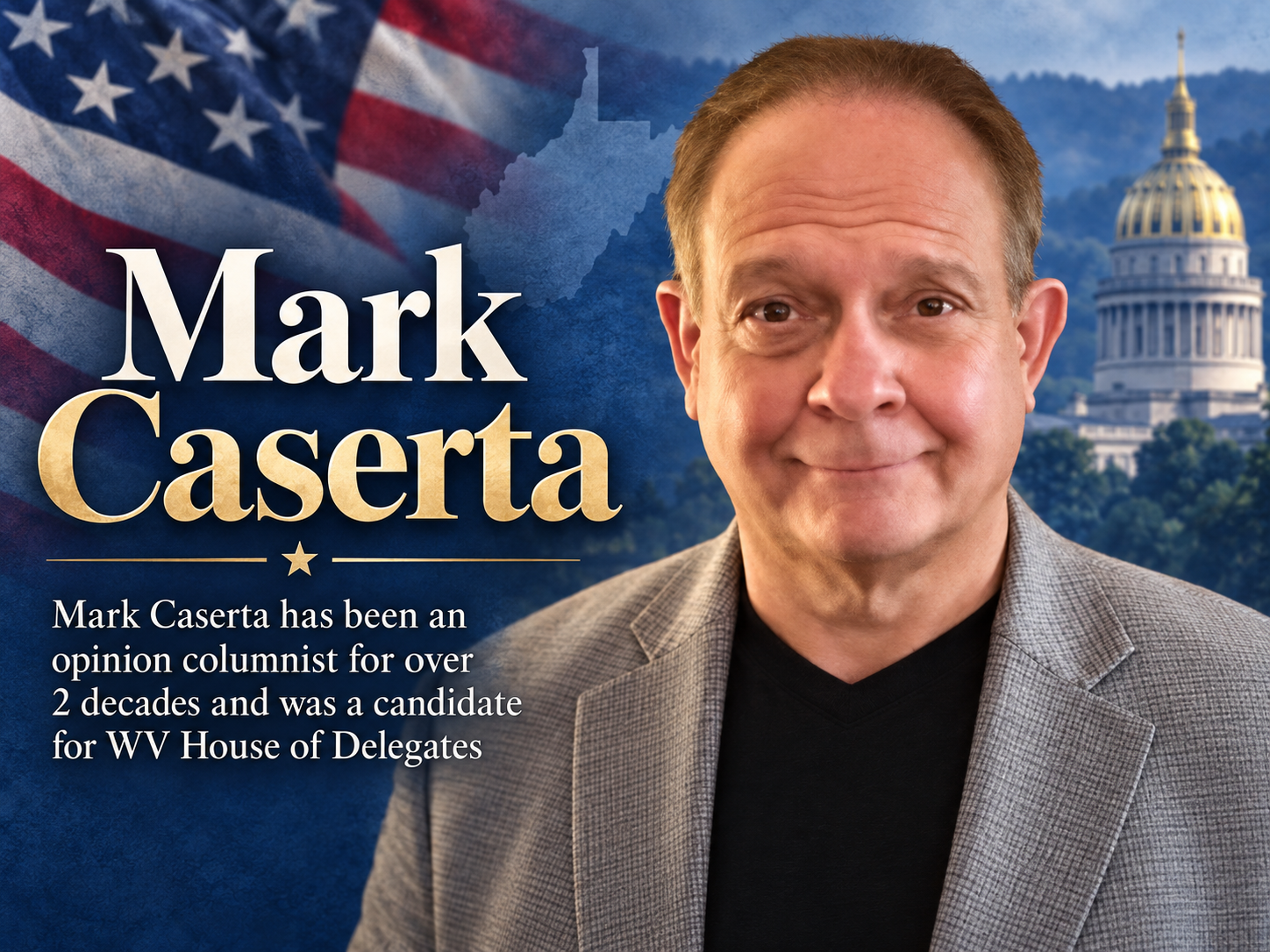
Mark Caserta is a candidate for West Virginia House of Delegates 28th District- Wayne County

Fact: 76 million people, 312 Electoral college votes, 7 swing states and 90 percent of all counties voted, in part, for Donald Trump to end open borders and protect our nation’s sovereignty.

We were dying as a nation. Illegal immigration was slowly overtaking our country with an estimated 20 million unvetted illegals pouring into our country during the Biden administration.

Every single state, every single race and ethnicity moved toward the right and voted for common sense in stopping this insanity. They were tired of woke, failing policies that were causing America to fail on many levels to include healthcare, education, jobs and the rule of law.

Also understand, we are a nation of immigrants – LEGAL immigrants. If anyone comes to our country illegally, they have committed a crime – period. The argument that conservatives are against immigration is inaccurate and often leveraged with intellectual dishonesty.

One must understand congress makes the laws that protect our nation. These laws include immigration laws. Law enforcement agents do not get to pick and choose which laws to uphold. Their job is simply to enforce them.

If you truly love America, stop fighting and work together to make a positive difference rather than create more division. If we plan to have a viable future for our children, we must be united.

Leaders who compare law enforcement agents to Nazis or challenge their authority are emboldening protesters to risk their lives.

Where was this anger and dissension when innocent victims like Laken Riley, Rachael Morin and Jocelyn Nungaray were brutally raped and murdered by illegal immigrants? Have you researched the brutality of these murders?

Why do we make the choice to fight more for the criminals than we do for the victims? Is that really who we are? Is that the rule of law we want for our children?

There are evil forces at work here attempting to divide our people. We MUST choose NOT to allow that to happen.

Good choices are never made out of emotion. Good choices are made with wisdom, temperence and prayer.

Let’s do the exact opposite of what the enemy would have us do.

It’s a great time to remember the civil discourse Charlie Kirk modeled for us.

Let’s be Charlie Kirk

Pastor Mike Lewis: Opioids: Weapons of mass destruction – Battle begins at the border.

15 Jan
Mike Lewis is a pastor and businessman who travels the world serving others

Opioid addiction destroyed an entire generation of sons, daughters, parents & families. We didn’t see it coming – it was a fraud perpetrated on Americans by big pharma

Now, since 2021 fentanyl has killed an average of 300k Americans a year, mainly driven by open borders allowing the flow from China but sold by cartel members

6.5k children in WV sit in foster care because their family is dead or detained

Another 4k sit with kinship family members because their parents are dead or detained

300 kids a night sleep in hotels & offices because there is no room in the inn

575 kids from WV live out of state because we have no special needs centers to house them

WV is last in workforce participation 

48/50 in national education rankings 

47/50 in early mortality 

I have spent 30+ years serving those who had no hope until we introduced them to Jesus – food, clothing, counseling, housing, training, relocation, abortion decision change and more

I have buried +100 sons, daughters, parents & my own brother as a result of illegal drugs and hopelessness drive by addiction driven by open borders pouring fentanyl in

When you have a solvable problem like open borders and removing illegal criminals from our great country- you do it. You do the hard work. The unpopular work. The work that will save another generation from death & detention 

I have traveled to 86 countries in my career – know what they all have?  A secure border

I have been detained by machine gun weilding border agents in India, China and El Salvador all in their attempt to ensure their border laws were followed.  Me, an American executive working for an $11b corporation providing thousands of jobs in their countries 

We are called to protect the widows & orphans. WV leads the nation in both. 

I’ll die defending them. My last breath will be in defense of babies & families and in favor of the removal of those who are here to kill, steal and destroy them

If your spiritual resume is similar then we can sharpen each other. If the only thing you have done is type keyboard quotes then lay down the phone and pick up a servants sword and make a change not a charge

A warrior for WV!

Mark Caserta: We still live in a Republic – for now.

20 Jan

Mark Caserta has been writing opinion columns for nearly 25 years and is editor for Free State Patriot

Got your attention? Good.

We nearly had to take out a loan to purchase this chuck roast I’m preparing to put on the oven. I know prices tend to rise, but this is out of control.

We live in a Republic, which means we are supposed to have representatives who represent the will of the people. Many people don’t know what that looks like. Many politicians don’t care – as long as they remain in power.

There are still good people out there who want to do the right thing as our representatives. Find out who they are and vote for them. If you don’t vote, don’t complain about what you permit.

Families are hurting. People are wandering grocery store aisles looking at items on the shelves they can no longer afford. It’s truly heartbreaking if you understand what’s happening in government.

There are those who will swear government isn’t the problem. Well, to a point they’re right. The people who sit on the sidelines and allow progressive liberals to control their lives are the problem!

The government should not control the people. People should control the government. It’s time, no, it’s past time that we re-engage and take back our lives and the futures of our children and grandchildren.

Corrupt politicians believe we are defeated. They believe they’ve beaten us down and taken away our spirit to fight. They want everyone subservient to their governing hypocrisy. They are relentless in their ideology to dominate, not serve their constituents.

Are we beaten? Is this the way we want it? Is this the environment we want for our children?

It starts with a single, persistent voice in the wilderness. It begins with you and me. Being angry isn’t enough.
Put some action behind that anger.

Fire leaders who will not lead. Vote in November.