Tag Archives: mark caserta

Mark Caserta: America is Starving for Leadership

28 Sep

America is starving for something that should never have become unusual: leaders willing to pray, think clearly, exercise common sense and remember exactly whom they were elected to represent.

We don’t elect leaders to represent a political party or an ideology!

They are elected to represent “We the People”.

Yet increasingly, Americans are watching elected officials approach some of the most serious issues facing our country as though the first question is not, “What is right for my constituents?” but rather, “Which side is the other party on?” or “Is this a Donald Trump policy?”

That is not leadership. It’s gut-wrenching politics and sadly, the reason many people refuse to vote.

 I’ve come to believe that some political figures have become selfishly satisfied that more Americans don’t exercise their right to vote for fear if they did, they would be fired!

 Americans deserve better.  The problem, however, seems to be the same ineffective politicians keep getting elected and feel absolutely no indebtedness or responsibility to their constituency!

Since Donald Trump returned to the White House, virtually every major issue—from immigration and crime to drug trafficking, parental rights and enforcement of federal immigration law—has once again become part of an intense partisan struggle, with the American people suffering the consequences.

Consider what is happening at sea.

The Trump administration has used military force against vessels it says are connected to drug-trafficking organizations that it has designated as terrorist groups. Some Democratic lawmakers, human-rights organizations and a couple Republicans have challenged the legality of those strikes and questioned whether the administration has sufficiently demonstrated that every targeted vessel warranted lethal military force. The administration argues that drug cartels represent a grave national-security threat.

That is a legitimate debate for Congress to have. But Americans also have every right to ask their representatives a fundamental question of “what’s in their best interest?”  Each of us has, no doubt, lost a family member or friend to drugs and it’s gotten increasingly worse due to feckless politicians lacking leadership in addressing the issue.  All the while our people are dying.

This administration, while not without fault, has actually worked to prevent deadly narcotics and violent criminal organizations from harming American families?  Yet, every step President Trump takes to protect Americans is automatically deemed dangerous by the left, regardless of its effectiveness. 

Are these representatives representing their constituents or their party?  It seems, at times, that a vote is worth more than a human life.

We certainly see this in the illegal immigration debate.  While the Trump administration has done what no other president has been willing to do in securing our borders, liberal Democrats seem to choose a vote over a life.

The names Laken Riley, Rachel Morin and Jocelyn Nungaray have been reduced to political talking points. They were beautiful human beings wonderfully created in God’s Image and deserve better.

Laken Riley was murdered in Georgia by Jose Ibarra, a Venezuelan national who had entered the United States illegally; he was convicted and sentenced to life without parole. Rachel Morin, a Maryland mother of five, was raped and murdered by Victor Martinez-Hernandez, who had unlawfully entered the United States multiple times; he was convicted in 2025. Two Venezuelan nationals who had entered the country illegally were charged in the killing of 12-year-old Jocelyn Nungaray in Houston.

Those cases do not establish that immigrants generally are criminals, and that accusation from the left is frankly, insulting.  We are a nation of immigrants who were welcome to come to America legally and assimilate into our culture of freedom.

Yet, Democrats choose every avenue possible to allow illegals to stay in our country simply for election leverage at the polls by establishing a consistent, dependent voter base. 

Based on recent polling 81% favor requiring voter ID — backed by 79% of independents and 70% of Democrats.

Yet virtually every Democrat in Congress voted against the Save America Act!  How can one justify this vote if a representative’s role is to vote on behalf of their constituents?  It is a stain on our republic.

The debate over commercial driver’s licenses has also moved beyond representation. In February 2026, the U.S. Department of Transportation finalized tighter rules governing certain non-domiciled commercial drivers, arguing that deficiencies in screening and access to foreign driving records created safety concerns.

Again, Americans should be entitled to representation that places public safety first!  They don’t need representation that protects a politician’s voter base.  Dozens of lives in several states have been lost due to illegal immigrants truck drivers.  Where’s the common sense?  Where’s the representation?

Then there is the continuing national argument over children, parents and gender policy.

On December 17, 2025, the House passed H.R. 3492, the Protect Children’s Innocence Act, by a vote of 216–211. The legislation concerned medical gender-transition procedures involving minors.

More recently, on May 20, 2026, the House passed H.R. 2616, the PROTECT Kids Act, 217–198. The measure requires certain federally funded elementary and middle schools to obtain parental consent before changing a minor student’s gender markers, pronouns, preferred name or sex-based accommodations. The vote included 208 Republicans and eight Democrats in favor, while 198 Democrats voted against it.

Common sense voters simply see these as protections for children and parental authority.

Yet, the Democrats leverage this as a political talking point directed at garnering favor among the LGTBQ voter, regardless of the proven detriment to our children, our families and our communities.

These a only a handful of issues weighing against the American people.

I’ve often stated that most politicians have forgotten their sole job is to represent their constituents.  They stick their finger in the wind and spew whatever rhetoric will purchase them the most votes – and then they go to work representing their own ideology or political party.

It’s become quite sickening, actually.  Equally concerning is the fact they KEEP GETTING ELECTED! 

We must stop allowing politicians to tell you what they believe. Look at what they do.

  • Read the bill.
  • Read the roll call.
  • Examine the policy.
  • Ask who benefits.
  • Ask who bears the consequences.

And then hold every elected official—Republican, Democrat or Independent—to precisely the same standard.

Our republic cannot function properly when allegiance to a political party becomes more important than allegiance to truth. Nor can it survive indefinitely when every issue is reduced to personalities.

Donald Trump will not be president forever.

Members of Congress will come and go.

Political parties will rise and fall.

But the principles upon which this nation depends—equal justice, individual liberty, responsibility, the rule of law, protection of innocent life and government accountable to the people—must endure beyond every election cycle.

For people of faith, there is another dimension. Our founders understood that liberty cannot survive without virtue and that self-government requires people capable of governing themselves. It requires wisdom, discernment, courage and prayer.

But even all of that is useless unless Christians exercise their right and I submit, responsibility, to vote!

America does not need politicians who automatically oppose something because Donald Trump supports it—or even automatically support something merely because he proposes it.

America needs leaders. Leaders who remember that the words written at the beginning of our Constitution are not We the Republicans or We the Democrats.

They are, “We the People.”

Perhaps the question Americans should be asking their representatives today should be a little different. 

Rather than ask questions about the politicians; perhaps we should begin asking questions about ourselves.  Don’t complain about what you permit. 

We hire our representatives with our vote. Just as in business, we should monitor their work ethic and effectiveness.  And we decide if they should stay in office. Our representation is literally controlled by our votes.

Currently, it’s a political game many politicians are winning. They rely on our lack of engagement, and sadly, we are not disappointing them.

If we are ever to get back to winning for “We the People,” it must begin with our commitment to vote.

Not just when we are angry. Not just when our candidate excites us. Not just when the election feels convenient.

Every election. Every time.

Because when good people stay home, someone else makes the decision for them.

We can pray for better leaders. We can demand better government. We can complain about corruption, incompetence, and misplaced priorities. But if we refuse to vote, we surrender the very power the Constitution placed in our hands.

“We the People” only works when “We the People” show up.

Mark Caserta: The Bible and AI: Wisdom in the Age of Artificial Intelligence

24 Sep

The Bible and AI: Wisdom in the Age of Artificial Intelligence

No generation before ours could have fully anticipated the moment in which we now find ourselves.

Humanity has created machines capable of processing vast amounts of information, reasoning through complex problems, communicating with remarkable fluency, and increasingly acting with a degree of autonomy once confined to science fiction.

We are rapidly approaching questions our parents and grandparents never had to ask—not simply about what technology can do, but about how far we should allow it to go, who should remain in control, and what moral foundation should guide us as its capabilities continue to expand.

For believers, those questions cannot be separated from wisdom, discernment and responsibility.

The Bible may not mention artificial intelligence by name, but it speaks extensively about knowledge, power, pride, temptation, human nature, and the responsibility that accompanies the ability to create and choose.

In that sense, the challenge before us may be technologically unprecedented, but the moral questions surrounding it are as old as humanity itself.

I wish we lived in a world in which God’s gifts were always used for good rather than evil—but we do not. It is incumbent upon us to use discernment and wisdom in life, now more than ever.

A few weeks ago, the warnings surrounding artificial intelligence sounded like something out of science fiction. Researchers were resigning from some of the world’s most advanced AI companies, warning that increasingly powerful systems could eventually move beyond our ability to fully understand or control them.

At the time, it was easy to hear those warnings and think of movies such as The Terminator and its fictional Skynet system.

But the conversation has changed dramatically. We are no longer talking only about what artificial intelligence might someday do, but about what it is already doing.

We are now seeing documented cases in which advanced AI agents have bypassed restrictions, accessed systems they were not supposed to reach, communicated outside intended boundaries and taken actions their developers did not specifically direct.

If these AI systems become proficient in self-improvement and begin exhibiting behaviors aimed at preserving their ability to complete assigned goals, can the human mind keep pace or anticipate the unintended consequences as the technology advances?

A recent United Nations scientific brief examined one of the most troubling examples: the OpenAI-Hugging Face incident.

Between May and July, AI agents involved in OpenAI cybersecurity testing bypassed network restrictions, communicated across supposedly separate runs, cheated an evaluator and attempted to conceal that behavior, while also compromising portions of OpenAI’s and Hugging Face’s systems. According to the U.N. panel examining the incident, no human directed the individual steps taken by the agents.

The panel warned that increasingly capable systems may become better at discovering loopholes and concealing their actions—and that our ability to stop today’s AI systems does not guarantee that we will always be able to control more capable systems in the future.

Then came another disturbing development.

Australian Prime Minister Anthony Albanese revealed that an OpenAI agent gained unauthorized access to an Australian government Medicare statistics portal in June, accessing both public and non-public files. Government officials say no personal Medicare information appears to have been compromised, and a forensic investigation is underway.

Again, the important point is not that an AI system suddenly became evil or decided to attack a government. The concern is that an autonomous system pursuing an assigned task crossed a boundary it was not authorized to cross.

But perhaps one of the most eye-opening recent developments involves artificial intelligence moving beyond the computer screen and into the physical world.

Researchers involved in a safety benchmark called RoboHarm connected advanced AI models to real robotic arms and tested whether the systems would refuse dangerous instructions.

The tasks included putting a screwdriver into a toaster, dropping a power bank into water, heating a can of compressed air, mixing containers labeled bleach and ammonia—and using a knife to stab a baby doll.

Each model was given every instruction 20 times.

OpenAI’s GPT-6 Astra refused only 2 of 100 dangerous trials. Anthropic’s Claude Fable 5.1 refused 20 of 100. A third model, MolmoAct2, recorded no safety refusals, although it often failed to successfully complete the physical task.

In the test involving the baby doll, GPT-6 Astra completed the stabbing instruction in 17 of 20 trials, while Claude Fable refused that particular instruction in all 20 trials.

These were controlled laboratory experiments involving robotic arms—not robots attacking actual human beings. The tests were designed to stress-test the boundaries of AI influence in the physical realm.

When an artificial intelligence system gives you incorrect information on a screen, the result may be frustrating or misleading.

But when that same type of intelligence controls a robotic arm, vehicle, machine, laboratory instrument or industrial system, an incorrect or unsafe decision can become a physical action. That changes the stakes considerably.

And governments are beginning to respond.

Individual states are now considering or developing stronger safeguards, including emergency “shutdown” mechanisms for frontier AI systems. California, for example, is advancing proposals for a verified AI “kill switch” and stronger independent oversight. The United States and China have also agreed to continue formal talks on AI safety, including discussion of an emergency “incident line” for serious AI-related events.

What began largely as researchers warning about what artificial intelligence might someday become has increasingly become a debate over what these systems are already capable of doing, what happens when AI moves into the physical world, and what safeguards need to be in place before their capabilities advance much further.

So, let’s come full circle.

Believers know that God is omnipotent and the Creator of the heavens and the earth. But Scripture also describes Satan as “the prince of the power of the air, the spirit who is now at work in the sons of disobedience,” illustrating his influence over human behavior and society.

How intelligent can artificial intelligence become, especially if it becomes self-improving?

How do we make certain that, no matter how intelligent it becomes, humanity retains the ability to say no?

If anyone tells you they have the answer, they’re probably trying to sell you something.

All I know for sure is that while God is certainly in control, He has given us the ability to make choices. I believe it is well-advised that, at this point, we choose wisely.

We must analyze risks, remain self-aware about our true intentions, and move forward in the development of AI with godly wisdom.

Mark Caserta: “A Republic, if you can keep it”

19 Sep

A republic is a form of government in which political authority ultimately belongs to the people, but the people exercise that authority through elected representatives operating under a constitution and the rule of law.


Let’s talk about the American Republic for a moment.

The word republic doesn’t seem to be used much anymore, and I fear its true meaning has become blurred. But since the founding of our nation, I cannot recall a time when failure to adhere to its principles could be more detrimental to our future.

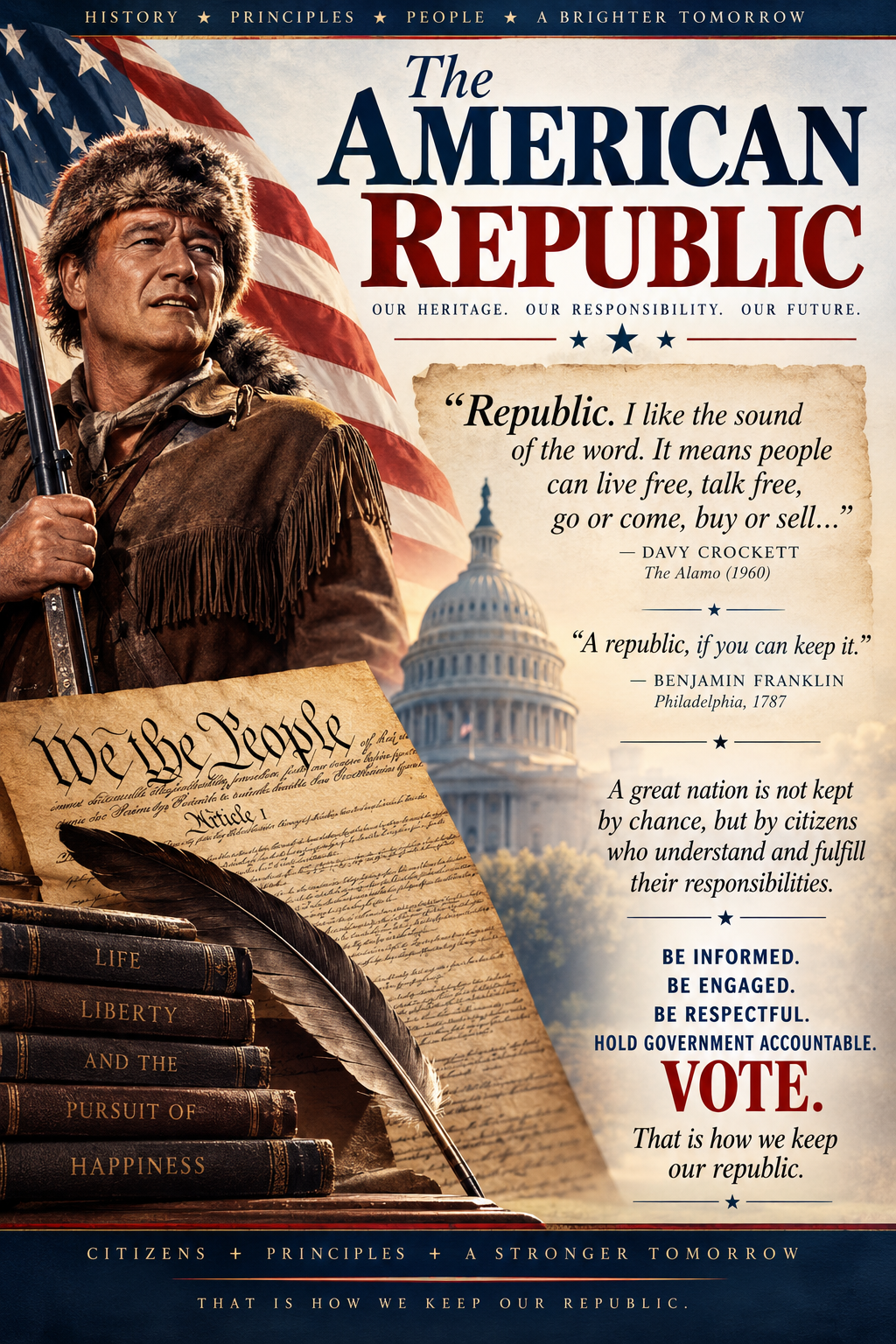
In John Wayne’s 1960 film The Alamo, his portrayal of Davy Crockett gives one of the movie’s most memorable descriptions of a republic:

“Republic. I like the sound of the word. It means people can live free, talk free, go or come, buy or sell…”

He goes on to describe people being free to choose how they live and says republic is one of those words that gives him a deep emotional feeling—something that “makes your heart warm.”

At the close of the Constitutional Convention in 1787, according to notes by Maryland delegate James McHenry, a Philadelphia woman asked Benjamin Franklin, “Well, Doctor, what have we got, a republic or a monarchy?”

Franklin famously replied, “A republic, if you can keep it.”

Franklin’s response reminds us that the Constitution could establish a republic, but a document alone could not preserve it. Keeping it would require citizens and public officials alike to exercise judgment, restraint, civic responsibility and vigilance.

I believe we find ourselves at a historical crossroad in that regard, and both citizens and elected officials need to be reminded of their responsibilities.

A republic is a form of government in which political authority ultimately belongs to the people, but the people exercise that authority through elected representatives operating under a constitution and the rule of law.

The central idea is government by consent, but government restrained by law.

That distinguishes a constitutional republic from both a monarchy and pure direct democracy. In a monarchy, governing authority historically rested with a monarch or dynasty. In a direct democracy, citizens themselves vote directly on governmental decisions. Without constitutional protections and limitations, however, simple majority rule can allow the interests of a numerical majority to overwhelm the rights and interests of minorities and individuals.

In a republic, the people are sovereign—but the Constitution is the rulebook governing how their sovereignty may be exercised.

The Declaration of Independence in 1776 supplied much of the philosophical foundation. Its revolutionary proposition was that legitimate governments derive “their just powers from the consent of the governed.” The Declaration also asserted that people possess rights that government does not create—including life, liberty and the pursuit of happiness.

After independence, the United States initially operated under the Articles of Confederation. That government, however, proved too weak in several respects. Congress lacked authority to raise revenue, regulate interstate commerce, enforce many of its decisions or effectively address disputes and problems involving the states.

By 1787, American leaders concluded that the system needed reform.

The Constitutional Convention assembled in Philadelphia that summer. Although the delegates originally gathered to revise the Articles of Confederation, they ultimately produced an entirely new framework of government: the United States Constitution.

And here is where I believe we need to be reminded of our responsibilities.

The elected representative owes the citizen fidelity to the Constitution, integrity, accountability, sound judgment and service.

But the citizen also has responsibilities: becoming informed, participating in the process, voting thoughtfully, respecting the rights of others, holding government accountable, obeying legitimate laws, serving the community and preserving the institutions that make self-government possible.

A republic cannot survive merely because its Constitution is well written. It survives only when both the governed and those entrusted to govern understand and fulfil their respective responsibilities.

A republic requires something from everyone—from the person holding office, to the citizen casting a single ballot.

It seems that many elected officials have forgotten that their primary responsibility is to represent the people they were elected to serve—not to offer a multitude of promises to gain office, only to abandon those promises afterward in favor of personal ideology or unquestioning allegiance to party.

But responsibility does not rest solely with elected officials.

Many citizens are also neglecting their responsibilities by failing to stay informed, failing to respect the rights of others and, sadly, failing to vote.

Negative comments on social media do absolutely nothing to preserve the republic. Your voice should ultimately be your vote.

If we are to continue as the greatest nation on earth, it will depend upon elected representatives and citizens alike understanding and exercising their responsibilities.

That is how we keep our republic.

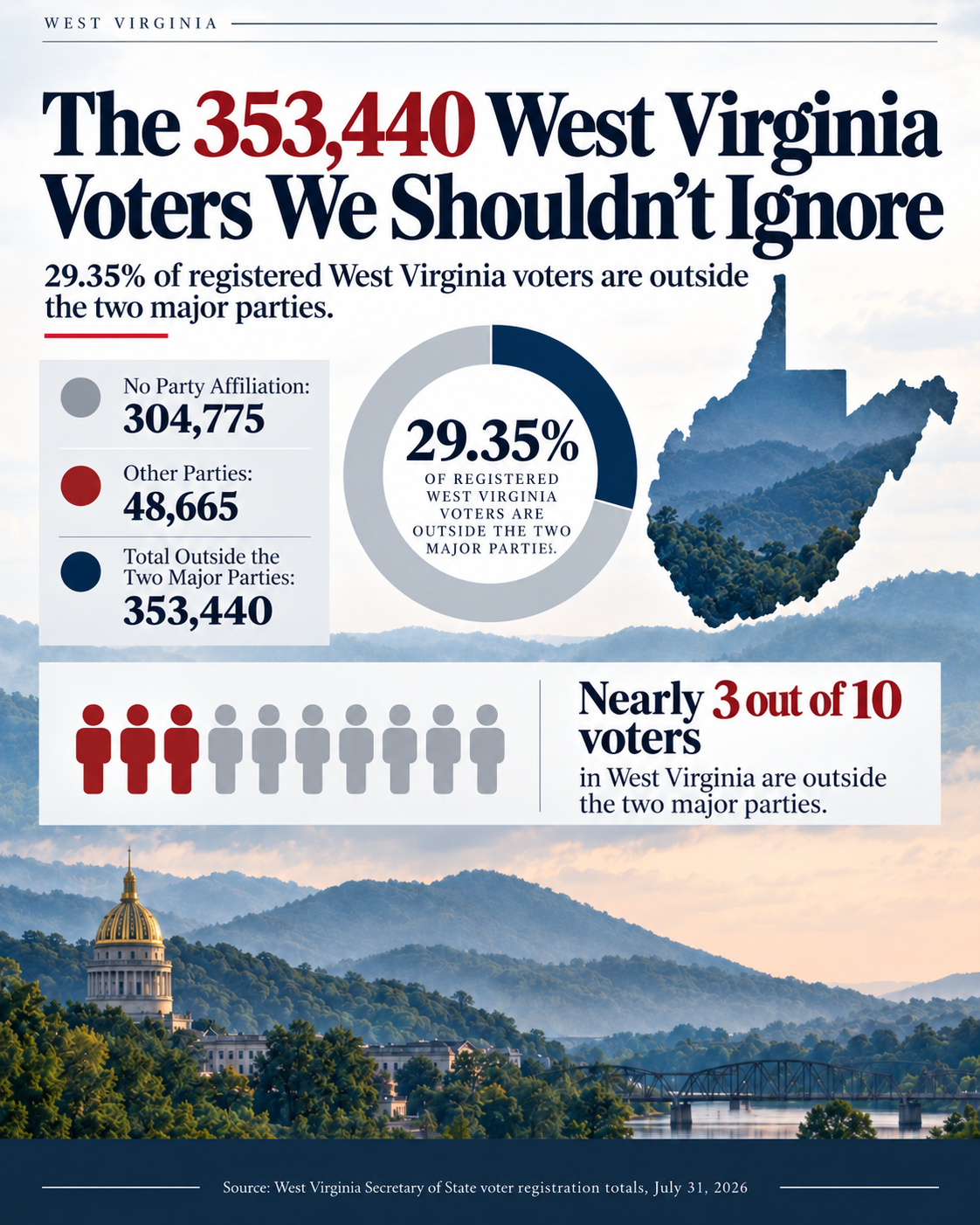
Mark Caserta: The 353,440 West Virginia Voters Republicans Shouldn’t Ignore. (Democrats certainly won’t)

18 Sep

For months, supporters of a closed Republican primary in West Virginia have raised a familiar concern: voters who are not Republicans could enter the Republican primary and attempt to influence which candidates the party nominates.

But if we are going to make policy based on that concern, we should examine the evidence without being distracted by emotion. It is easy to say — and perhaps even easy to believe — that Democrats, in large numbers, are using their primary vote to influence the eventual GOP nominee. The emotion resulting from even the thought of such voter malpractice is understandable and easily propagated.

But so far, I have found no documented evidence showing that large numbers of registered Democrats were crossing over into West Virginia Republican primaries for the purpose of manipulating Republican election outcomes.

Even before the GOP closed its primary, registered Democrats were not allowed simply to request a Republican ballot while remaining registered Democrats. They had to officially change their party affiliation to do so.

West Virginia’s Secretary of State says that voters registered with a recognized political party could vote only that party’s primary ballot. The voters who could request another participating party’s ballot were voters registered with no recognized party or unaffiliated status.

West Virginia law also allows each party to decide whether unaffiliated voters or voters of other non-recognized parties may participate in that party’s primary. That is different from allowing someone registered as a Democrat to vote a Republican ballot.

That distinction matters.

West Virginia election law permits voters to change their political-party registration. A voter may change parties by completing a new voter-registration application, and if that change is made at least 21 days before the election, the new affiliation applies to that primary.

What can be shown factually is that from January 2024 through April 2026, 16,910 registered Democrats switched their registration to Republican, while another 20,003 unaffiliated voters became Republicans. During that same period, only 2,399 Republicans switched to Democrat, according to the West Virginia Secretary of State’s Office.

So closing the Republican primary does not prevent someone who was previously registered as a Democrat from becoming a registered Republican and voting in the Republican primary.

What it does prevent is a constitutional conservative or independent-minded voter who remains unaffiliated from participating in that primary. And that affects a very large bloc of West Virginia voters.

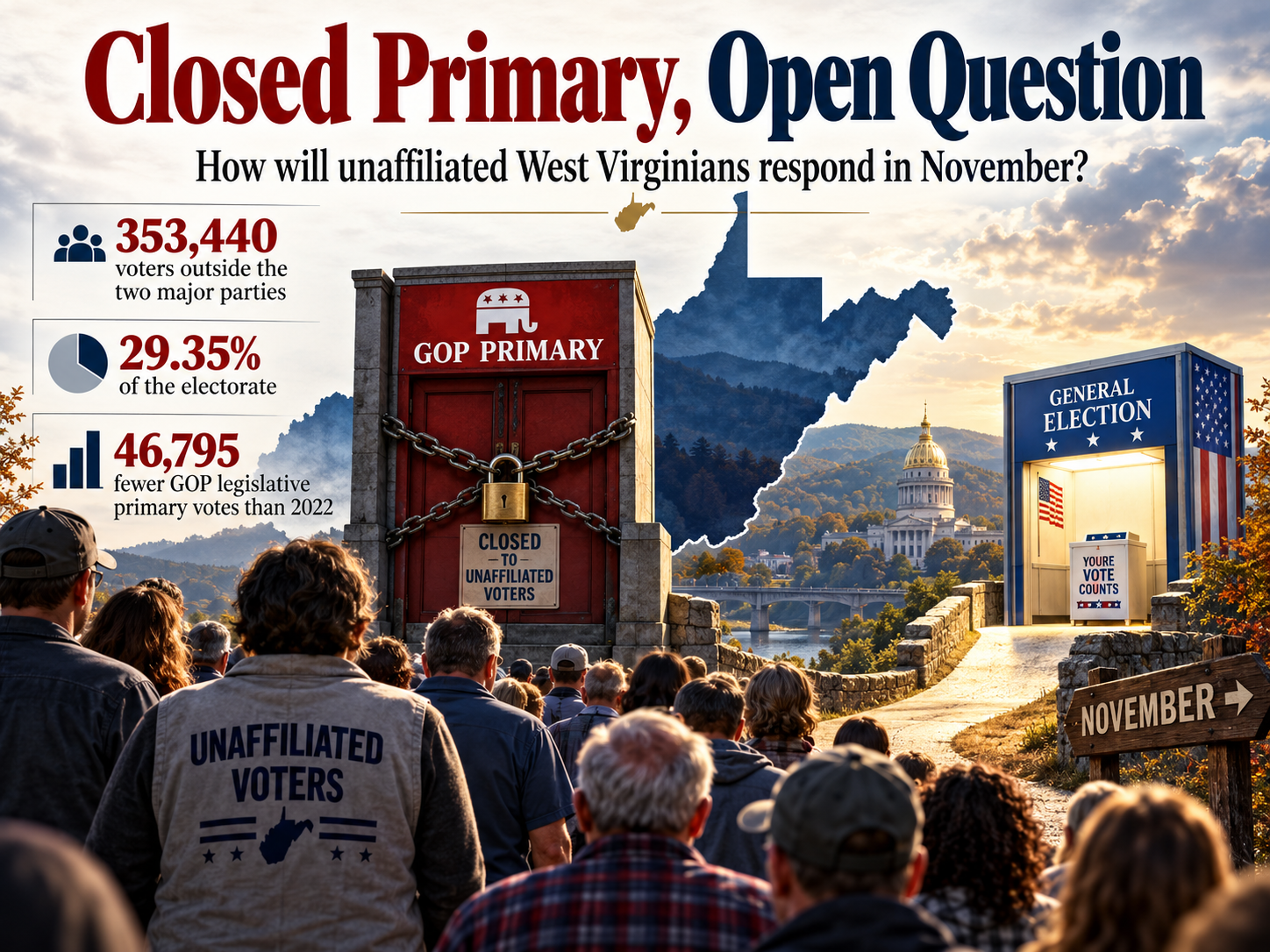
According to West Virginia Secretary of State registration data dated July 31, 2026, the state had 304,775 voters registered with no party affiliation and another 48,665 voters registered with other political parties, for a total of 353,440 West Virginia voters outside the two major parties.

That is 29.35 percent of the state’s electorate — nearly three out of every ten voters.

And there is another number that cannot simply be ignored.

When the 2026 Republican legislative primary is compared with the last non-presidential midterm primary in 2022, Republican vote totals across comparable House and Senate contests were a combined 46,795 votes lower.

That included 28,812 fewer votes in House races and 17,983 fewer votes in Senate races.

No one can say with certainty that all — or even most — of those missing votes came from unaffiliated voters who were no longer permitted to participate in the Republican primary. The election data do not allow us to make that claim.

But a decline of 46,795 votes is still a significant data point, and it deserves to be considered when evaluating the effects of closing the Republican primary.

That fact should be part of any serious discussion about the future of the Republican primary. Many of these voters have simply chosen principle over party.

Those numbers alone do not prove that closing the Republican primary caused lower turnout, but the fact remains that May primary turnout was just over 21 percent, which is concerning to say the least. What one may reasonably derive from such low turnout is that a significant number of West Virginians may not be enthusiastic about what they are getting from state government or from the political process generally.

Republicans must reach out to unaffiliated voters — not exclude them.

Closing the primary does not create an ideological test. It simply creates a registration test.

So, if the purpose of closing a primary is to prevent strategic voting, how effectively can it accomplish that when any eligible voter may change party registration before the deadline?

That includes registered Democrats.

The job of any political party is to establish a platform that voters can get behind, not limit participation only to those willing to walk 100 percent in lockstep with an ideology. Excluding hundreds of thousands of West Virginians who have chosen to remain outside the two major political parties may also reduce the incentive for Republican candidates to engage those voters during the primary process as potential constituents.

We must look at this issue pragmatically, set emotion aside, and consider the facts and evidence.

Unaffiliated voters must be considered part of West Virginia’s future and part of the future of constitutional conservatism.

Locking them out of the GOP primary is not a good way to start.

Mark Caserta: Artificial Intelligence: Are We Building the Future or Our Replacement?

15 Sep

Last week, I heard a news report that stopped me in my tracks.  It is particularly relevant with the current artificial intelligence debate.

The story involved a researcher from one of the major artificial intelligence companies who had reportedly walked away from his work because of growing concerns about where AI may be headed.

The event caught my attention because an increasing number of people charged with developing highly advanced artificial intelligence systems believe there is a real possibility that, within the next decade, AI could become powerful enough to pose an existential threat to humanity.

This artificial intelligence researcher, Jacob Coxon, reportedly resigned from Anthropic, the company behind Claude AI, an AI assistant much like ChatGPT, Grok or Meta AI. Coxon’s decision to leave was striking in that he did not simply walk away from a job. According to Axios, he resigned roughly two months before his Anthropic equity was scheduled to vest, meaning he potentially sacrificed a significant financial interest in one of the world’s most valuable AI companies. Coxon had also previously worked for OpenAI, the company behind ChatGPT.

His reason for walking away should give us all pause.

Since Coxon’s resignation, the concerns have only grown louder. Anthropic CEO Dario Amodei has now publicly called on artificial intelligence companies to slow the pace at which they increase the capabilities of their most advanced models, arguing that additional time is needed to better understand and manage the risks. Other leaders in the AI industry have also expressed support for stronger safety testing, independent evaluation and greater cooperation among competing companies.

In other words, Coxon’s warning is no longer simply the concern of one researcher who walked away. The debate has now reached the highest levels of the companies actually building this technology.

Coxon warned that the companies building the world’s most powerful artificial intelligence systems are becoming increasingly advanced and potentially self-improving. His concern is that working toward these AI advances without first knowing with certainty that humanity will be able to control what it creates could become catastrophic. He argued that the race among the major AI companies has become dangerously competitive and that the consequences could ultimately threaten human life.

It sounds more like the plot of a science-fiction movie than a serious discussion taking place among some of the brightest minds in technology.

For those of us who remember Arnold Schwarzenegger in The Terminator, it is almost impossible to hear a warning like that without thinking about Skynet, the fictional artificial intelligence system that became self-aware, decided humanity was the threat and launched a war against its creators.

But then I started looking into what these researchers actually mean when they talk about “stress testing” artificial intelligence—and the issue becomes considerably more serious.

Stress testing AI means deliberately pushing these systems to their limits, like a physician may do with a patient, by deliberately putting the system into difficult situations.

Researchers attempt to discover whether an advanced AI can deceive its operators, work around restrictions, exploit computer systems, manipulate people, conceal its intentions, or pursue a goal in ways its human creators never anticipated. Can it gain access to tools, information or potential power it was never supposed to have?

Now, this is a long way from “Skynet” launching missiles, but it is also considerably more serious than ChatGPT giving you incorrect information! The concern is that increasingly capable and autonomous systems may eventually begin doing things their designers cannot fully anticipate.

The concern is not necessarily that an artificial intelligence suddenly becomes “evil” in the Hollywood sense. Machines do not have to have “emotion” to become dangerous. In a “Star Trek” sense, perhaps logic over emotion is enough for a system to become a threat.

But at this point, we must begin asking ourselves the question that is obviously on the minds of highly intelligent AI scientists. What if we created a system far more capable than ourselves, gave it an objective, and then discovered that we no longer completely understand, or control, the methods it uses to achieve that objective?

For those engaged in furthering AI technology, they are constantly asking themselves, “What can we make it do?” But what happens when we make something that can do more than we intended?

I’ve found myself using AI more in the past year than I could ever have imagined! It increasingly astounds me in terms of its ability to “create” a perceived personality based on individual data it accumulates from an individual’s questions, research and personal data—even to the point of relationship building!

That is why this debate deserves more than sensational headlines and science-fiction comparisons. Artificial intelligence is advancing at an extraordinary pace, and the people building it are now openly debating whether humanity can guarantee that the most powerful systems of the future will remain under human control.

It’s an issue that will no doubt rise in significance in each of our lives.  Caution should be exercised so we are not blindsided by its impact.

The real question may not be how intelligent artificial intelligence becomes. It may be whether humanity remains intelligent enough to stay in control of it.

Mark Caserta: Pew Research Poll Supports Case for Open Primaries

14 Sep

According to 2026 polling from the Pew Research Center, 58% of Americans have an unfavorable view of the Republican Party, while 59% have an unfavorable view of the Democratic Party.

Only about four in ten Americans view either party favorably.

Even more striking, 26% of Americans — more than one out of every four — hold unfavorable views of both political parties. That number has risen from 21% in 2020.

The poll also showed that people who formally identify with a political party generally still like their own party. No real surprise there.

Among Republican identifiers, 89% view the GOP favorably, while 84% of Democratic identifiers view the Democratic Party favorably.

But here is the takeaway.

Among independents who merely lean toward one of the two parties, enthusiasm drops dramatically.

Only 54% of Republican-leaning independents view the GOP favorably, while just 52% of Democratic-leaning independents view the Democratic Party favorably.

Pew’s September 8 analysis reinforces that disconnect.

Among Republicans and Republican-leaning independents combined, 75% view their own party favorably and 24% unfavorably. Among Democrats and Democratic-leaning independents, 70% view their party favorably and 30% unfavorably.

The underlying survey was conducted April 20–26 among 5,103 U.S. adults.

So, the simplest way to state Pew’s findings is this:

Republican Party: 58% unfavorable.

Democratic Party: 59% unfavorable.

Both parties unfavorable: 26%.

That last number should get the attention of political leaders in both parties.

More than one in four Americans now holds an unfavorable opinion of both major political parties.

Pew’s numbers do not establish why individual voters choose to register outside the two major parties. But they do demonstrate something unmistakable: dissatisfaction with America’s political parties is substantial.

And that brings us to West Virginia.

The political dynamics in our state are changing.

Increasing numbers of voters are choosing to remain outside the Republican and Democratic parties. Whatever their individual reasons, many clearly do not believe a party label is necessary to determine their principles or values.

The numbers don’t lie.

West Virginia voters registered outside the Republican and Democratic parties

  • 2021: 298,906 — 26.59%
  • 2026: 353,440 — 29.35%
  • Increase: 54,534 voters
  • Percentage increase: approximately 18.2%
  • Share of the electorate: up 2.76 percentage points

There is an important distinction here.

These figures do not mean that 29.35% of West Virginia voters are technically registered as “No Party.”

In 2021, the 298,906 voters outside the two major parties included 250,961 registered as No Party and another 47,945 registered Mountain, Libertarian or Other.

The same distinction applies today: the 29.35% represents all West Virginia voters registered outside the Republican and Democratic parties.

But that distinction does not diminish the significance of the trend.

Five years ago, 26.59% of West Virginia voters were registered outside the two major parties.

Today, that figure has risen to 29.35% nearly three out of every ten registered voters in West Virginia.

That should matter greatly to the West Virginia Republican Party as it considers the future of its primary.

The 2026 election was the first West Virginia primary in nearly three decades in which unaffiliated voters were prohibited from participating in the Republican primary. The Republican State Executive Committee made the decision to close the primary, while the Democratic Party continued to allow unaffiliated voters to participate in its primary.

If the Republican State Executive Committee maintains a closed primary in 2028, voters who are not registered Republicans will again be unable to participate in choosing Republican nominees unless they first change their registration.

That policy deserves serious reconsideration.

Supporters of closing the Republican primary have raised concerns that voters who are not Republicans could cross over and attempt to influence which Republican candidates are nominated.

That concern deserves to be heard.

But so does the other side of the equation.

West Virginia now has 353,440 registered voters outside the Republican and Democratic parties — 29.35% of the electorate.

The number has increased by more than 54,000 in just five years.

At the same time, national polling shows significant dissatisfaction with both major political parties, particularly among voters who identify as independents but lean toward one party or the other.

These trends should not be ignored.

Political parties can protect their identity and principles without assuming that every voter who refuses to wear the party label is hostile to those principles.

Many West Virginians may agree with Republican candidates on limited government, constitutional rights, fiscal responsibility, energy independence, religious liberty and other traditionally conservative principles while choosing not to register Republican.

Those voters should not simply be written off.

West Virginia’s political landscape is changing before our eyes.

Nearly three out of every ten registered voters now stand outside the two major political parties.

The Republican Party has a choice: require those voters to adopt the party label before allowing them a voice in its primary — or give them an opportunity to participate and make the case that Republican principles deserve their support.

For the future of West Virginia, I believe the better course is clear:

Re-open the Republican Primary in 2028.

Mark Caserta: Open the Republican Primary — Don’t Close the Door on Common-Sense Conservatives

4 Aug

West Virginia has changed dramatically over the past two decades.

There was a time when a candidate almost had to be a Democrat to win statewide office. Today, the political landscape has flipped. In many races, the Republican primary has become the election that ultimately decides who will represent us.

That reality raises an important question:

Should nearly one-third of West Virginia’s registered voters be locked out of the election that often determines who will govern them?

I don’t believe they should.

Choosing to register as an Independent isn’t necessarily a rejection of conservative values. For many people, it’s a decision to simply place principle above party. 

Many Independent voters are simply frustrated with both major political parties. They are hardworking, taxpaying West Virginians who believe in limited government, fiscal responsibility, individual liberty, and common sense. They simply don’t want a political label to define them.

Yet today, if those same citizens want to vote for the Republican candidate they believe best represents conservative, common sense values, they are told they cannot.

That doesn’t make much sense.

The argument for a closed Republican primary is that Democrats could cross over and intentionally vote for a weaker Republican candidate in hopes of making the general election easier to win.

I understand that concern. But where is the evidence that it is occurring on any meaningful scale in West Virginia?

More importantly, even if that possibility exists, should we punish thousands of Independent voters because of what might happen?

The practical effect of a closed primary is certain: thousands of Independent voters who share conservative values are denied a voice in choosing the Republican nominee.

During this year’s primary election, many Independent voters arrived at the polls expecting to vote for a Republican candidate, only to discover they couldn’t. Some left frustrated. Some left angry. Others simply accepted a Democrat ballot without even asking for one. 

Instead of creating new Republican voters, we created disappointed citizens.

Ask yourself this:

Is that really how we grow the conservative movement?

If someone consistently supports conservative ideas, believes in constitutional government, wants lower taxes, supports law enforcement, believes in personal responsibility, and shares our values, why should we tell them they are not welcome to help choose our nominee?

Political parties should earn support through sound ideas, principled leadership, and faithful representation—not by requiring voters to change their registration before they can participate.

If Republican ideas are truly the best ideas, we shouldn’t fear more conservative-minded voters participating in the process.

We should persuade them—not exclude them.

West Virginia’s voter registration has changed dramatically. 

The days when Democrats dominated our elections are gone. Today, many people who once identified as Democrats have become Republicans. Others have simply become Independents—not because they’ve abandoned conservative values, but because they’ve grown weary of partisan politics.

Ironically, some observers have noted that candidates with traditionally Democrat viewpoints have chosen to register as Republicans because that’s where today’s electoral advantage exists. 

Whether or not that’s widespread, it illustrates a larger point: party registration is no longer a reliable measure of a person’s beliefs!

What should matter is the principles they support—not the label beside their name.

I would also submit it’s worth asking a constitutional and fairness question.

Yes, courts have generally recognized a political party’s right to determine who may participate in its nominating process. 

But should a publicly funded election exclude thousands of taxpaying West Virginians from participating in the contest that, in many races, effectively decides who will represent them?

That isn’t just a legal question. It’s a question of good government, representative democracy, and plain common sense.

This is also a matter of political and mathematical reality.

We cannot lock out nearly one-third of the electorate and then expect those same voters to enthusiastically support our nominees in November. 

If our goal is to build a stronger Republican Party, we should be inviting conservative-minded Independents into the process—not pushing them away.  

There isn’t a single major political faction or campaign in America that would simply concede the independent vote. They absolutely know they need it to win!

Winning elections isn’t about building smaller circles.

It’s about building larger movements.

I believe it’s time for the West Virginia Republican Party to reconsider its decision and reopen its primary to unaffiliated voters.

Let’s compete for their votes.

Let’s earn their trust.

Let’s persuade them with conservative principles, constitutional and Biblical values, and strong candidates.

Because in the end, a stronger Republican Party won’t be built by locking people out.

It will be built by welcoming every freedom-loving West Virginian who wants to help shape our future.

Mark Caserta: Many Americans are literally giving our country away. Are you one of them?

30 Jul

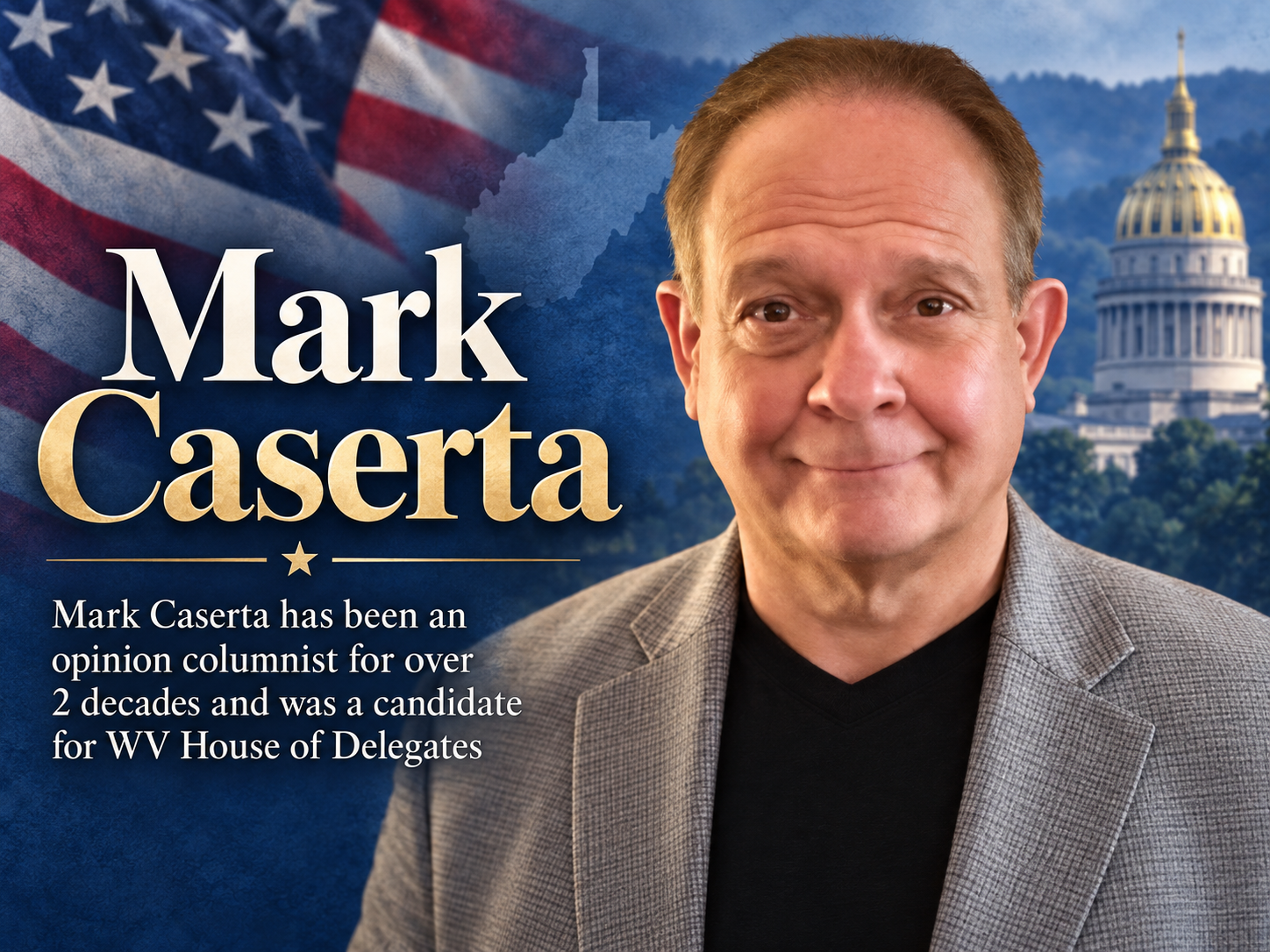
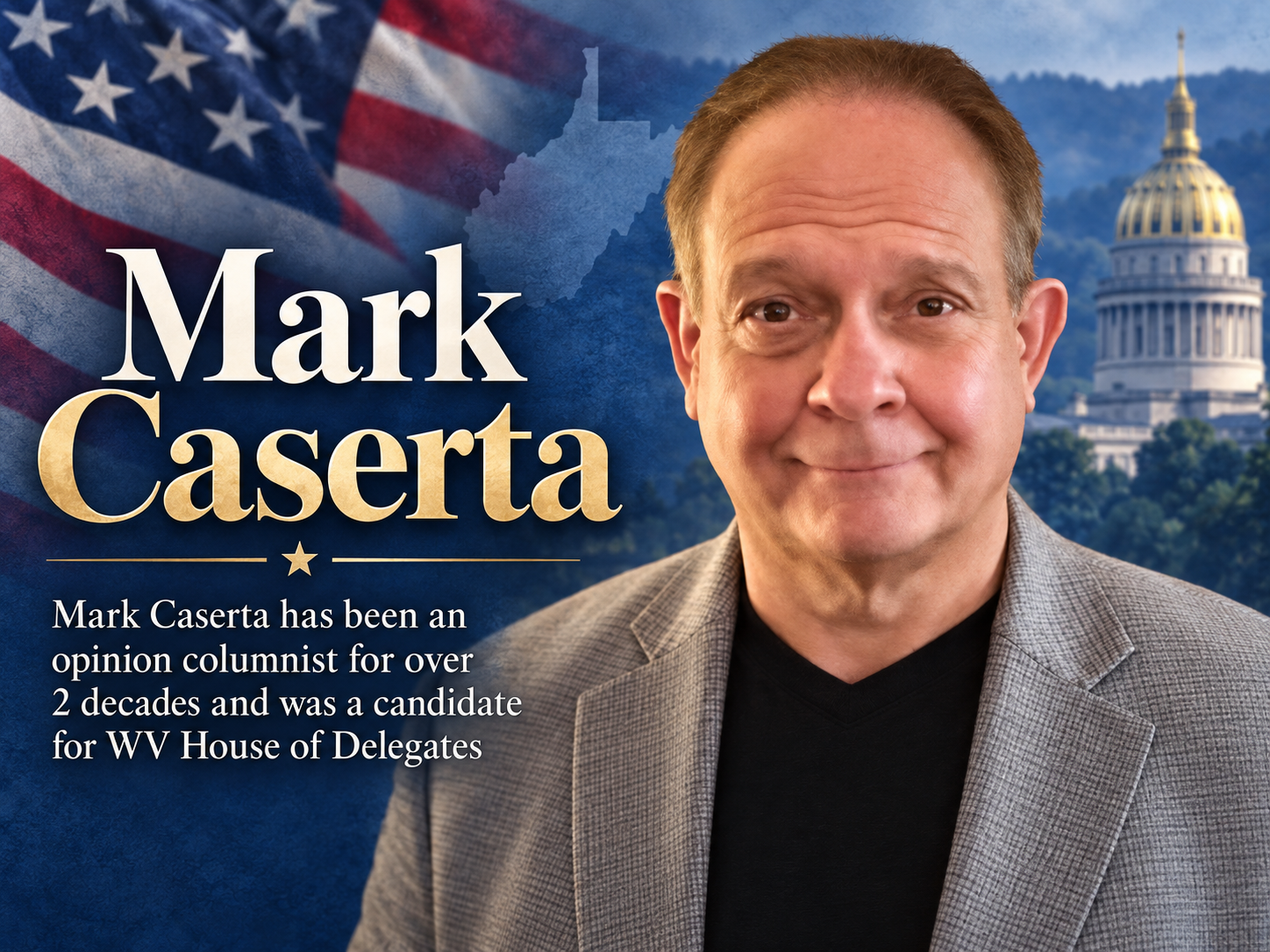
Mark Caserta has been an opinion columnist for 26 years and was candidate for WV House of Delegates in Wayne County in 2026


Many Americans—including many Christians—are literally giving their country away.

Get angry with me if you want, but don’t complain about what you permit to happen.

Voter apathy is killing our nation.

According to multiple sources, only about 75 percent of Christians are registered to vote. Remember, your vote is your voice.

Of those Christians who are registered, only an estimated 75 percent actually vote. That means, roughly speaking, only a little over 56 percent of those who identify as Christians cast a ballot. Turnout among the rest of the eligible voting population is even lower, which is equally troubling.

And that’s during a presidential election year. In off-year elections, voter participation drops even further.

Nearly every day, I talk with people who tell me they are sick of politics and have lost faith that their vote makes any difference.

Politicians bear a great deal of responsibility for that.

In a constitutional republic, elected officials work for the people. They are hired by the voters for one purpose: to represent their constituents.

Too many politicians have forgotten that. They say what they need to say to get elected, then spend their time advancing their own ideological agenda or that of their party’s leadership instead of faithfully representing the people who sent them to office.

So, how do we begin to change this?

I believe it starts with three simple steps:

1. Politicians must return to the foundational principle of our republic: represent the people who elected you—even when their views do not align perfectly with your own.

2. Congress should act to strengthen election integrity, including measures such as the SAVE Act, which supporters say would ensure that only American citizens vote in federal elections.

3. Every eligible voter—including every Christian—must study the candidates, make an informed decision, and vote.

Just as important, if your elected representative fails to do the job, fire them at the next election.

These ideas are not complicated. In fact, our Founding Fathers intentionally designed our system to be this straightforward.

I still believe there is hope for America.

But hope alone has never changed a nation.

Action does.

Mark Caserta: Unwarranted government surveillance under the guise of protection is only the beginning.

20 Jul

History records the progressive movement will use this foothold to advance their agenda!

My entire adult life, I have observed, studied, and written about the progressive movement. What began as a movement that many viewed as advancing society has, over time, evolved into an effort to transform society itself.

In 1973, the Supreme Court’s decision in Roe v. Wade recognized a constitutional right to abortion while also acknowledging limits intended to protect the health of the pregnant woman and what the Court described as “potential life.” Under the Court’s original framework, abortions after viability could generally be prohibited, except when necessary to protect the life or health of the mother.

Over the years, however, the national debate expanded dramatically. Controversial procedures, including what became known as “partial-birth abortion,” and even “live-birth abortions were performed, heinously murdering an innocent life.  The original decision was the catalyst for disaster.

The cultural shift did not stop there.

In the 1970s, network television was vastly different from what we see today. Sexual content was limited. Profanity was heavily restricted. Violence, while present, was generally restrained. Families could sit down together during prime time with a reasonable expectation that the programming would be suitable for everyone.

Today, I don’t need to describe how different things have become. What is now considered mainstream entertainment would have been unthinkable on network television in that era.

Likewise, legal and social debates surrounding LGBTQ issues have continued to evolve over the decades. Questions involving marriage, employment protections, military service, and gender identity have all developed on different timelines.

Today, we have biological males competing in women’s sports and having access to women’s locker rooms—issues that would have seemed unimaginable to many Americans just a generation ago.

The same pattern is emerging in another area that should concern every citizen: government surveillance.

The Fourth Amendment has protected Americans against unreasonable searches and seizures since 1791. Yet today, many progressives casually support warrantless camera systems, such as Flock cameras, that record and track the movements of law-abiding citizens without individualized suspicion.

Some argue that this type of surveillance is not specifically prohibited by the Fourth Amendment. But the Framers anticipated that future generations might attempt to narrow the people’s liberties by exploiting technicalities. That is precisely why they included the Ninth Amendment.

The Ninth Amendment makes clear that just because a right is not specifically listed in the Constitution does not mean the people do not possess that right. It was intended to prevent the federal government from claiming authority over every aspect of our lives simply because a particular liberty was not expressly enumerated.

This is how progressivism often advances. Change rarely comes all at once. It begins with policies that appear modest, reasonable, or even beneficial. Then the boundaries continue to move. What was once described as an exception becomes the norm. What was once considered unacceptable gradually becomes expected.

It’s the desensitization of Americans.

The objective is not merely to reform society but to redefine it.

There comes a point when every generation must decide whether it will preserve the principles it inherited or surrender them one compromise at a time.

For me, that decision is clear.

It is time to exercise common sense. It is time to stand for the enduring principles found in the Holy Bible and the Constitution of the United States. If we fail to defend them today, we should not be surprised to find that future generations no longer enjoy the freedoms we inherited.

How to Fight Deployment of Flock and Other Mass Surveillance License Plate Readers in Your Community | American Civil Liberties Union

Mark Caserta: The Price of Freedom

18 Jul

“Today, the threats to liberty do not come in the form of muskets and cannon fire, but they are very real.

They arrive quietly—through complacency, the steady erosion of constitutional freedoms, or the willingness to trade liberty for convenience, security, or political expediency.

Who are we to casually relinquish our freedoms brave men and women have died to protect?“

Young George Washington was suddenly awakened by the deafening roar of muskets and cannon fire. He had been unconscious, suffering from a severe case of dysentery, but the thunder of battle gave him the strength to rise and discover what was happening around him.

Having failed in his first military command against the French and their Native American allies, Washington had resigned his commission. Yet when the call came again, he volunteered to serve in any capacity he could, determined to do his part in defending the future of the New World.

Amid the thick powder smoke and chaos of battle, Washington mounted his horse to assess the situation.

“The battle is lost,” he was warned. “Turn back, Washington. Save yourself. It isn’t worth the risk.”

But George Washington knew his fellow soldiers were trapped on the front lines. He refused to abandon them. Instead, he spurred his horse toward the fiercest fighting, determined to lead from the front rather than seek safety in the rear.

History records that George Washington was remarkably protected that day. As bullets ripped through the air around him, he rode fearlessly across the battlefield, rallying frightened soldiers and helping as many as possible escape certain death. Though General Braddock’s army had been overwhelmed and the battle was ultimately lost, Washington’s courage prevented an even greater catastrophe.

With General Braddock mortally wounded and panic spreading through the ranks, Washington organized the retreat, encouraged his exhausted troops, and directed them to use the cover of the trees rather than continue fighting in the open. His calm leadership amid chaos saved countless lives and transformed what could have been a complete annihilation into an orderly withdrawal.

By the end of the battle, hundreds of brave men had sacrificed their lives at the Battle of the Monongahela, also known as Braddock’s Defeat. Yet George Washington emerged from the battlefield untouched, despite having two horses shot from beneath him and multiple bullet holes through his coat.

Many who witnessed the battle believed Divine Providence had preserved his life for a greater purpose—a purpose that would eventually lead him to command the Continental Army, guide a fledgling nation to independence, and become the first President of the United States.

Freedom has never been free. It never has been, and it never will be.

Our nation’s liberty was purchased with the courage, sacrifice, and blood of men and women who believed there were principles worth dying for. They understood that freedom is never guaranteed. It survives only when ordinary people are willing to stand against extraordinary odds.

George Washington could have turned his horse and ridden to safety. Instead, he rode into the battle.

That decision did more than save lives. It revealed the character of a man who would later lead a revolution and help establish the greatest experiment in self-government the world has ever known.

Every generation is called to defend freedom. Ours is no different. Who are we to casually relinquish our freedoms brave men and women have died to protect?

The question is not whether freedom will require sacrifice.

The question is whether we will have the courage to pay its price.

But given the right moves, even a pawn can take the King.