
For months, supporters of a closed Republican primary in West Virginia have raised a familiar concern: voters who are not Republicans could enter the Republican primary and attempt to influence which candidates the party nominates.
But if we are going to make policy based on that concern, we should examine the evidence without being distracted by emotion. It is easy to say — and perhaps even easy to believe — that Democrats, in large numbers, are using their primary vote to influence the eventual GOP nominee. The emotion resulting from even the thought of such voter malpractice is understandable and easily propagated.
But so far, I have found no documented evidence showing that large numbers of registered Democrats were crossing over into West Virginia Republican primaries for the purpose of manipulating Republican election outcomes.
Even before the GOP closed its primary, registered Democrats were not allowed simply to request a Republican ballot while remaining registered Democrats. They had to officially change their party affiliation to do so.
West Virginia’s Secretary of State says that voters registered with a recognized political party could vote only that party’s primary ballot. The voters who could request another participating party’s ballot were voters registered with no recognized party or unaffiliated status.
West Virginia law also allows each party to decide whether unaffiliated voters or voters of other non-recognized parties may participate in that party’s primary. That is different from allowing someone registered as a Democrat to vote a Republican ballot.
That distinction matters.
West Virginia election law permits voters to change their political-party registration. A voter may change parties by completing a new voter-registration application, and if that change is made at least 21 days before the election, the new affiliation applies to that primary.
What can be shown factually is that from January 2024 through April 2026, 16,910 registered Democrats switched their registration to Republican, while another 20,003 unaffiliated voters became Republicans. During that same period, only 2,399 Republicans switched to Democrat, according to the West Virginia Secretary of State’s Office.
So closing the Republican primary does not prevent someone who was previously registered as a Democrat from becoming a registered Republican and voting in the Republican primary.
What it does prevent is a constitutional conservative or independent-minded voter who remains unaffiliated from participating in that primary. And that affects a very large bloc of West Virginia voters.
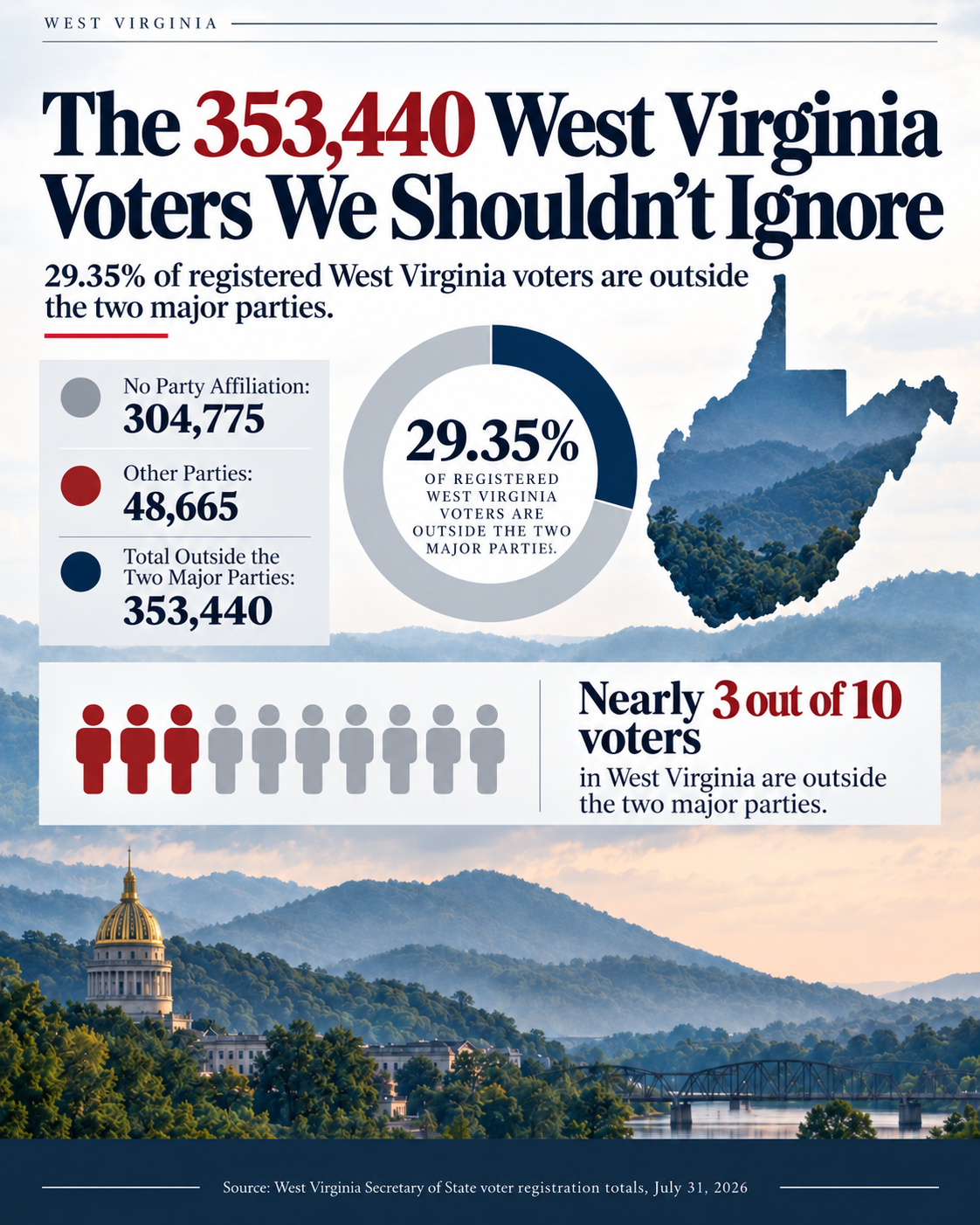
According to West Virginia Secretary of State registration data dated July 31, 2026, the state had 304,775 voters registered with no party affiliation and another 48,665 voters registered with other political parties, for a total of 353,440 West Virginia voters outside the two major parties.
That is 29.35 percent of the state’s electorate — nearly three out of every ten voters.
And there is another number that cannot simply be ignored.
When the 2026 Republican legislative primary is compared with the last non-presidential midterm primary in 2022, Republican vote totals across comparable House and Senate contests were a combined 46,795 votes lower.
That included 28,812 fewer votes in House races and 17,983 fewer votes in Senate races.
No one can say with certainty that all — or even most — of those missing votes came from unaffiliated voters who were no longer permitted to participate in the Republican primary. The election data do not allow us to make that claim.
But a decline of 46,795 votes is still a significant data point, and it deserves to be considered when evaluating the effects of closing the Republican primary.
That fact should be part of any serious discussion about the future of the Republican primary. Many of these voters have simply chosen principle over party.
Those numbers alone do not prove that closing the Republican primary caused lower turnout, but the fact remains that May primary turnout was just over 21 percent, which is concerning to say the least. What one may reasonably derive from such low turnout is that a significant number of West Virginians may not be enthusiastic about what they are getting from state government or from the political process generally.
Republicans must reach out to unaffiliated voters — not exclude them.
Closing the primary does not create an ideological test. It simply creates a registration test.
So, if the purpose of closing a primary is to prevent strategic voting, how effectively can it accomplish that when any eligible voter may change party registration before the deadline?
That includes registered Democrats.
The job of any political party is to establish a platform that voters can get behind, not limit participation only to those willing to walk 100 percent in lockstep with an ideology. Excluding hundreds of thousands of West Virginians who have chosen to remain outside the two major political parties may also reduce the incentive for Republican candidates to engage those voters during the primary process as potential constituents.
We must look at this issue pragmatically, set emotion aside, and consider the facts and evidence.
Unaffiliated voters must be considered part of West Virginia’s future and part of the future of constitutional conservatism.
Locking them out of the GOP primary is not a good way to start.

