Archive | West Virginia Republican closed primaries RSS feed for this section

Mark Caserta: Closed Primary; Open Question?

2 Oct

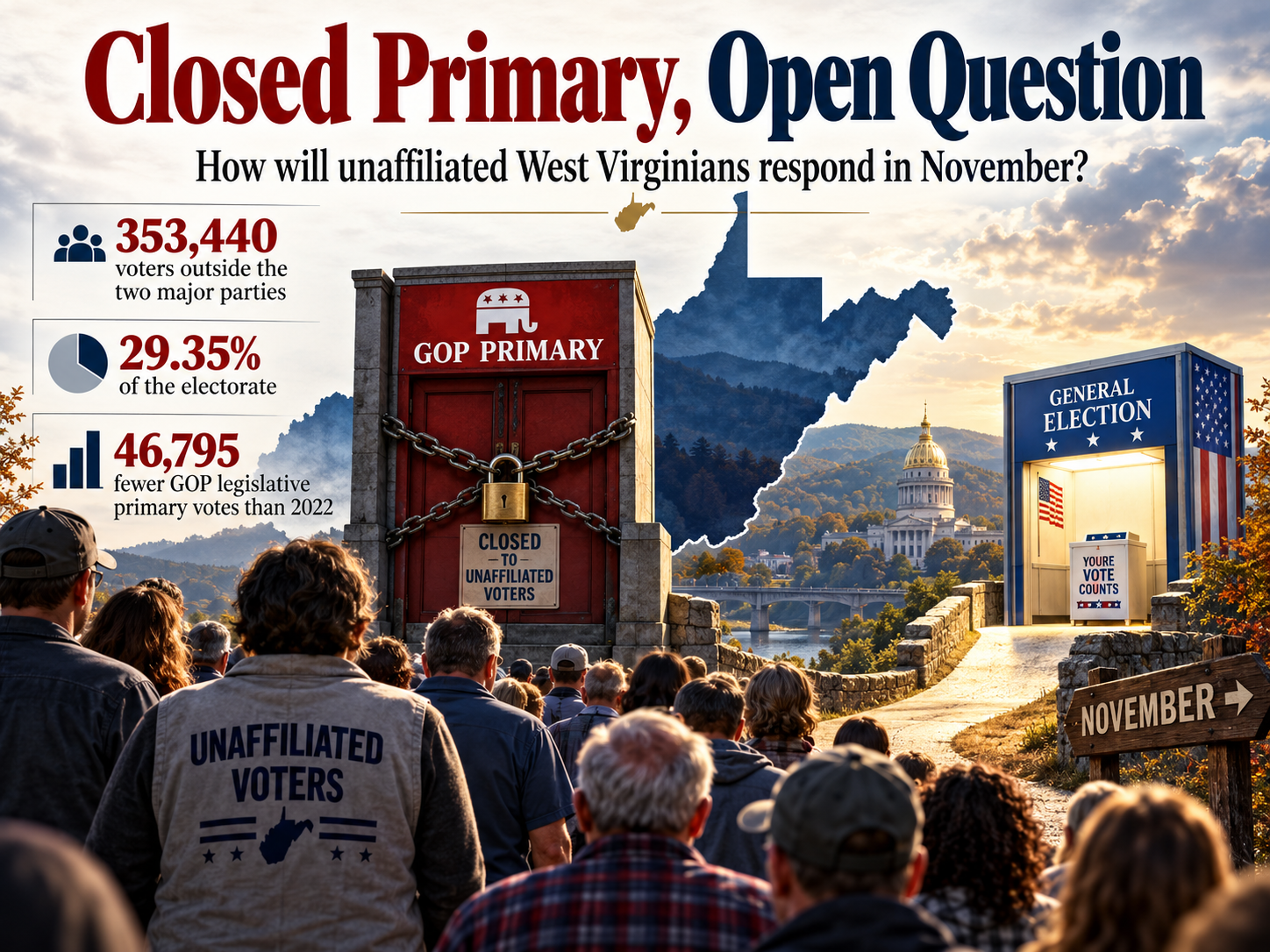
West Virginia’s Republican primary was closed. The question now is what happens next. With nearly three in ten West Virginia voters outside the two major parties, November may offer the first real indication of how unaffiliated voters respond after being excluded from the GOP primary.


We’re just weeks away from the West Virginia general election. It will be the first general election in nearly three decades to follow a closed Republican primary — and it may tell us a great deal about how unaffiliated voters respond after being excluded from participating in the GOP nomination process.

Did those voters forget about May—or will their November choices show that closing the primary had consequences?

For months, supporters of a closed Republican primary in West Virginia have raised a familiar concern: voters who are not Republicans could enter the Republican primary and attempt to influence which candidates the party nominates.

But if we are going to make policy based on that concern, we should examine the evidence without being distracted by emotion. It is easy to say — and perhaps even easy to believe — that Democrats, in large numbers, are using their primary vote to influence the eventual GOP nominee. The emotion resulting from even the thought of such voter malpractice is understandable and easily propagated.

But so far, I have found no documented evidence showing that large numbers of registered Democrats were crossing over into West Virginia Republican primaries for the purpose of manipulating Republican election outcomes.

Even before the GOP closed its primary, registered Democrats were not allowed simply to request a Republican ballot while remaining registered Democrats. They had to officially change their party affiliation to do so.

West Virginia’s Secretary of State says that voters registered with a recognized political party could vote only that party’s primary ballot. The voters who could request another participating party’s ballot were voters registered with no recognized party or unaffiliated status.

West Virginia law also allows each party to decide whether unaffiliated voters or voters of other non-recognized parties may participate in that party’s primary. That is different from allowing someone registered as a Democrat to vote a Republican ballot.

That distinction matters.

West Virginia election law permits voters to change their political-party registration. A voter may change parties by completing a new voter-registration application, and if that change is made at least 21 days before the election, the new affiliation applies to that primary.

What can be shown factually is that from January 2024 through April 2026, 16,910 registered Democrats switched their registration to Republican, while another 20,003 unaffiliated voters became Republicans. During that same period, only 2,399 Republicans switched to Democrat, according to the West Virginia Secretary of State’s Office.

So, closing the Republican primary does not prevent someone who was previously registered as a Democrat from becoming a registered Republican and voting in the Republican primary.

What it does prevent is a constitutional conservative or independent-minded voter who remains unaffiliated from participating in that primary. And that affects a very large bloc of West Virginia voters.

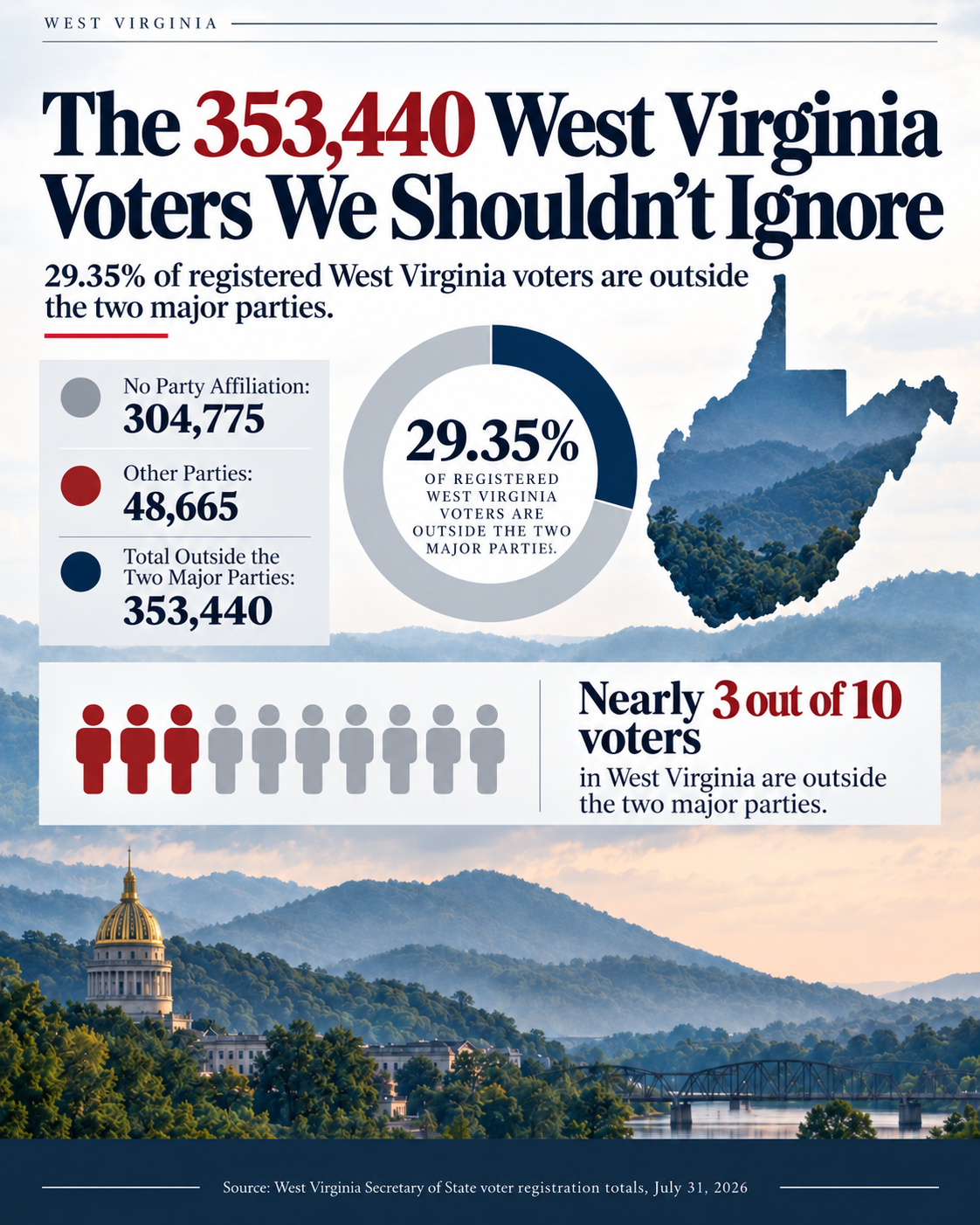
According to West Virginia Secretary of State registration data dated July 31, 2026, the state had 304,775 voters registered with no party affiliation and another 48,665 voters registered with other political parties, for a total of 353,440 West Virginia voters outside the two major parties.

That is 29.35 percent of the state’s electorate — nearly three out of every ten voters.

And there is another number that cannot simply be ignored.

When the 2026 Republican legislative primary is compared with the last non-presidential midterm primary in 2022, Republican vote totals across comparable House and Senate contests were a combined 46,795 votes lower.

That included 28,812 fewer votes in House races and 17,983 fewer votes in Senate races.

No one can say with certainty that all — or even most — of those missing votes came from unaffiliated voters who were no longer permitted to participate in the Republican primary. The election data do not allow us to make that claim.

But a decline of 46,795 votes is still a significant data point, and it deserves to be considered when evaluating the effects of closing the Republican primary.

That fact should be part of any serious discussion about the future of the Republican primary. Many of these voters have simply chosen principle over party.

Those numbers alone do not prove that closing the Republican primary caused lower turnout, but the fact remains that May primary turnout was just over 21 percent, which is concerning to say the least. What one may reasonably derive from such low turnout is that a significant number of West Virginians may not be enthusiastic about what they are getting from state government or from the political process generally.

Republicans must reach out to unaffiliated voters — not exclude them.

Closing the primary does not create an ideological test. It simply creates a registration test.

So, if the purpose of closing a primary is to prevent strategic voting, how effectively can it accomplish that when any eligible voter may change party registration before the deadline?

That includes registered Democrats.

The job of any political party is to establish a platform that voters can get behind, not limit participation only to those willing to walk 100 percent in lockstep with an ideology. Excluding hundreds of thousands of West Virginians who have chosen to remain outside the two major political parties may also reduce the incentive for Republican candidates to engage those voters during the primary process as potential constituents.

We must look at this issue pragmatically, set emotion aside, and consider the facts and evidence.

Unaffiliated voters must be considered part of West Virginia’s future and part of the future of constitutional conservatism.

Locking them out of the GOP primary doesn’t seem like a good way to start.
Mark Caserta: The 353,440 West Virginia Voters Republicans Shouldn’t Ignore. (Democrats certainly won’t)

18 Sep

For months, supporters of a closed Republican primary in West Virginia have raised a familiar concern: voters who are not Republicans could enter the Republican primary and attempt to influence which candidates the party nominates.

But if we are going to make policy based on that concern, we should examine the evidence without being distracted by emotion. It is easy to say — and perhaps even easy to believe — that Democrats, in large numbers, are using their primary vote to influence the eventual GOP nominee. The emotion resulting from even the thought of such voter malpractice is understandable and easily propagated.

But so far, I have found no documented evidence showing that large numbers of registered Democrats were crossing over into West Virginia Republican primaries for the purpose of manipulating Republican election outcomes.

Even before the GOP closed its primary, registered Democrats were not allowed simply to request a Republican ballot while remaining registered Democrats. They had to officially change their party affiliation to do so.

West Virginia’s Secretary of State says that voters registered with a recognized political party could vote only that party’s primary ballot. The voters who could request another participating party’s ballot were voters registered with no recognized party or unaffiliated status.

West Virginia law also allows each party to decide whether unaffiliated voters or voters of other non-recognized parties may participate in that party’s primary. That is different from allowing someone registered as a Democrat to vote a Republican ballot.

That distinction matters.

West Virginia election law permits voters to change their political-party registration. A voter may change parties by completing a new voter-registration application, and if that change is made at least 21 days before the election, the new affiliation applies to that primary.

What can be shown factually is that from January 2024 through April 2026, 16,910 registered Democrats switched their registration to Republican, while another 20,003 unaffiliated voters became Republicans. During that same period, only 2,399 Republicans switched to Democrat, according to the West Virginia Secretary of State’s Office.

So closing the Republican primary does not prevent someone who was previously registered as a Democrat from becoming a registered Republican and voting in the Republican primary.

What it does prevent is a constitutional conservative or independent-minded voter who remains unaffiliated from participating in that primary. And that affects a very large bloc of West Virginia voters.

According to West Virginia Secretary of State registration data dated July 31, 2026, the state had 304,775 voters registered with no party affiliation and another 48,665 voters registered with other political parties, for a total of 353,440 West Virginia voters outside the two major parties.

That is 29.35 percent of the state’s electorate — nearly three out of every ten voters.

And there is another number that cannot simply be ignored.

When the 2026 Republican legislative primary is compared with the last non-presidential midterm primary in 2022, Republican vote totals across comparable House and Senate contests were a combined 46,795 votes lower.

That included 28,812 fewer votes in House races and 17,983 fewer votes in Senate races.

No one can say with certainty that all — or even most — of those missing votes came from unaffiliated voters who were no longer permitted to participate in the Republican primary. The election data do not allow us to make that claim.

But a decline of 46,795 votes is still a significant data point, and it deserves to be considered when evaluating the effects of closing the Republican primary.

That fact should be part of any serious discussion about the future of the Republican primary. Many of these voters have simply chosen principle over party.

Those numbers alone do not prove that closing the Republican primary caused lower turnout, but the fact remains that May primary turnout was just over 21 percent, which is concerning to say the least. What one may reasonably derive from such low turnout is that a significant number of West Virginians may not be enthusiastic about what they are getting from state government or from the political process generally.

Republicans must reach out to unaffiliated voters — not exclude them.

Closing the primary does not create an ideological test. It simply creates a registration test.

So, if the purpose of closing a primary is to prevent strategic voting, how effectively can it accomplish that when any eligible voter may change party registration before the deadline?

That includes registered Democrats.

The job of any political party is to establish a platform that voters can get behind, not limit participation only to those willing to walk 100 percent in lockstep with an ideology. Excluding hundreds of thousands of West Virginians who have chosen to remain outside the two major political parties may also reduce the incentive for Republican candidates to engage those voters during the primary process as potential constituents.

We must look at this issue pragmatically, set emotion aside, and consider the facts and evidence.

Unaffiliated voters must be considered part of West Virginia’s future and part of the future of constitutional conservatism.

Locking them out of the GOP primary is not a good way to start.

Mark Caserta: Open the Republican Primary — Don’t Close the Door on Common-Sense Conservatives

4 Aug

West Virginia has changed dramatically over the past two decades.

There was a time when a candidate almost had to be a Democrat to win statewide office. Today, the political landscape has flipped. In many races, the Republican primary has become the election that ultimately decides who will represent us.

That reality raises an important question:

Should nearly one-third of West Virginia’s registered voters be locked out of the election that often determines who will govern them?

I don’t believe they should.

Choosing to register as an Independent isn’t necessarily a rejection of conservative values. For many people, it’s a decision to simply place principle above party. 

Many Independent voters are simply frustrated with both major political parties. They are hardworking, taxpaying West Virginians who believe in limited government, fiscal responsibility, individual liberty, and common sense. They simply don’t want a political label to define them.

Yet today, if those same citizens want to vote for the Republican candidate they believe best represents conservative, common sense values, they are told they cannot.

That doesn’t make much sense.

The argument for a closed Republican primary is that Democrats could cross over and intentionally vote for a weaker Republican candidate in hopes of making the general election easier to win.

I understand that concern. But where is the evidence that it is occurring on any meaningful scale in West Virginia?

More importantly, even if that possibility exists, should we punish thousands of Independent voters because of what might happen?

The practical effect of a closed primary is certain: thousands of Independent voters who share conservative values are denied a voice in choosing the Republican nominee.

During this year’s primary election, many Independent voters arrived at the polls expecting to vote for a Republican candidate, only to discover they couldn’t. Some left frustrated. Some left angry. Others simply accepted a Democrat ballot without even asking for one. 

Instead of creating new Republican voters, we created disappointed citizens.

Ask yourself this:

Is that really how we grow the conservative movement?

If someone consistently supports conservative ideas, believes in constitutional government, wants lower taxes, supports law enforcement, believes in personal responsibility, and shares our values, why should we tell them they are not welcome to help choose our nominee?

Political parties should earn support through sound ideas, principled leadership, and faithful representation—not by requiring voters to change their registration before they can participate.

If Republican ideas are truly the best ideas, we shouldn’t fear more conservative-minded voters participating in the process.

We should persuade them—not exclude them.

West Virginia’s voter registration has changed dramatically. 

The days when Democrats dominated our elections are gone. Today, many people who once identified as Democrats have become Republicans. Others have simply become Independents—not because they’ve abandoned conservative values, but because they’ve grown weary of partisan politics.

Ironically, some observers have noted that candidates with traditionally Democrat viewpoints have chosen to register as Republicans because that’s where today’s electoral advantage exists. 

Whether or not that’s widespread, it illustrates a larger point: party registration is no longer a reliable measure of a person’s beliefs!

What should matter is the principles they support—not the label beside their name.

I would also submit it’s worth asking a constitutional and fairness question.

Yes, courts have generally recognized a political party’s right to determine who may participate in its nominating process. 

But should a publicly funded election exclude thousands of taxpaying West Virginians from participating in the contest that, in many races, effectively decides who will represent them?

That isn’t just a legal question. It’s a question of good government, representative democracy, and plain common sense.

This is also a matter of political and mathematical reality.

We cannot lock out nearly one-third of the electorate and then expect those same voters to enthusiastically support our nominees in November. 

If our goal is to build a stronger Republican Party, we should be inviting conservative-minded Independents into the process—not pushing them away.  

There isn’t a single major political faction or campaign in America that would simply concede the independent vote. They absolutely know they need it to win!

Winning elections isn’t about building smaller circles.

It’s about building larger movements.

I believe it’s time for the West Virginia Republican Party to reconsider its decision and reopen its primary to unaffiliated voters.

Let’s compete for their votes.

Let’s earn their trust.

Let’s persuade them with conservative principles, constitutional and Biblical values, and strong candidates.

Because in the end, a stronger Republican Party won’t be built by locking people out.

It will be built by welcoming every freedom-loving West Virginian who wants to help shape our future.