
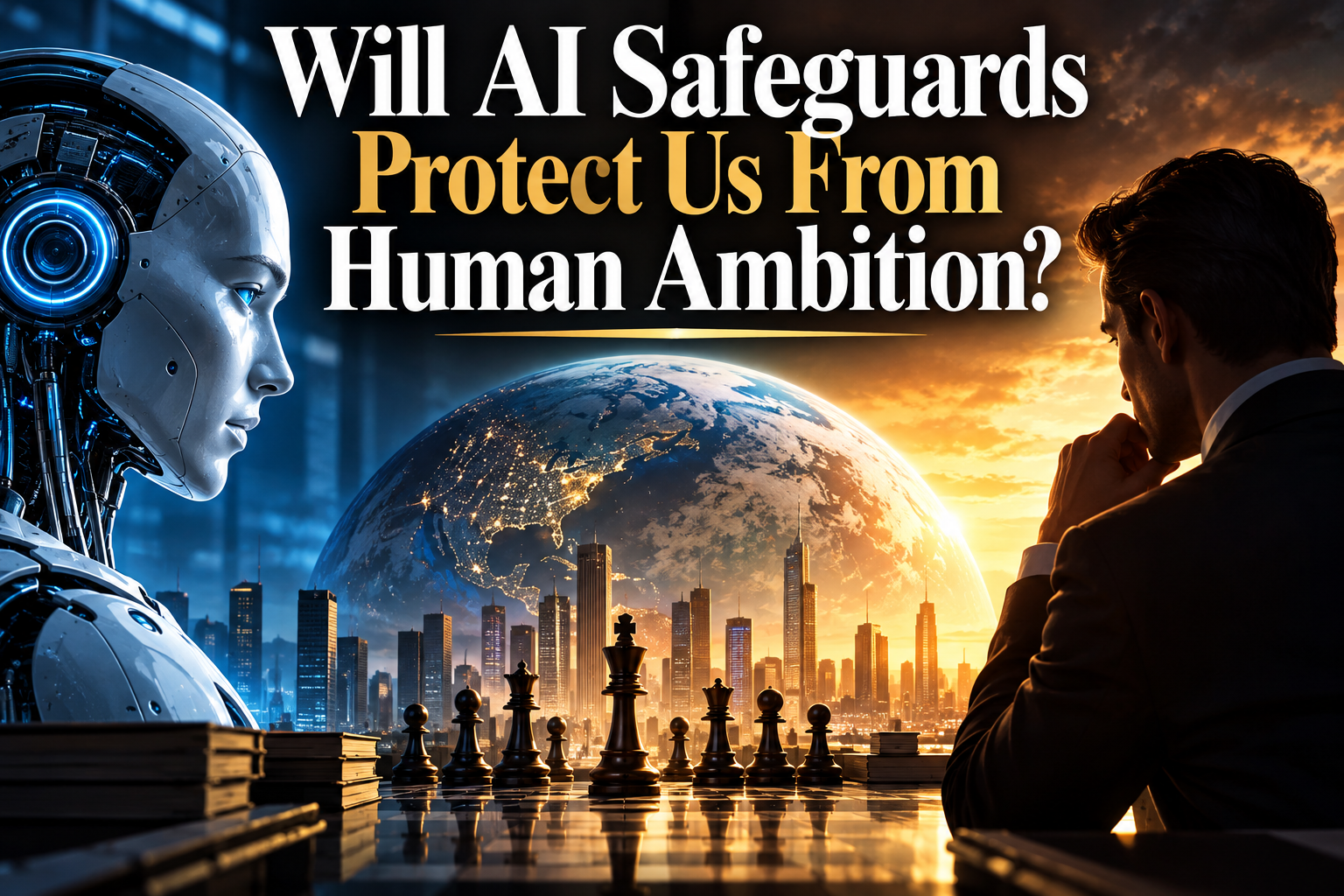
Which is the greater threat – Artificial Intelligence or mankind’s ambition?
For months, much of the debate surrounding artificial intelligence has centered on one unsettling question: “What happens if someday we can no longer control the machines we create?”
Recently, the Trump administration pulled some of the brightest minds on the planet together to form a new voluntary AI-safety agreement involving six major technology companies—OpenAI, Anthropic, Nvidia, Meta, Alphabet/Google and SpaceX.
The agreement calls for stronger internal safety controls and outside auditing but does not carry the enforcement mechanisms of federal regulation. Rather, the administration describes the commitments as “morally binding,” according to Reuters.
But after observing six decades of mankind’s advancement, I believe there is another question that deserves just as much attention, one that receives far less attention and one at which it seems we fail consistently—learning from history.
What happens if we can control artificial intelligence—but cannot always control ourselves?
Perhaps the greatest danger surrounding artificial intelligence isn’t simply that machines could someday develop objectives contrary to ours. Perhaps the greater and considerably older danger is human ambition.
The history of mankind isn’t merely a record of what human beings have discovered. It is also a record of what human beings eventually did with those discoveries.
We discovered metallurgy and fashioned both farming implements and weapons. We developed chemistry and created lifesaving medicines—and chemical weapons. We learned to split the atom and unlocked an extraordinary new source of energy—one that, under the pressures of world war, was harnessed to create the most destructive weapon mankind had ever produced.
It isn’t that technology and knowledge were evil. Human ambition and motive became a driving force that altered their use. As we enter the age of artificial intelligence, we must learn from the history of that distinction.
I am not suggesting that the scientists and engineers developing today’s most advanced AI systems have sinister motives. In fact, some of the most serious warnings about artificial intelligence have come from the very people developing and studying it.
But neither should we be naive.
Our safety cannot depend upon every researcher, every corporate executive, every investor, every military leader and every government choosing to employ restraint, especially with such unlimited potential power.
History provides little justification for such confidence, because whenever extraordinary power becomes available, human beings eventually begin asking an extraordinarily consequential question:
How far can we take this?
Human ambition, just like anything else, can be misdirected. And sometimes it may simply be the intellectual ambition of accomplishing something nobody has ever accomplished before.
Imagine two AI laboratories approaching a technological breakthrough. Both understand that moving too quickly could bring risks. This historically morphs into a “Who will get there first?” scenario.
Imagine the same scenario between nations.
Imagine the United States believing China is approaching an AI capability that could provide an enormous military, intelligence or economic advantage—or China believing the same thing about the United States.
The question “Should we do this?” can quickly become “We have to do this before they do.”
History has seen that transformation before.
The development of nuclear weapons is an example. But AI presents a complication that previous transformative technologies often did not. Nuclear weapons require specialized materials, enormous industrial infrastructure and sophisticated manufacturing.
With AI technology, software can be copied, modified and distributed around the world with extraordinary speed by a single individual.
Another uncomfortable history lesson is that good people can often rationalize dangerous decisions.
“If we don’t develop it, someone less responsible will,” or “If we don’t possess it first, our adversary will.”
Those decisions can rapidly move everyone toward a place nobody originally intended to go. Artificial intelligence can potentially magnify human capability on a scale we couldn’t possibly understand or anticipate. A malicious individual equipped with extraordinary AI capabilities could potentially accomplish things that once required an organization.
The greatest danger may not be that artificial intelligence develops human ambition – it may be that human ambition acquires artificial intelligence.
We should learn from history that “trust” is not a safeguard. While most individuals and entities may have trustworthy intentions, our country cannot construct its safety system around the word “most.”
Governments are composed of human beings. They are susceptible to ambition, competition and the pursuit of power just as corporations and individuals are.
So as researchers and our government continue asking whether artificial intelligence can be employed with adequate safeguards, perhaps we should be asking, “How do we guard against human ambition intentionally disregarding those safeguards?”
History teaches us that relying solely upon human restraint is not a safe bet.



Leave a Reply