Tag Archives: elections

Mark Caserta: Closed Primary; Open Question?

2 Oct

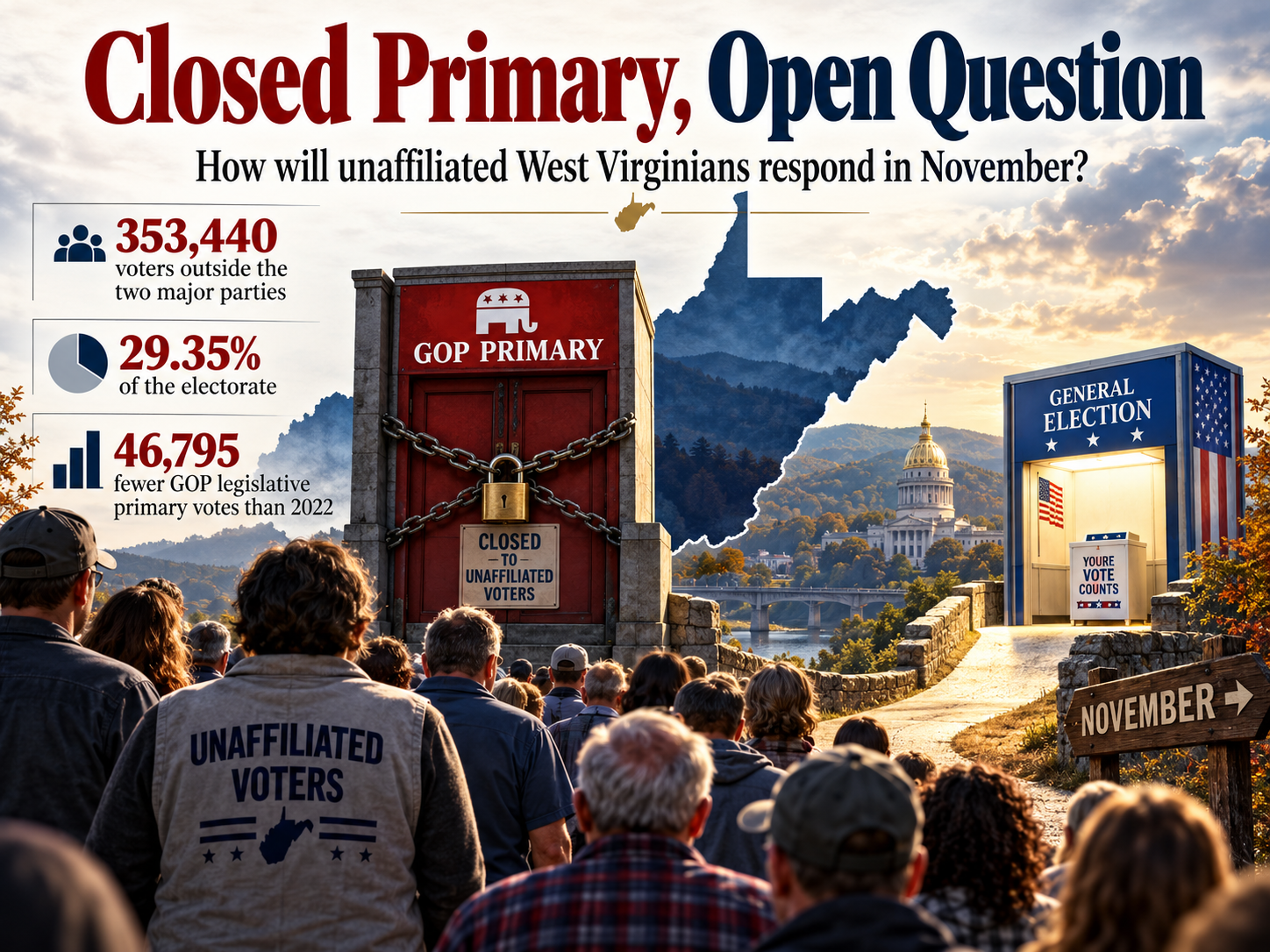
West Virginia’s Republican primary was closed. The question now is what happens next. With nearly three in ten West Virginia voters outside the two major parties, November may offer the first real indication of how unaffiliated voters respond after being excluded from the GOP primary.


We’re just weeks away from the West Virginia general election. It will be the first general election in nearly three decades to follow a closed Republican primary — and it may tell us a great deal about how unaffiliated voters respond after being excluded from participating in the GOP nomination process.

Did those voters forget about May—or will their November choices show that closing the primary had consequences?

For months, supporters of a closed Republican primary in West Virginia have raised a familiar concern: voters who are not Republicans could enter the Republican primary and attempt to influence which candidates the party nominates.

But if we are going to make policy based on that concern, we should examine the evidence without being distracted by emotion. It is easy to say — and perhaps even easy to believe — that Democrats, in large numbers, are using their primary vote to influence the eventual GOP nominee. The emotion resulting from even the thought of such voter malpractice is understandable and easily propagated.

But so far, I have found no documented evidence showing that large numbers of registered Democrats were crossing over into West Virginia Republican primaries for the purpose of manipulating Republican election outcomes.

Even before the GOP closed its primary, registered Democrats were not allowed simply to request a Republican ballot while remaining registered Democrats. They had to officially change their party affiliation to do so.

West Virginia’s Secretary of State says that voters registered with a recognized political party could vote only that party’s primary ballot. The voters who could request another participating party’s ballot were voters registered with no recognized party or unaffiliated status.

West Virginia law also allows each party to decide whether unaffiliated voters or voters of other non-recognized parties may participate in that party’s primary. That is different from allowing someone registered as a Democrat to vote a Republican ballot.

That distinction matters.

West Virginia election law permits voters to change their political-party registration. A voter may change parties by completing a new voter-registration application, and if that change is made at least 21 days before the election, the new affiliation applies to that primary.

What can be shown factually is that from January 2024 through April 2026, 16,910 registered Democrats switched their registration to Republican, while another 20,003 unaffiliated voters became Republicans. During that same period, only 2,399 Republicans switched to Democrat, according to the West Virginia Secretary of State’s Office.

So, closing the Republican primary does not prevent someone who was previously registered as a Democrat from becoming a registered Republican and voting in the Republican primary.

What it does prevent is a constitutional conservative or independent-minded voter who remains unaffiliated from participating in that primary. And that affects a very large bloc of West Virginia voters.

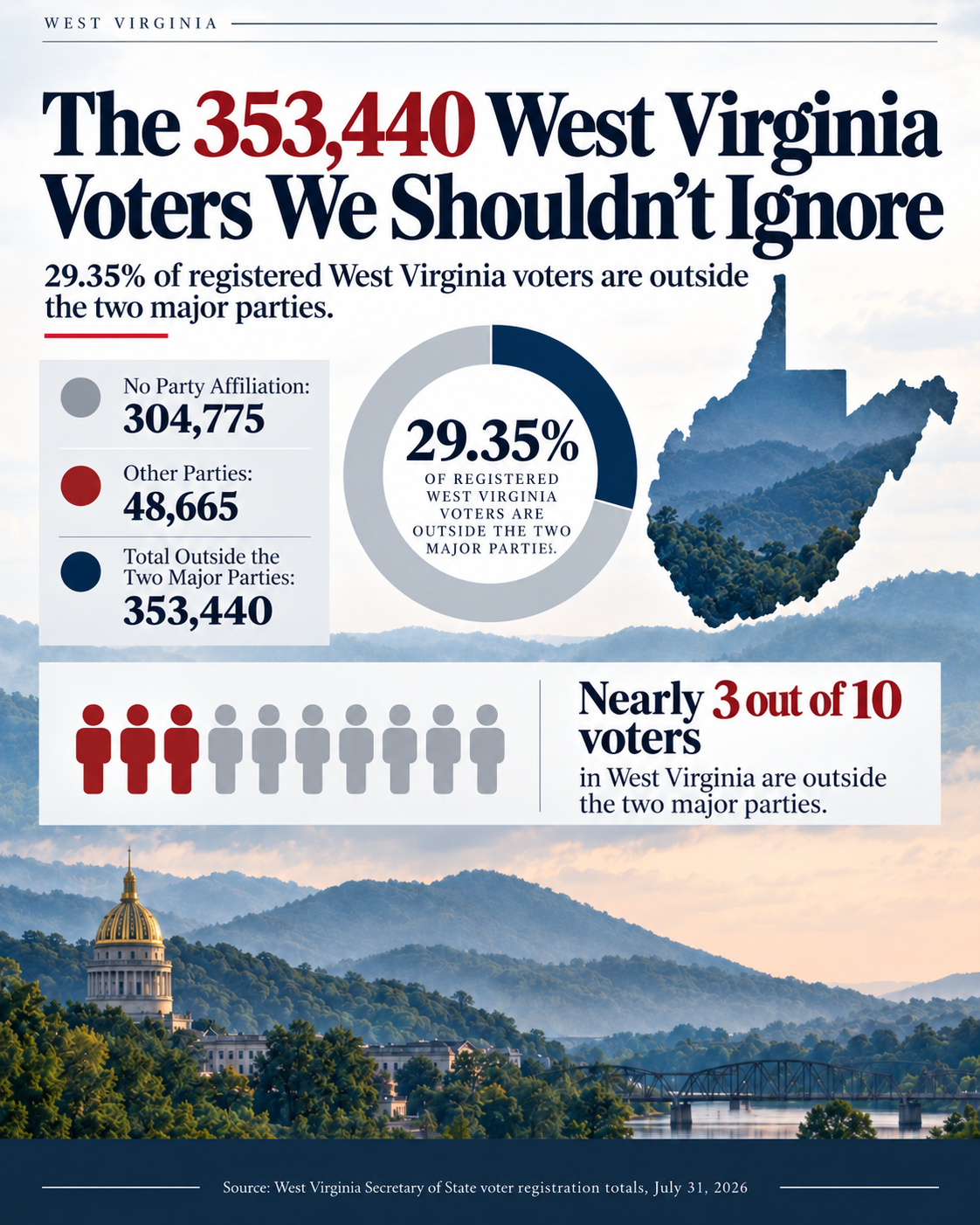
According to West Virginia Secretary of State registration data dated July 31, 2026, the state had 304,775 voters registered with no party affiliation and another 48,665 voters registered with other political parties, for a total of 353,440 West Virginia voters outside the two major parties.

That is 29.35 percent of the state’s electorate — nearly three out of every ten voters.

And there is another number that cannot simply be ignored.

When the 2026 Republican legislative primary is compared with the last non-presidential midterm primary in 2022, Republican vote totals across comparable House and Senate contests were a combined 46,795 votes lower.

That included 28,812 fewer votes in House races and 17,983 fewer votes in Senate races.

No one can say with certainty that all — or even most — of those missing votes came from unaffiliated voters who were no longer permitted to participate in the Republican primary. The election data do not allow us to make that claim.

But a decline of 46,795 votes is still a significant data point, and it deserves to be considered when evaluating the effects of closing the Republican primary.

That fact should be part of any serious discussion about the future of the Republican primary. Many of these voters have simply chosen principle over party.

Those numbers alone do not prove that closing the Republican primary caused lower turnout, but the fact remains that May primary turnout was just over 21 percent, which is concerning to say the least. What one may reasonably derive from such low turnout is that a significant number of West Virginians may not be enthusiastic about what they are getting from state government or from the political process generally.

Republicans must reach out to unaffiliated voters — not exclude them.

Closing the primary does not create an ideological test. It simply creates a registration test.

So, if the purpose of closing a primary is to prevent strategic voting, how effectively can it accomplish that when any eligible voter may change party registration before the deadline?

That includes registered Democrats.

The job of any political party is to establish a platform that voters can get behind, not limit participation only to those willing to walk 100 percent in lockstep with an ideology. Excluding hundreds of thousands of West Virginians who have chosen to remain outside the two major political parties may also reduce the incentive for Republican candidates to engage those voters during the primary process as potential constituents.

We must look at this issue pragmatically, set emotion aside, and consider the facts and evidence.

Unaffiliated voters must be considered part of West Virginia’s future and part of the future of constitutional conservatism.

Locking them out of the GOP primary doesn’t seem like a good way to start.
Mark Caserta: The 353,440 West Virginia Voters Republicans Shouldn’t Ignore. (Democrats certainly won’t)

18 Sep

For months, supporters of a closed Republican primary in West Virginia have raised a familiar concern: voters who are not Republicans could enter the Republican primary and attempt to influence which candidates the party nominates.

But if we are going to make policy based on that concern, we should examine the evidence without being distracted by emotion. It is easy to say — and perhaps even easy to believe — that Democrats, in large numbers, are using their primary vote to influence the eventual GOP nominee. The emotion resulting from even the thought of such voter malpractice is understandable and easily propagated.

But so far, I have found no documented evidence showing that large numbers of registered Democrats were crossing over into West Virginia Republican primaries for the purpose of manipulating Republican election outcomes.

Even before the GOP closed its primary, registered Democrats were not allowed simply to request a Republican ballot while remaining registered Democrats. They had to officially change their party affiliation to do so.

West Virginia’s Secretary of State says that voters registered with a recognized political party could vote only that party’s primary ballot. The voters who could request another participating party’s ballot were voters registered with no recognized party or unaffiliated status.

West Virginia law also allows each party to decide whether unaffiliated voters or voters of other non-recognized parties may participate in that party’s primary. That is different from allowing someone registered as a Democrat to vote a Republican ballot.

That distinction matters.

West Virginia election law permits voters to change their political-party registration. A voter may change parties by completing a new voter-registration application, and if that change is made at least 21 days before the election, the new affiliation applies to that primary.

What can be shown factually is that from January 2024 through April 2026, 16,910 registered Democrats switched their registration to Republican, while another 20,003 unaffiliated voters became Republicans. During that same period, only 2,399 Republicans switched to Democrat, according to the West Virginia Secretary of State’s Office.

So closing the Republican primary does not prevent someone who was previously registered as a Democrat from becoming a registered Republican and voting in the Republican primary.

What it does prevent is a constitutional conservative or independent-minded voter who remains unaffiliated from participating in that primary. And that affects a very large bloc of West Virginia voters.

According to West Virginia Secretary of State registration data dated July 31, 2026, the state had 304,775 voters registered with no party affiliation and another 48,665 voters registered with other political parties, for a total of 353,440 West Virginia voters outside the two major parties.

That is 29.35 percent of the state’s electorate — nearly three out of every ten voters.

And there is another number that cannot simply be ignored.

When the 2026 Republican legislative primary is compared with the last non-presidential midterm primary in 2022, Republican vote totals across comparable House and Senate contests were a combined 46,795 votes lower.

That included 28,812 fewer votes in House races and 17,983 fewer votes in Senate races.

No one can say with certainty that all — or even most — of those missing votes came from unaffiliated voters who were no longer permitted to participate in the Republican primary. The election data do not allow us to make that claim.

But a decline of 46,795 votes is still a significant data point, and it deserves to be considered when evaluating the effects of closing the Republican primary.

That fact should be part of any serious discussion about the future of the Republican primary. Many of these voters have simply chosen principle over party.

Those numbers alone do not prove that closing the Republican primary caused lower turnout, but the fact remains that May primary turnout was just over 21 percent, which is concerning to say the least. What one may reasonably derive from such low turnout is that a significant number of West Virginians may not be enthusiastic about what they are getting from state government or from the political process generally.

Republicans must reach out to unaffiliated voters — not exclude them.

Closing the primary does not create an ideological test. It simply creates a registration test.

So, if the purpose of closing a primary is to prevent strategic voting, how effectively can it accomplish that when any eligible voter may change party registration before the deadline?

That includes registered Democrats.

The job of any political party is to establish a platform that voters can get behind, not limit participation only to those willing to walk 100 percent in lockstep with an ideology. Excluding hundreds of thousands of West Virginians who have chosen to remain outside the two major political parties may also reduce the incentive for Republican candidates to engage those voters during the primary process as potential constituents.

We must look at this issue pragmatically, set emotion aside, and consider the facts and evidence.

Unaffiliated voters must be considered part of West Virginia’s future and part of the future of constitutional conservatism.

Locking them out of the GOP primary is not a good way to start.

Mark Caserta: Pew Research Poll Supports Case for Open Primaries

14 Sep

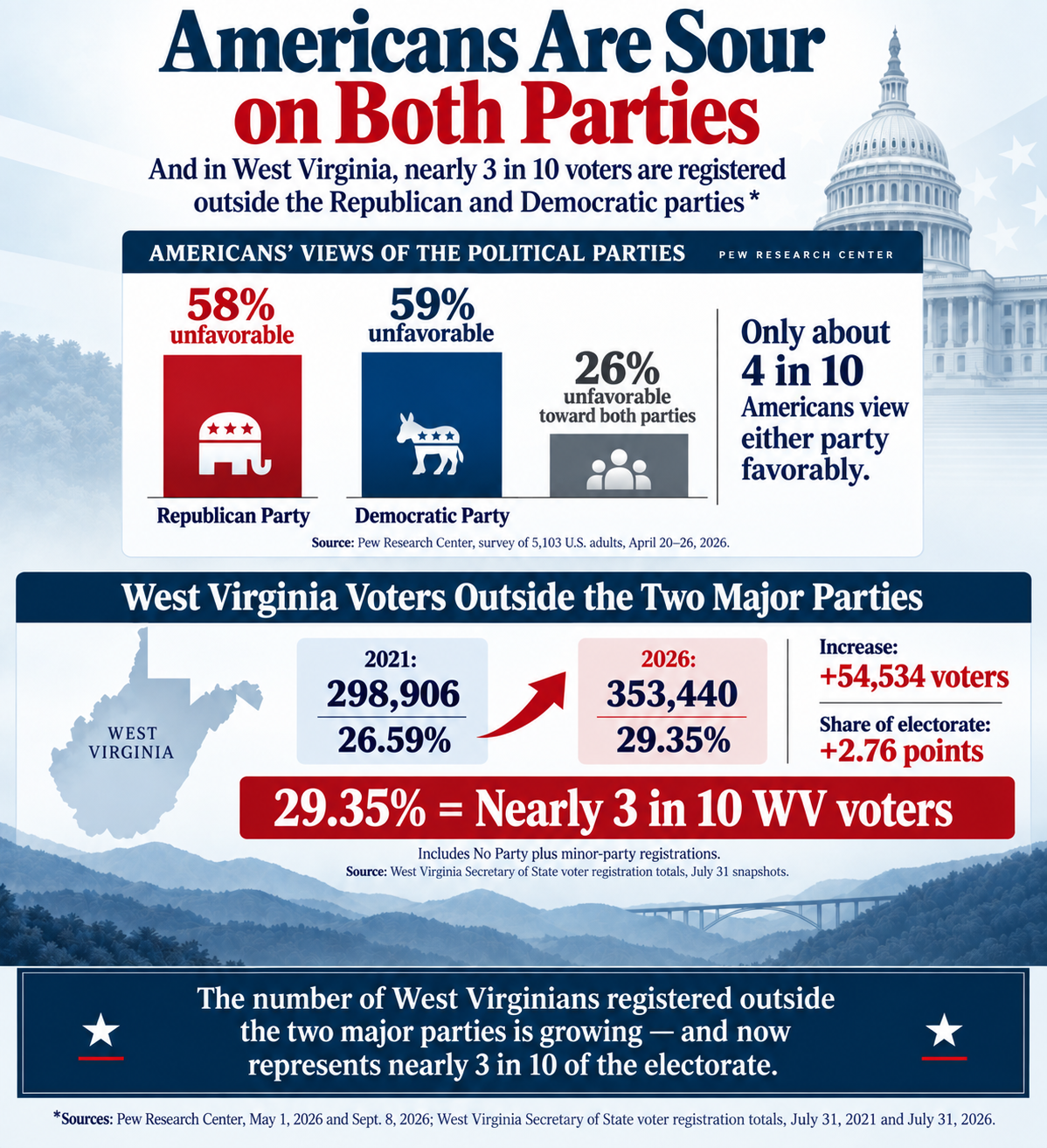
According to 2026 polling from the Pew Research Center, 58% of Americans have an unfavorable view of the Republican Party, while 59% have an unfavorable view of the Democratic Party.

Only about four in ten Americans view either party favorably.

Even more striking, 26% of Americans — more than one out of every four — hold unfavorable views of both political parties. That number has risen from 21% in 2020.

The poll also showed that people who formally identify with a political party generally still like their own party. No real surprise there.

Among Republican identifiers, 89% view the GOP favorably, while 84% of Democratic identifiers view the Democratic Party favorably.

But here is the takeaway.

Among independents who merely lean toward one of the two parties, enthusiasm drops dramatically.

Only 54% of Republican-leaning independents view the GOP favorably, while just 52% of Democratic-leaning independents view the Democratic Party favorably.

Pew’s September 8 analysis reinforces that disconnect.

Among Republicans and Republican-leaning independents combined, 75% view their own party favorably and 24% unfavorably. Among Democrats and Democratic-leaning independents, 70% view their party favorably and 30% unfavorably.

The underlying survey was conducted April 20–26 among 5,103 U.S. adults.

So, the simplest way to state Pew’s findings is this:

Republican Party: 58% unfavorable.

Democratic Party: 59% unfavorable.

Both parties unfavorable: 26%.

That last number should get the attention of political leaders in both parties.

More than one in four Americans now holds an unfavorable opinion of both major political parties.

Pew’s numbers do not establish why individual voters choose to register outside the two major parties. But they do demonstrate something unmistakable: dissatisfaction with America’s political parties is substantial.

And that brings us to West Virginia.

The political dynamics in our state are changing.

Increasing numbers of voters are choosing to remain outside the Republican and Democratic parties. Whatever their individual reasons, many clearly do not believe a party label is necessary to determine their principles or values.

The numbers don’t lie.

West Virginia voters registered outside the Republican and Democratic parties

  • 2021: 298,906 — 26.59%
  • 2026: 353,440 — 29.35%
  • Increase: 54,534 voters
  • Percentage increase: approximately 18.2%
  • Share of the electorate: up 2.76 percentage points

There is an important distinction here.

These figures do not mean that 29.35% of West Virginia voters are technically registered as “No Party.”

In 2021, the 298,906 voters outside the two major parties included 250,961 registered as No Party and another 47,945 registered Mountain, Libertarian or Other.

The same distinction applies today: the 29.35% represents all West Virginia voters registered outside the Republican and Democratic parties.

But that distinction does not diminish the significance of the trend.

Five years ago, 26.59% of West Virginia voters were registered outside the two major parties.

Today, that figure has risen to 29.35% nearly three out of every ten registered voters in West Virginia.

That should matter greatly to the West Virginia Republican Party as it considers the future of its primary.

The 2026 election was the first West Virginia primary in nearly three decades in which unaffiliated voters were prohibited from participating in the Republican primary. The Republican State Executive Committee made the decision to close the primary, while the Democratic Party continued to allow unaffiliated voters to participate in its primary.

If the Republican State Executive Committee maintains a closed primary in 2028, voters who are not registered Republicans will again be unable to participate in choosing Republican nominees unless they first change their registration.

That policy deserves serious reconsideration.

Supporters of closing the Republican primary have raised concerns that voters who are not Republicans could cross over and attempt to influence which Republican candidates are nominated.

That concern deserves to be heard.

But so does the other side of the equation.

West Virginia now has 353,440 registered voters outside the Republican and Democratic parties — 29.35% of the electorate.

The number has increased by more than 54,000 in just five years.

At the same time, national polling shows significant dissatisfaction with both major political parties, particularly among voters who identify as independents but lean toward one party or the other.

These trends should not be ignored.

Political parties can protect their identity and principles without assuming that every voter who refuses to wear the party label is hostile to those principles.

Many West Virginians may agree with Republican candidates on limited government, constitutional rights, fiscal responsibility, energy independence, religious liberty and other traditionally conservative principles while choosing not to register Republican.

Those voters should not simply be written off.

West Virginia’s political landscape is changing before our eyes.

Nearly three out of every ten registered voters now stand outside the two major political parties.

The Republican Party has a choice: require those voters to adopt the party label before allowing them a voice in its primary — or give them an opportunity to participate and make the case that Republican principles deserve their support.

For the future of West Virginia, I believe the better course is clear:

Re-open the Republican Primary in 2028.

Mark Caserta: Politicians should constrain themselves to representation, not personal ideology.

13 May

Mark Caserta is a resident of Wayne County, WV. and has been a conservative columnist for 25 years.


While many so-called politicians have forgotten their primary duty of representation, the Democrat Party has one foot in the grave and the other on thin ice when it comes to maintaining their legitimacy.

It is unfathomable that in our Republic form of government, (in which citizens vote for individuals whose job is solely to represent their constituents in government) the so-called “representatives” would choose to represent the 20 percent “radical” ideology of an issue rather than the clear majority of voters!

These are the current “hills” Democrats have been willing to die on! It is quite remarkable when you tally all of the lunacy!

Democrats support open borders – period. Come one, come all. Just be sure you vote for the hand that feeds you with taxpayer dollars. They are willing to provide housing, healthcare and all the amenities for anyone willing to come to the U.S. and help keep them in power.

Democrats are against requiring any proof of citizenship prior to being allowed to vote. Why? The answer, once again, can only be they want illegals to be complicit in their fight to stay in power.

Democrats fight for the rights of illegal aliens, to include terrorist groups like MS-13 and Tren de Aragua while absolutely ignoring the rights of American citizens, such as Rachael Morin, Laken Riley, Jocelyn Nungaray, each horrifically murdered by illegals in our country. Liberal Democrats refuse to even mention their names in the conversation.

Democrats are against the deportation of criminal illegal aliens and have even traveled to El Salvador in an attempt to initiate the return of one such confirmed member of a terrorist organization. They spend their time and your money attempting to stop President Trump from doing what he promised he would do, at the risk of American lives and safety. Liberal judges have even gone as far as order plane load of illegals returned to our country!

Democrats are against lowering your taxes. In fact, they want to raise your taxes! This is particularly egregious considering the amount of waste, fraud and abuse DOGE uncovered.

Democrats are against the aforementioned, Department of Government Efficiency! Why? Clearly, it’s because they were being shown and feckless, inefficient boobs who were more focused on becoming millionaires on your dime than they were making American great!

Democrats do not believe there are only two genders, male and female. It’s the epitome of hypocrisy that the very individuals who cling dearly to the “science of climate change” totally ignore it when it comes to biological gender.

Democrats believe in allowing some young people to be convinced they require a “gender reassignment” in order to be content and live life happily. Obviously, God made a mistake, but with certain man-made medications, God’s error can be corrected. Oh, and by the way, your parents do not need to know!

Democrats support allowing men, who identify as women, to compete in women’s sports. It’s hard to believe we are even having this conversation, but these are the same “liberal loons” who support a woman’s right to an abortion but ignore their right to compete safely and fairly in sports. What happens when a male weightlifter says he now identifies as a woman and competes in female powerlifting events? How ludicrous is that?

Democrats believe a baby in the womb does not represent “life” until it is birthed and fight for abortion on demand during any stage of the pregnancy. Even then, some liberals want to legalize post-birth abortion simply on the grounds of mother’s rights. These are the same morons who would claim we found life on Mars if a microbe was located. Common sense is not permitted in the Democrat Party.

One cannot help but wonder about the legitimacy of the Democrat Party! Who are these people? Who do they feel they represent? Liberal Democrats are willingly making our nation’s system of checks and balances invalid, due to their ignorance. They are out of ideas and out of the will of most Americans.

If the Democrat Party does not begin representing the people who elected them, they will disappear, and a third party will emerge. And if they cannot abide by the Constitution and do their jobs – good riddance!

The job of an elected representative in our Republic, is to represent the people who elected them – period. May we all be reminded that knowledge, in itself, is not power. But the ability to use that knowledge on behalf of the people is the power voters expect politicians to usurp.