
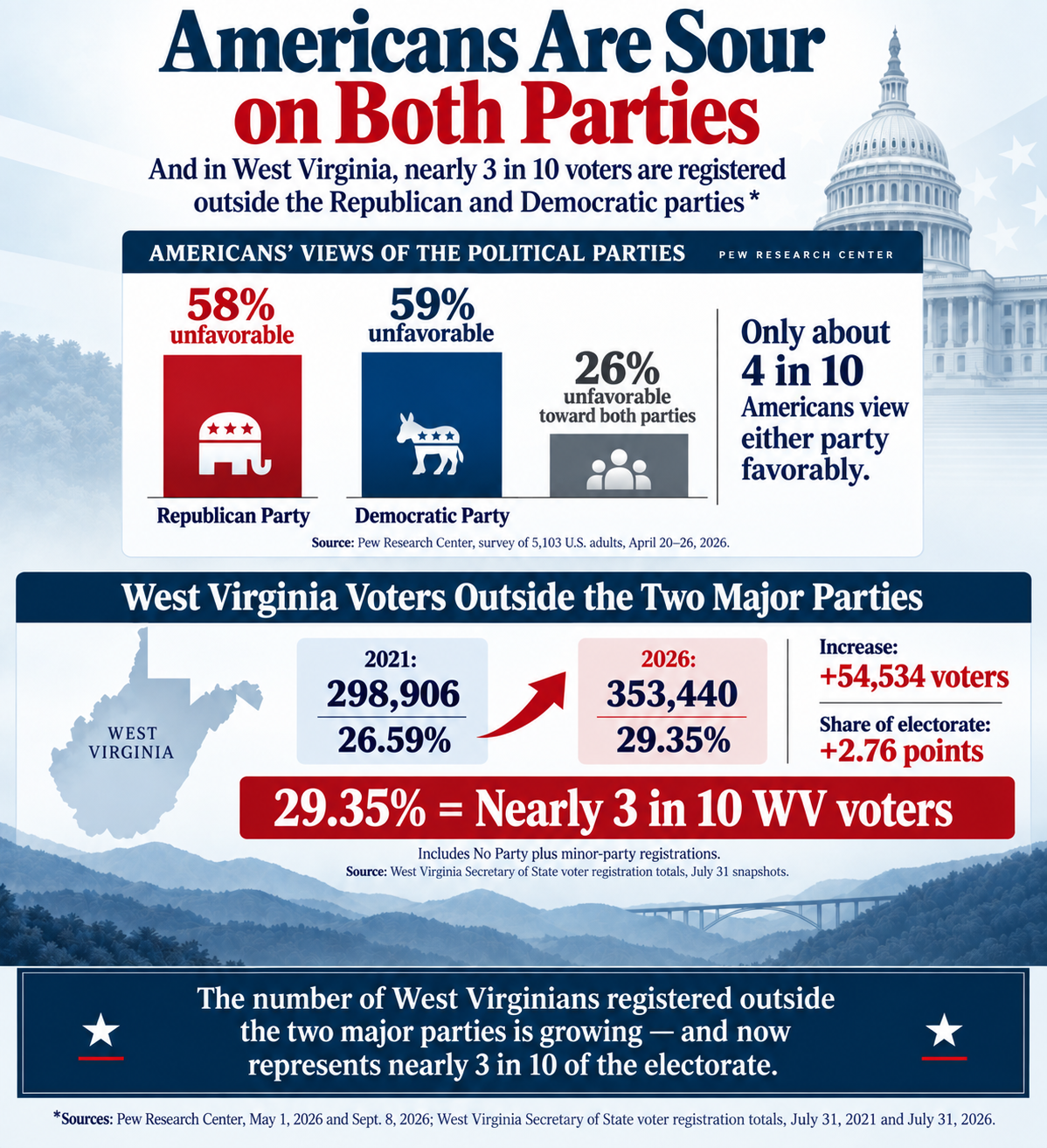
According to 2026 polling from the Pew Research Center, 58% of Americans have an unfavorable view of the Republican Party, while 59% have an unfavorable view of the Democratic Party.
Only about four in ten Americans view either party favorably.
Even more striking, 26% of Americans — more than one out of every four — hold unfavorable views of both political parties. That number has risen from 21% in 2020.
The poll also showed that people who formally identify with a political party generally still like their own party. No real surprise there.
Among Republican identifiers, 89% view the GOP favorably, while 84% of Democratic identifiers view the Democratic Party favorably.
But here is the takeaway.
Among independents who merely lean toward one of the two parties, enthusiasm drops dramatically.
Only 54% of Republican-leaning independents view the GOP favorably, while just 52% of Democratic-leaning independents view the Democratic Party favorably.
Pew’s September 8 analysis reinforces that disconnect.
Among Republicans and Republican-leaning independents combined, 75% view their own party favorably and 24% unfavorably. Among Democrats and Democratic-leaning independents, 70% view their party favorably and 30% unfavorably.
The underlying survey was conducted April 20–26 among 5,103 U.S. adults.
So, the simplest way to state Pew’s findings is this:
Republican Party: 58% unfavorable.
Democratic Party: 59% unfavorable.
Both parties unfavorable: 26%.
That last number should get the attention of political leaders in both parties.
More than one in four Americans now holds an unfavorable opinion of both major political parties.
Pew’s numbers do not establish why individual voters choose to register outside the two major parties. But they do demonstrate something unmistakable: dissatisfaction with America’s political parties is substantial.
And that brings us to West Virginia.
The political dynamics in our state are changing.
Increasing numbers of voters are choosing to remain outside the Republican and Democratic parties. Whatever their individual reasons, many clearly do not believe a party label is necessary to determine their principles or values.
The numbers don’t lie.
West Virginia voters registered outside the Republican and Democratic parties
- 2021: 298,906 — 26.59%
- 2026: 353,440 — 29.35%
- Increase: 54,534 voters
- Percentage increase: approximately 18.2%
- Share of the electorate: up 2.76 percentage points
There is an important distinction here.
These figures do not mean that 29.35% of West Virginia voters are technically registered as “No Party.”
In 2021, the 298,906 voters outside the two major parties included 250,961 registered as No Party and another 47,945 registered Mountain, Libertarian or Other.
The same distinction applies today: the 29.35% represents all West Virginia voters registered outside the Republican and Democratic parties.
But that distinction does not diminish the significance of the trend.
Five years ago, 26.59% of West Virginia voters were registered outside the two major parties.
Today, that figure has risen to 29.35% nearly three out of every ten registered voters in West Virginia.
That should matter greatly to the West Virginia Republican Party as it considers the future of its primary.
The 2026 election was the first West Virginia primary in nearly three decades in which unaffiliated voters were prohibited from participating in the Republican primary. The Republican State Executive Committee made the decision to close the primary, while the Democratic Party continued to allow unaffiliated voters to participate in its primary.
If the Republican State Executive Committee maintains a closed primary in 2028, voters who are not registered Republicans will again be unable to participate in choosing Republican nominees unless they first change their registration.
That policy deserves serious reconsideration.
Supporters of closing the Republican primary have raised concerns that voters who are not Republicans could cross over and attempt to influence which Republican candidates are nominated.
That concern deserves to be heard.
But so does the other side of the equation.
West Virginia now has 353,440 registered voters outside the Republican and Democratic parties — 29.35% of the electorate.
The number has increased by more than 54,000 in just five years.
At the same time, national polling shows significant dissatisfaction with both major political parties, particularly among voters who identify as independents but lean toward one party or the other.
These trends should not be ignored.
Political parties can protect their identity and principles without assuming that every voter who refuses to wear the party label is hostile to those principles.
Many West Virginians may agree with Republican candidates on limited government, constitutional rights, fiscal responsibility, energy independence, religious liberty and other traditionally conservative principles while choosing not to register Republican.
Those voters should not simply be written off.
West Virginia’s political landscape is changing before our eyes.
Nearly three out of every ten registered voters now stand outside the two major political parties.
The Republican Party has a choice: require those voters to adopt the party label before allowing them a voice in its primary — or give them an opportunity to participate and make the case that Republican principles deserve their support.
For the future of West Virginia, I believe the better course is clear:
Re-open the Republican Primary in 2028.

