
This is a question that should concern all Americans. What will Americans now earn from their choices in the midterms?
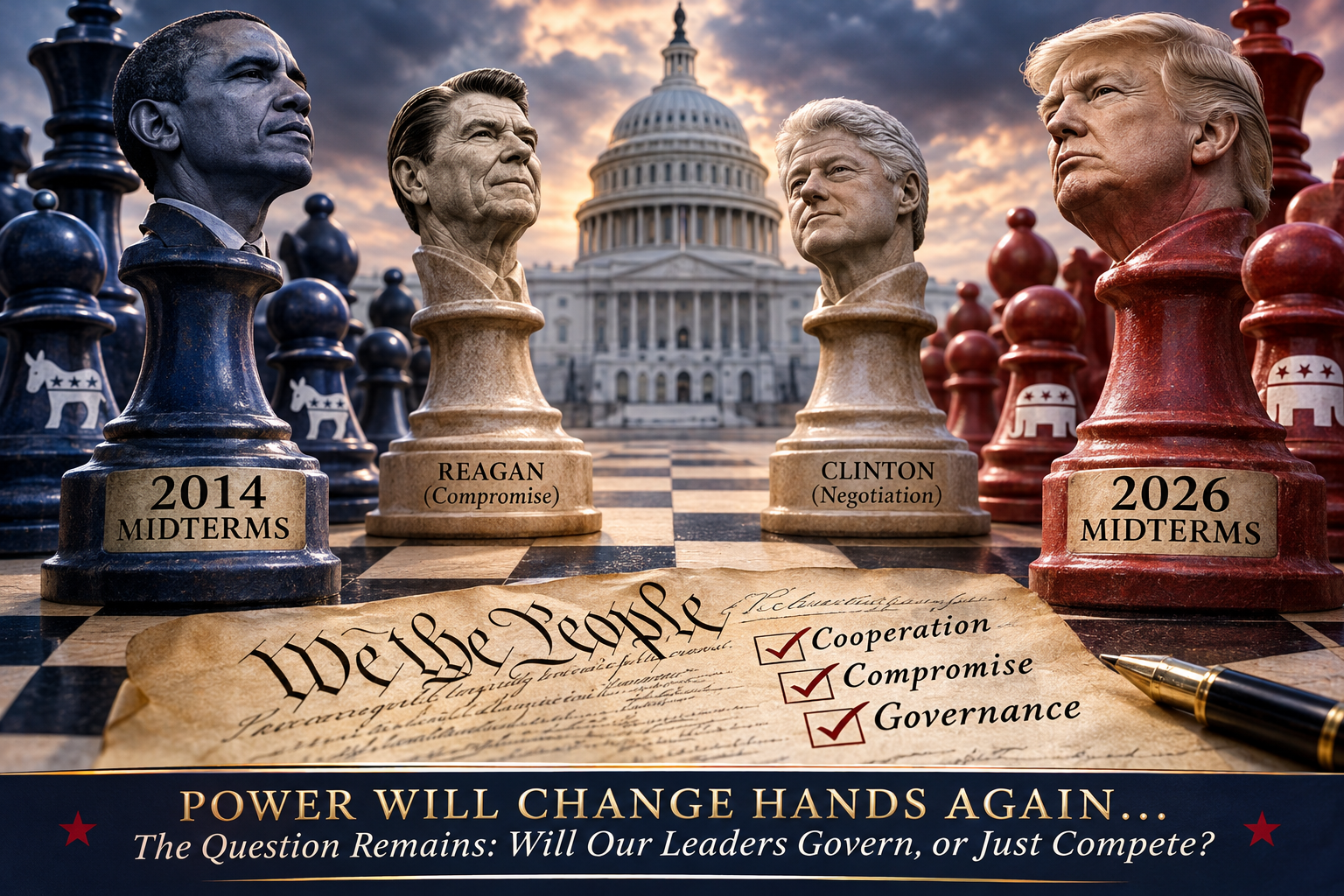
Twelve years ago, following the 2014 midterm elections, I wrote a column entitled, “Shift in Senate Power May Not Be Enough.”
Republicans had just regained control of the U.S. Senate, delivering a significant political setback to President Barack Obama. I argued that the change might accomplish little unless the president demonstrated a willingness to work with those who opposed him.
Now, twelve years later, history has presented us with a remarkable reversal.
Democrats have captured both chambers of Congress, handing President Donald Trump and the Republican Party a resounding defeat in the 2026 midterm elections.
The political parties have exchanged places, but the constitutional questions remain remarkably familiar.
In 2014, I criticized Obama’s reliance on executive authority and his inability to establish meaningful bipartisan relationships with Congress. I contrasted his leadership with Ronald Reagan and Bill Clinton, two presidents who understood that governing often requires negotiating with political adversaries.
I stand by that principle today.
President Trump now faces a similar challenge. With Democrats preparing to control Congress during his final two years, will he seek meaningful cooperation, or will Washington descend into another prolonged political stalemate?
The answer could define his remaining presidency.
Republicans should not dismiss these election results as merely another example of the historical difficulties facing a president’s party during midterm elections. Neither should Democrats assume their victories constitute an unrestricted mandate to obstruct the president.
Americans deserve better than two political parties treating control of Congress as a license for political warfare.
In my 2014 column, I expressed concern about Obama’s declaration that he possessed a pen and a phone and intended to use executive authority when Congress refused to act. My concern was not simply that a Democrat president might advance policies with which I disagreed. It was that executive action could increasingly substitute for the difficult work of legislative compromise.
That concern should not disappear because a Republican occupies the Oval Office.
Indeed, Republicans who condemned Obama’s executive actions must be willing to apply those same constitutional standards to President Trump. Otherwise, what we defended was not a principle, but a political preference.
Our Constitution establishes three separate branches of government for a reason. Congress was never intended to serve merely as an extension of presidential authority, regardless of which party controls the White House. Nor was the executive branch designed to govern without meaningful congressional accountability.
Certainly, presidents possess legitimate constitutional authority to act independently. But possessing that authority does not eliminate the responsibility to pursue legislative solutions whenever possible.
President Trump has demonstrated an extraordinary ability to command public attention and shape political debate. Yet effective presidential leadership requires more than dominating the national conversation. It requires more than just persuasion, negotiation and influence.
Occasionally, it requires compromise.
Ronald Reagan understood that distinction. Despite facing a Democrat-controlled House throughout his presidency, he recognized that advancing conservative principles sometimes required finding common ground.
Bill Clinton similarly negotiated with Republican congressional leadership, even amid profound disagreements.
Neither president was without controversy. But both demonstrated that divided government need not mean ineffective government.
For Republicans, this election should prompt serious reflection. What concerns drove voters away? Were they rejecting specific policies, expressing frustration with presidential leadership, or demanding greater accountability?
Those questions deserve thoughtful answers, not convenient excuses.
Democrats, meanwhile, must decide whether their congressional authority will address Americans’ concerns or become a two-year campaign against the president.
Neither party should mistake political victory for moral superiority.
I remain a constitutional conservative. My convictions have not changed simply because the occupants of the White House and congressional leadership have exchanged places.
The true measure of our convictions as Americans is whether we apply the same principles when doing so becomes politically uncomfortable. The Constitution does not change with election results. Neither should our respect for it.
In 2014, I concluded my column by warning Americans to fasten their seat belts because the road ahead would be rough.
Twelve years later, the political passengers have changed seats.
But unless our elected leaders remember that governing requires more than winning elections, Americans may find themselves traveling that same troubled road once again.


Leave a Reply