
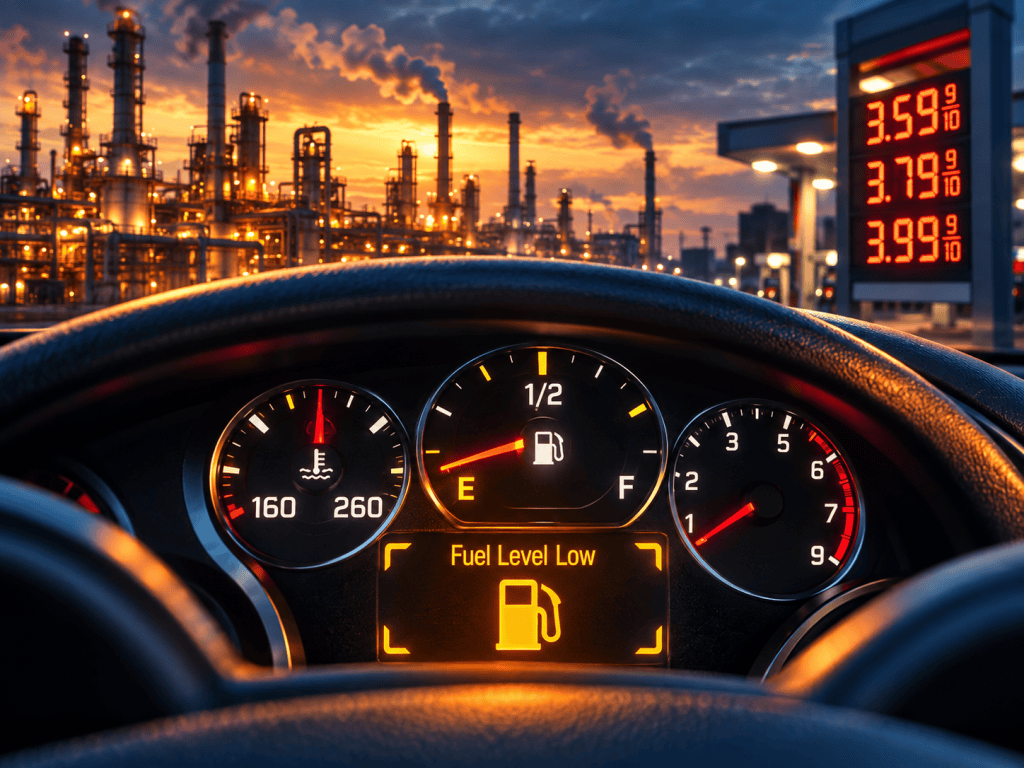
Americans are feeling the pressure of gasoline and diesel fuel prices at the pump and are being very vocal about it—with good reason.
No doubt, overall consumer affordability, which is largely impacted by the price of fuel, has become ample political fodder for politicians and the media to wage an influencing campaign on voters for the midterm elections in November.
But, as with most issues, it is very important to dig deeper than political “one-liners” and media hype.
America did not enter the Iran war with a vast amount of unused refining capacity sitting on the sidelines waiting to be called upon. Our refineries were already running hard.
According to the U.S. Energy Information Administration, refinery utilization reached 98 percent in late August and remained at 97.8 percent in early September. On face value, that sounds like tremendous efficiency, and it is. But this efficiency isn’t resulting in lower gas prices, hence the frustration.
How can gasoline prices rise sharply when the United States produces such enormous amounts of crude oil and the price of a barrel of oil doesn’t appear high enough to justify what consumers are seeing at the pump?
The answer may be found not simply in how much crude oil America has, but in how much capacity we have to turn that crude oil into gasoline, diesel, jet fuel and the other petroleum products our economy consumes every day.
The United States currently has roughly 18.2 million barrels per day of operable refining capacity spread across approximately 130 refineries.
Compare that with 2020, when the nation had approximately 135 operable refineries and around 19 million barrels per day of capacity.
Losing five operable refineries isn’t ample explanation for current fuel prices for consumers. It isn’t the amount of crude available that’s the problem. The latest U.S. Strategic Petroleum Reserve report shows it contained about 284.6 million barrels of crude oil!
The problem is refining capacity.
If a system is operating at 98 percent of its capacity, there isn’t much room remaining when something goes wrong. Refineries require maintenance. Equipment breaks. Hurricanes strike the Gulf Coast. Pipelines can experience disruptions.
Granted, many of these disruptions are “expected disruptions” and are usually built into a production model.
But then there is the unexpected disruption.
For years, America was able to operate its refining system extremely efficiently. Refineries could run at very high utilization rates, crude oil could move through global markets, and finished petroleum products could be imported or exported wherever market conditions demanded.
Then the war in Iran happened.
The Persian Gulf is one of the most important energy corridors on Earth. Any disruption—or even the credible threat of disruption—to crude oil production, shipping lanes, foreign refineries or the Strait of Hormuz can quickly affect global petroleum markets.
When refineries elsewhere in the world lose production or nations suddenly need additional fuel supplies, American refined petroleum products become even more valuable on the international market. That creates additional pressure on a U.S. refining system that was already operating close to its practical limits.
When refinery capacity becomes tight, the difference between the price of crude oil and the wholesale price of gasoline or diesel can increase considerably, resulting in increased prices at the pump.
The political debate inevitably attempts to place responsibility on one president, one political party, one oil company or one government policy. I wish there were a way to eliminate the hyperbole around the issue and spend more time on a viable solution.
The United States has demonstrated extraordinary success in producing oil. American crude production has reached levels once thought impossible. But getting the oil out of the ground isn’t the problem. The answer is having more refining capacity.
Believe it or not, the last new U.S. refinery built with significant downstream processing capacity was Marathon’s refinery in Garyville, Louisiana, in 1977!
I graduated from high school that year—I’m retired now.
If we are ever to rid our nation of these spikes in energy and fuel costs, we must build an energy system with enough reserve refining capacity to withstand a serious international disruption. Considering experts have told us that it takes around 5–10 years for a large, full-scale refinery in the U.S. to come online, we have little time to waste!
This isn’t the time to place blame or leap recklessly to another political party or ideology to solve the problem of affordability—far from it!
It’s time for leadership to come together in bipartisan fashion and craft a plan to address the issue.

