
A republic is a form of government in which political authority ultimately belongs to the people, but the people exercise that authority through elected representatives operating under a constitution and the rule of law.
Let’s talk about the American Republic for a moment.
The word republic doesn’t seem to be used much anymore, and I fear its true meaning has become blurred. But since the founding of our nation, I cannot recall a time when failure to adhere to its principles could be more detrimental to our future.
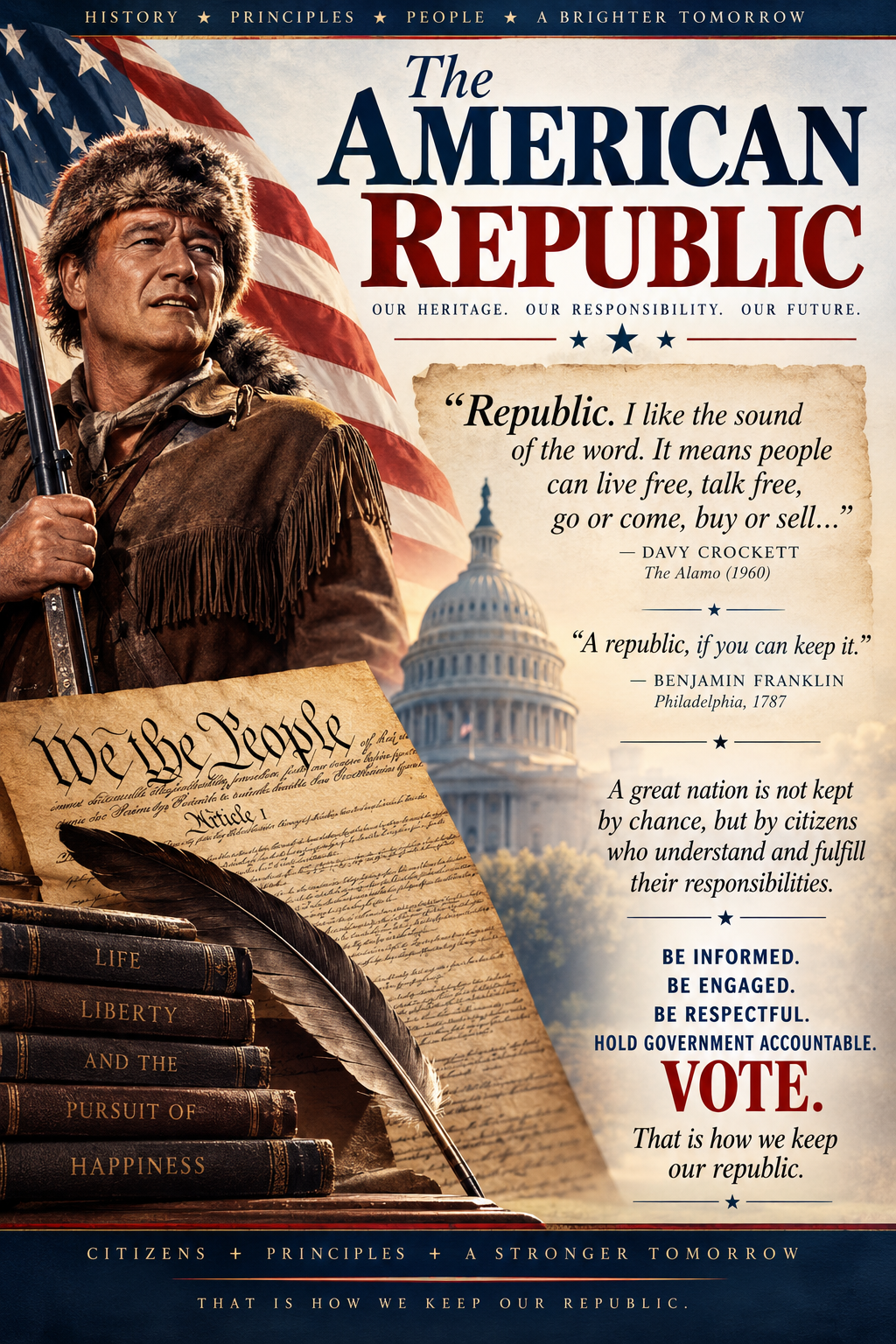
In John Wayne’s 1960 film The Alamo, his portrayal of Davy Crockett gives one of the movie’s most memorable descriptions of a republic:
“Republic. I like the sound of the word. It means people can live free, talk free, go or come, buy or sell…”
He goes on to describe people being free to choose how they live and says republic is one of those words that gives him a deep emotional feeling—something that “makes your heart warm.”
At the close of the Constitutional Convention in 1787, according to notes by Maryland delegate James McHenry, a Philadelphia woman asked Benjamin Franklin, “Well, Doctor, what have we got, a republic or a monarchy?”
Franklin famously replied, “A republic, if you can keep it.”
Franklin’s response reminds us that the Constitution could establish a republic, but a document alone could not preserve it. Keeping it would require citizens and public officials alike to exercise judgment, restraint, civic responsibility and vigilance.
I believe we find ourselves at a historical crossroad in that regard, and both citizens and elected officials need to be reminded of their responsibilities.
A republic is a form of government in which political authority ultimately belongs to the people, but the people exercise that authority through elected representatives operating under a constitution and the rule of law.
The central idea is government by consent, but government restrained by law.
That distinguishes a constitutional republic from both a monarchy and pure direct democracy. In a monarchy, governing authority historically rested with a monarch or dynasty. In a direct democracy, citizens themselves vote directly on governmental decisions. Without constitutional protections and limitations, however, simple majority rule can allow the interests of a numerical majority to overwhelm the rights and interests of minorities and individuals.
In a republic, the people are sovereign—but the Constitution is the rulebook governing how their sovereignty may be exercised.
The Declaration of Independence in 1776 supplied much of the philosophical foundation. Its revolutionary proposition was that legitimate governments derive “their just powers from the consent of the governed.” The Declaration also asserted that people possess rights that government does not create—including life, liberty and the pursuit of happiness.
After independence, the United States initially operated under the Articles of Confederation. That government, however, proved too weak in several respects. Congress lacked authority to raise revenue, regulate interstate commerce, enforce many of its decisions or effectively address disputes and problems involving the states.
By 1787, American leaders concluded that the system needed reform.
The Constitutional Convention assembled in Philadelphia that summer. Although the delegates originally gathered to revise the Articles of Confederation, they ultimately produced an entirely new framework of government: the United States Constitution.
And here is where I believe we need to be reminded of our responsibilities.
The elected representative owes the citizen fidelity to the Constitution, integrity, accountability, sound judgment and service.
But the citizen also has responsibilities: becoming informed, participating in the process, voting thoughtfully, respecting the rights of others, holding government accountable, obeying legitimate laws, serving the community and preserving the institutions that make self-government possible.
A republic cannot survive merely because its Constitution is well written. It survives only when both the governed and those entrusted to govern understand and fulfil their respective responsibilities.
A republic requires something from everyone—from the person holding office, to the citizen casting a single ballot.
It seems that many elected officials have forgotten that their primary responsibility is to represent the people they were elected to serve—not to offer a multitude of promises to gain office, only to abandon those promises afterward in favor of personal ideology or unquestioning allegiance to party.
But responsibility does not rest solely with elected officials.
Many citizens are also neglecting their responsibilities by failing to stay informed, failing to respect the rights of others and, sadly, failing to vote.
Negative comments on social media do absolutely nothing to preserve the republic. Your voice should ultimately be your vote.
If we are to continue as the greatest nation on earth, it will depend upon elected representatives and citizens alike understanding and exercising their responsibilities.
That is how we keep our republic.


Leave a Reply