Mark Caserta: Obama’s policies are on November ballot

29 Oct

obama vote 1

Oct. 15, 2014 @ 09:20 PM

No doubt when President Obama told Mitt Romney during the first 2012 presidential debate that he “liked” the term “Obamacare,” he was confident the appellation would be revered as an historic accomplishment for his administration.

Certainly Democrats have been willing to spend your hard-earned tax money to preserve the president’s aspirations. Bloomberg Government reports the cost of HealthCare.gov has now exceeded the $2 billion mark, while the total cost of Obama’s health care reform is more than $73 billion.

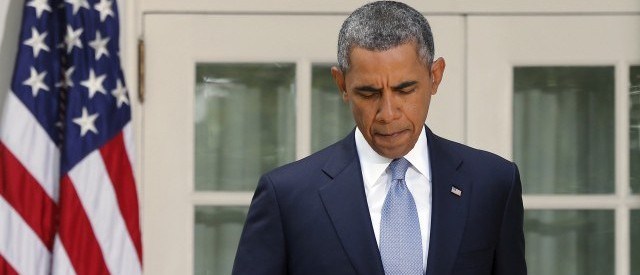
But nowadays it’s difficult to find a Democrat who openly supports any of this president’s policies in their election campaigns, much less Obama’s signature health care legislation. But in a recent speech, President Obama assured Americans his policies were indeed on November’s ballot.

obama vote 2

“I am not on the ballot this fall,” President Obama said. “But make no mistake: these policies are on the ballot. Every single one of them.”

Yes, there are people who now have healthcare who didn’t prior to the Affordable Care Act (ACA).

But millions have been forced off their existing plan (despite Obama’s promise this would never happen, winning him the esteemed Politifact “Lie of the Year” Award) into health care exchanges where they’re experiencing less coverage, higher deductibles and fewer choices in providers.

In fact, if the Congressional Budget Office (CBO) had scored the ACA correctly, it probably would never have passed! According to Forbes Magazine, 12.5 percent fewer people are uninsured by 2014, rather than the 37.3 percent projected by the CBO.

Additionally, of the millions with canceled coverage, 1 million remain uninsured. And Americans are experiencing far higher premiums than originally estimated while nearly $7,000 will be added in taxes/fees over a decade even for families in the lowest 20 percent of household income.

And all around the country businesses are preparing for the impact of the employer mandate under Obamacare. Understand, these companies will not simply absorb these additional costs. They’ll either cut expenses or raise prices.

Currently hundreds of employers are cutting back on employee’s hours to avoid paying for health care, forcing these individuals into purchasing coverage from an exchange or pay a fine.

obama vote 4

And many people still don’t realize the IRS will be the enforcer for ensuring everyone meets their “shared responsibility payment” as decreed by the individual mandate of Obamacare. And Americans have already seen what IRS leadership is willing to do to propagate this president’s ultra-liberal agenda.

Now, there are points in the ACA which should remain, such as coverage for “pre-existing” conditions. But Democrats failed to engage in the necessary conversation about allowing the free market to work in the insurance industry by instituting healthy interstate competition and tort reform.

Instead, they went right for socialized medicine.

Simply put, Barack Obama and complicit Democrats passed legislation that forces Americans into purchasing a product, despite their wants or needs, so they can “redistribute” the assets as they deem “fair.” They’ve taken the “care” out of health care and made it health “control.”

So Democrats may want to run, but they cannot hide. They gave us Obamacare.

obama vote 3

Mark Caserta is a conservative blogger, a Cabell County resident and a regular contributor to The Herald-Dispatch editorial page.

State Department plans to bring foreign Ebola patients to U.S.

28 Oct

STATE DEPARTMENT DOCUMENT REVEALS PLANS

ebola to us

The State Department has quietly made plans to bring Ebola-infected doctors and medical aides to the U.S. for treatment, according to an internal department document that argued the only way to get other countries to send medical teams to West Africa is to promise that the U.S. will be the world’s medical backstop.

Some countries “are implicitly or explicitly waiting for medevac assurances” before they will agree to send their own medical teams to join U.S. and U.N. aid workers on the ground, the State Department argues in the undated four-page memo, which was reviewed by The Washington Times.

“The United States needs to show leadership and act as we are asking others to act by admitting certain non-citizens into the country for medical treatment for Ebola Virus Disease (EVD) during the Ebola crisis,” says the four-page memo, which lists as its author Robert Sorenson, deputy director of the office of international health and biodefense.

More than 10,000 people have become infected with Ebola in Liberia, Sierra Leone and Guinea, and the U.S. has taken a lead role in arguing that the outbreak must be stopped in West Africa. President Obama has committed thousands of U.S. troops and has deployed American medical personnel, but other countries have been slow to follow.

In the memo, officials say their preference is for patients go to Europe, but there are some cases in which the U.S. is “the logical treatment destination for non-citizens.”

The document has been shared with Congress, where lawmakers already are nervous about the administration’s handling of the Ebola outbreak. The memo even details the expected price per patient, with transportation costs at $200,000 and treatment at $300,000.

A State Department official signaled Tuesday evening that the discussions had been shelved.

“There is no policy of the U.S. government to allow entry of non-U.S. citizen Ebola-infected to the United States. There is no consideration in the State Department of changing that policy,” the official said.

Another official said the department is considering using American aircraft equipped to handle Ebola cases to transport noncitizens to other countries.

ebola 6

“We have discussed allowing other countries to use our medevac capabilities to evacuate their own citizens to their home countries or third-countries, subject to reimbursement and availability,” the second department official said.

The internal State Department memo is described as “sensitive but unclassified.” A tracking sheet attached to it says it was cleared by offices of the deputy secretary, the deputy secretary for management, the office of Central African affairs and the medical services office.

A call to the number listed for Mr. Sorenson wasn’t returned Tuesday.

Mr. Obama has been clear about his desire to recruit medical and aid workers to fight Ebola in Africa.

“We know that the best way to protect Americans ultimately is going to stop this outbreak at the source,” the president said at the White House on Tuesday, praising U.S. aid workers who are already involved in the effort. “No other nation is doing as much to make sure that we contain and ultimately eliminate this outbreak than America.”

About half of the more than 10,000 cases in West Africa have been fatal.

Four cases have been diagnosed in the U.S., and three of those were health care workers treating infected patients. Two of those, both nurses at a Dallas hospital, have been cured.

ebola ny 1

Several American aid workers who contracted the disease overseas were flown to the U.S. for treatment.

The United Nations and World Health Organization are also heavily involved in deploying to the affected region, but other countries have been slower to provide resources to fight Ebola in West Africa or to agree to treat workers who contract the disease.

The State Department memo says only Germany has agreed to take non-German citizens who contract Ebola.

European nations are closer to West Africa, making transport easier, the State Department memo said.

Officials said the U.S. is the right place to treat some cases, notably those in which non-Americans are contracted to work in West Africa for U.S.-based charities, the Centers for Disease Control and Prevention or the U.S. Agency for International Development.

“So far all of the Ebola medevacs brought back to U.S. hospitals have been U.S. citizens. But there are many non-citizens working for U.S. government agencies and organizations in the Ebola-affected countries of West Africa,” the memo says. “Many of them are citizens of countries lacking adequate medical care, and if they contracted Ebola in the course of their work they would need to be evacuated to medical facilities in the United States or Europe.”

dr spencer

The memo says the State Department has a contract with Phoenix Aviation, which maintains an airplane capable of transporting an Ebola patient. The U.S. can transport noncitizens and have other countries or organizations pay the cost.

The U.S. has helped transport three health care workers to Germany and one to France.

In the U.S., the department memo lists three hospitals — the National Institutes of Health Clinical Center, the University of Nebraska Medical Center and Emory University Hospital in Atlanta — that are willing to take Ebola patients.

According to the memo, Homeland Security Department officials would be required to waive legal restrictions to speed the transport of patients into the U.S. “A pre-established framework would be essential to guarantee that only authorized individuals would be considered for travel authorization and that all necessary vetting would occur,” the memo says.

A Homeland Security spokeswoman didn’t return emails seeking comment.

Judicial Watch, a conservative-leaning public interest watchdog, revealed the existence of a State Department plan this month. When The Times described the document to Tom Fitton, Judicial Watch’s president, he said it is evidence of why the administration balked at adopting a travel ban on those from affected countries.

“Under this theory, there could be people moving here now, transporting people here now, and it could be done with no warning,” Mr. Fitton said. “If our borders mean anything, it is the ability to make sure that dire threats to the public health are kept out.”

ebola 8

After those initial reports surfaced, House Judiciary Committee Chairman Bob Goodlatte, Virginia Republican, sent a letter asking for answers. On Tuesday, he said the document The Times obtained “raises more concerns and questions than answers.”

“President Obama should be forthcoming with the American people about the scope of his plan to bring non-U.S. citizens infected with Ebola to the United States for treatment,” Mr. Goodlatte said in a statement.

Lawmaker claims plans may be in pipeline to bring non-citizens to US for Ebola treatment

28 Oct

WHAT IS OBAMA TRYING TO DO TO OUR NATION?

crisis mode

A top Republican congressman claims the Obama administration is exploring plans to bring non-U.S. citizens infected with Ebola to the United States for treatment.

Rep. Bob Goodlatte, R-Va., chairman of the House Judiciary Committee, told Fox News that his office has received “information from within the administration” that these plans are being developed. So far, only American Ebola patients have been brought back to the U.S. for treatment from the disease epicenter in West Africa.

Goodlatte warned that expanding that policy could put the country at more risk.

ebola 8

“Members of the media, my office have received confidential communications saying that those plans are being developed,” Goodlatte said Monday night.

“This is simply a matter of common sense that if you are concerned about this problem spreading — and this is a deadly disease that we’re even concerned about the great health care workers when they come back not spreading it — we certainly shouldn’t be bringing in the patients.”

The chairman wrote a letter last week to Homeland Security Secretary Jeh Johnson and Secretary of State John Kerry asking whether such plans exist, but he says he has not gotten a response.

The details are sketchy, if such a plan even exists.

ebola treatment

A Goodlatte aide told FoxNews.com that “someone in one of the agencies” contacted their office with the tip — presumably, the plan would apply to non-U.S. residents. Who would pay for the transport and treatment is an open question.

In his letter last week, Goodlatte asked whether the administration is formulating such a plan, seeking details and communications among their employees.

The conservative watchdog group Judicial Watch also reported, shortly before Goodlatte sent the letter, that the administration is “actively formulating” plans to bring Ebola patients into the U.S., with the specific goal of treating them “within the first days of diagnosis.”

Goodlatte earlier had pushed the president to consider using his authority to impose a temporary ban on non-U.S. citizen travel to the United States from the three African countries hardest-hit by Ebola.

“We think, again, that’s just plain common sense, a practical way to stop this disease from spreading,” he said.

The Obama administration has pushed back on those calls, saying the most effective approach is to stop Ebola at its source in West Africa.

Ebola can survive on surfaces for almost TWO MONTHS

27 Oct

This just keeps getting worse…but here are some tips for avoiding the virus.

ebola 4

Tests reveal certain strains survive for weeks when stored at low temperatures

  • Research claims certain strains of Ebola can remain on surfaces for 50 days
  • It survived the longest on glass surfaces stored at 4° (39°F)
  • Centres for Disease Control and Prevention claims Ebola typically lives on a ‘dry’ surface for hours – including doorknobs and tables
  • But when stored in moist conditions such in mucus, this is extended 
  • Survival time depends on the surface, and the room temperature
  • Virus can be killed using household bleach and people must come into direct contact with the sample to risk infection 

The number of confirmed Ebola cases passed the 10,000 mark over the weekend, despite efforts to curb its spread.

And while the disease typically dies on surfaces within hours, research has discovered it can survive for more than seven weeks under certain conditions.

During tests, the UK’s Defence Science and Technology Laboratory (DSTL) found that the Zaire strain will live on samples stored on glass at low temperatures for as long as 50 days. 

The left-hand charts plot survival rates of Zaire strain of Ebola (Zebov) and Lake Victoria marburgvirus (Marv) on glass (a) and plastic (b) at 4° (39°F) over 14 days. The right-hand charts reveal the survival rate under the same conditions over 50 days. Both viruses survived for 26 days, and Ebola was extracted after 50 days

The tests were initially carried out by researchers from DSTL before the current outbreak, in 2010, but the strain investigated is one of five that is still infecting people globally.

The findings are also quoted in advice from the Public Agency of Health in Canada. 

Ebola was discovered in 1976 and is a member of the Filoviridae family.

This family includes the Zaire ebolavirus (Zebov), which was first identified in 1976 and is the most virulent; Sudan ebolavirus, (Sebov); Tai Forest ebolavirus; Ebola-Reston (Rebov), and Bundibugyo ebolavirus (Bebov) – the most recent species, discovered in 2008.

HOW LONG DOES EBOLA SURVIVE?

For their 2010 paper, ‘The survival of filoviruses in liquids, on solid substrates and in a dynamic aerosol’, the UK’s Defence Science and Technology Laboratory (DSTL) tested two particular filoviruses on a variety of surfaces.

These were the Lake Victoria marburgvirus (Marv), and Zaire ebolavirus (Zebov).

Each was placed into guinea pig tissue samples and tested for their ability to survive in different liquids and on different surfaces at different temperatures, over a 50-day period.

When stored at 4° (39°F), by day 26, viruses from three of the samples were successfully extracted; Zebov on the glass sample, and Marv on both glass and plastic.

By day 50, the only sample from which the virus could be recovered was the Zebov from tissue on glass. 

For their 2010 paper, ‘The survival of filoviruses in liquids, on solid substrates and in a dynamic aerosol’, Sophie Smither and her colleagues tested two particular filoviruses on a variety of surfaces.

These were the Lake Victoria marburgvirus (Marv), and Zebov.

Each was placed into guinea pig tissue samples and tested for their ability to survive in different liquids, and on different surfaces at different temperatures, over a 50-day period.

When stored at 4° (39°F), by day 26, viruses from three of the samples were successfully extracted; Zebov on the glass sample, and Marv on both glass and plastic.

By day 50, the only sample from which the virus could be recovered was the Zebov from tissue on glass.

‘This study has demonstrated that filoviruses are able to survive and remain infectious, for extended periods when suspended within liquid and dried onto surfaces,’ explained the researchers.

‘Data from this study extend the knowledge on the survival of filoviruses under different conditions and provide a basis with which to inform risk assessments and manage exposure.’

The researchers do stress that these tests were carried out in a controlled lab environment, and not in the real world, but published their findings to highlight the survival rates. 

Last week the Centers for Disease Control and Prevention (CDC) updated its Ebola guidelines following the rise in infections. 

Ebola (pictured) was discovered in 1976 and is a member of the Filoviridae family. This family includes the Zaire ebolavirus (Zebov), which was first identified in 1976 and is the most virulent; Sudan ebolavirus, (Sebov); Tai Forest ebolavirus; Ebola-Reston (Rebov), and Bundibugyo ebolavirus (Bebov)

Ebola (pictured) was discovered in 1976 and is a member of the Filoviridae family. This family includes the Zaire ebolavirus (Zebov), which was first identified in 1976 and is the most virulent; Sudan ebolavirus, (Sebov); Tai Forest ebolavirus; Ebola-Reston (Rebov), and Bundibugyo ebolavirus (Bebov)

The centre explained that Ebola is not spread through the air, water, or food and a person infected with Ebola can’t spread the disease until symptoms appear.

The time from exposure to when signs or symptoms of the disease appear, known as the incubation period, is two to 21 days, but the average time is eight to 10 days.

HOW TO PROTECT YOURSELF

The Centres for Disease Control and Prevention advises:

• DO wash your hands often with soap and water or use an alcohol-based hand sanitizer.

• Do NOT touch the blood or body fluids (like urine, feces, saliva, vomit, sweat, and semen) of people who are sick.

• Do NOT handle items that may have come in contact with a sick person’s blood or body fluids, like clothes, bedding, needles,or medical equipment.

• Do NOT touch the body of someone who has died of Ebola.

Ebola is spread through direct contact, through broken skin or through eyes, nose, or mouth, via blood and body fluids of a person who is sick with Ebola, or objects, such as needles, that have been contaminated with the blood or body fluids of a person sick with Ebola. 

Signs of Ebola include fever and symptoms like severe headache, muscle pain, vomiting, diarrhea, stomach pain, or unexplained bleeding or bruising. 

Dr Tom Fletcher of the Royal Army Medical Corps, who has treated victims in Guinea and Sierra Leone, says: ‘The initial symptoms are quite non-specific and similar to a flu-like illness. 

‘They include fever, headache and lethargy. This progresses to severe diarrhoea and vomiting.’ 

Officials have emphasised there is no risk of transmission from people who have been exposed to the virus, but are not yet showing symptoms.  

But, specialists at Emory University Hospital in Atlanta found that the virus is present on a patient’s skin after symptoms develop, underlining how contagious the disease is once symptoms set in.

According to the CDC, the virus can survive for a few hours on dry surfaces like doorknobs and countertops and can survive for several days in puddles or other collections of body fluid. 

However, bleach solutions, including household bleach, can kill it.

As Ebola grabs headlines, how close to curing it are we?

Ebola is only spread through direct contact, through broken skin or through eyes, nose, or mouth, via blood and body fluids of a person who is sick with Ebola, or objects, such as needles, that have been contaminated with the blood or body fluids of a person sick with Ebola. It can be killed using bleach 

CDC to release new guidelines for returning Ebola workers

There is no FDA-approved vaccine available for Ebola, but experimental vaccines and treatments for Ebola are under development.

The CDC advises people wash their hands with soap and water or use an alcohol-based hand sanitiser, to protect themselves. 

It warns to not touch the blood or body fluids, including urine, faeces, saliva, vomit, sweat, and semen of people who are sick. 

Ebola was once thought to originated in gorillas, because human outbreaks began after people ate gorilla meat.

But scientists now believe that bats are the natural reservoir for the virus, and that apes and humans catch it from eating food that bats have drooled or defecated on, or by coming in contact with surfaces covered in infected bat droppings and then touching their eyes or mouths. 

The current outbreak seems to have started in a village near Guéckédou, Guinea, where bat hunting is common, according to Doctors Without Borders.

US Ambassador Power will abide by quarantine requirements

Officials have emphasized that there is no risk of transmission from people who have been exposed to the virus (pictured) but are not yet showing symptoms. But, specialists at Emory University Hospital in Atlanta found that the virus is present on a patient’s skin after symptoms develop

Ebola was once thought to originated in gorillas, because human outbreaks began after people ate gorilla meat. But scientists now believe that bats are the natural reservoir for the virus, and that apes and humans catch it from eating food that bats have drooled or defecated on

Read more: http://www.dailymail.co.uk/sciencetech/article-2809803/Ebola-surfaces-TWO-months-Tests-reveal-certain-strains-survive-weeks-stored-low-temperatures.html#ixzz3HP7Z5G4I
Follow us: @MailOnline on Twitter | DailyMail on Facebook

Obama forces Chris Christie into embarrassing U-turn to allow Ebola nurse to leave New Jersey quarantine tent

27 Oct

OBAMA ATTEMPTING TO CONTROL THE STATES?????

north west 2dems turn 3north west 3

  • New Jersey governor said Monday that the CDC has cleared a nurse on 21-day quarantine to go home after she tested negative for Ebola twice
  • The health care worker was held after returning from Sierra Leone, and threatened a federal lawsuit to get herself released
  • A 21-day Ebola quarantine order for Americans returning from western Africa was put in place by Christie and New York Gov. Andrew Cuomo
  • Under White House pressure, Cuomo changed his rules to allow home quarantines for those with no symptoms
  • Obama aides already lobbied Christie to rethink New Jersey’s rules after the nurse twice tested negative for Ebola 

Chris Christie was forced on Monday to allow a nurse being kept in a tent in a hospital parking lot to go home after intense White House pressure to relax a mandatory 21-day quarantine the New Jersey Governor had imposed at a state level.

The embarrassing turnaround came after Obama chaired a White House meeting on the rules and successfully lobbied Christie’s New York counterpart, Gov. Andrew Cuomo, to relax their quarantine rules – even as Americans grow more concerned about the possibility of a pandemic emergency.

Cuomo gave in on behalf of New Yorkers. But as of Sunday Christie was still pushing for more aggressive measures to protect New Jerseyans, saying he had ‘no second thoughts’ about the policy. 

Christie is a likely entrant into the 2016 Republican Party presidential primary, and the intergovernmental Ebola skirmishes will provide both major political parties with new ammunition.

Nurse Kaci Hickox tested negative for Ebola twice, but she had remained in a forced hospital quarantine as of Monday morning.

The governors of New York and New Jersey announced last week mandatory quarantine for people returning to the United States through airports in their states who are deemed 'high risk' but the rules have now been relaxed to allow self-quarantine at home.  New Jersey, led by Chris Christie, pictured,  first resisted pressure to roll back the new rules but caved under pressure from the White House today

Anthony Fauci, director of the National Institute of Allergy and Infectious Disease, says mandatory 21-day quarantines are 'a little bit draconian'

The two states each have one of the five airports where passengers who have spent time in Liberia, Sierra Leone or Guinea are allowed to enter the United States.

Illinois, home to Chicago O’Hare International Airport, also has a similar quarantine order in place, in open defiance of the White House.

The Obama administration pushed back on Sunday, following the latest all-hands Ebola meeting in the White House.

‘We have also let these states know that we are working on new guidelines for returning healthcare workers that will protect the American people against imported cases, while, at the same time, enabling us to continue to tackle this epidemic in West Africa.’

Dr. Anthony Fauci, the director of the National Institute of Allergy and Infectious Diseases, said Sunday on the CBS program ‘Face the Nation’ that state-level quarantines send a message to health care professionals that volunteering in the Ebola hot zone will present new levels of inconvenience when they return. 

The New York Times first reported that aides to Obama were lobbying Christie and Cuomo to relax their new rules.

New York Gov. Andrew Cuomo (center) says he doesn't know how his 'mandatory' quarantine would be enforced

There has been sharp criticism of the guidelines after Hickox was forcibly quarantined in a New Jersey hospital isolation unit, even though she had displayed no symptoms and had tested negative for Ebola.

Under the new New York guidelines, medical professionals who have had contact with Ebola patients can now be quarantined at home instead and receive twice-daily monitoring, if they have no symptoms.

Family members will be allowed to stay, and friends may also visit with the approval of health officials.  

Senior administration officials had called the initial decision on Friday by the governors to impose such rules ‘uncoordinated and hurried.’ 

Meanwhile, Hickox, the first nurse forcibly quarantined in New Jersey under the state’s new policy, said her isolation at a hospital was ‘inhumane,’ adding: ‘We have to be very careful about letting politicians make health decisions.’

Hickox is now suing and has now hired Norman Siegel, a high profile civil rights attorney, to challenge the order.  

Christie on Sunday defended quarantining as necessary to protect the public and predicted it ‘will become a national policy sooner rather than later.’

‘The government’s job is to protect safety and health of our citizens,’ Christie said on Fox News Sunday. ‘I have no second thoughts about it.’

In a  telephone interview with CNN, Kaci Hickox, the nurse quarantined at a New Jersey hospital because she had contact with Ebola patients in West Africa, said the process of keeping her isolated is 'inhumane'

In a telephone interview with CNN, Kaci Hickox, the nurse quarantined at a New Jersey hospital because she had contact with Ebola patients in West Africa, said the process of keeping her isolated is ‘inhumane’

Nurse Kaci Hickox was the first medical professional to be quarantined in New Jersey immediately upon returning to the United States from West Africa, where she had worked in treating Ebola patients.S he lashed out at Christie for giving her a diagnosis of sorts as 'obviously ill.'

Previously, Christie had characterized Hickox as ‘obviously ill.’

‘I’m sorry, but that’s just a completely unacceptable statement in my opinion,’ Hickox said Sunday during a phone interview with CNN. ‘For him—a politician who’s trusted and respected—to make a statement that’s categorically not true is just unacceptable and appalling.’

Cuomo also came under scrutiny over the weekend for criticizing Craig Spencer, a doctor who tested positive for Ebola on Thursday, for not obeying a 21-day voluntary quarantine. However, on Sunday, he called the health care workers ‘heroes’ and said his administration would encourage more medical workers to volunteer to fight Ebola.

Under the revised protocols Cuomo detailed on Sunday night, the state also will pay for any lost compensation if the quarantined workers are not paid by a volunteer organization.

‘My personal practice is to err on the side of caution,’ Cuomo said. ‘The old expression is, ‘Hope for the best but prepare for the worst.” 

‘We’re staying one step ahead,’ Cuomo said. ‘We’re doing everything possible. Some people say we’re being too cautious. I’ll take that criticism.’

For much of the weekend, the governors had been under fire from members of the medical community and the White House in what they saw as an overreaction. 

President Barack Obama gives a hug to Dallas nurse Nina Pham in the Oval Office of the White House on Friday, the day she was declared free of the virus
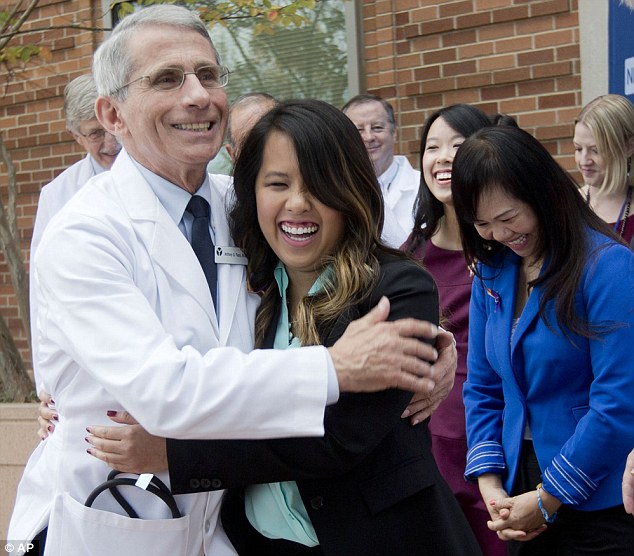
Patient Nina Pham is hugged by Dr. Anthony Fauci, director of the National Institute of Allergy and Infectious Diseases, outside of National Institutes of Health (NIH) . Pham, the first nurse diagnosed with Ebola after treating an infected man at a Dallas hospital is free of the virus.

Dr. Anthony Fauci (left), director of The National Institute of Allergy and Infectious Diseases, warned that the mandatory, 21-day quarantining of medical workers returning from West Africa is unnecessary and could discourage volunteers from traveling to the danger zone

‘The best way to protect us is to stop the epidemic in Africa, and we need those health care workers, so we do not want to put them in a position where it makes it very, very uncomfortable for them to even volunteer to go,’ said Dr. Anthony Fauci, director of the National Institute of Allergy and Infectious Diseases.

Fauci made the rounds on five major Sunday morning talk shows to argue that policy should be driven by science — and that science says people with the virus are not contagious until symptoms appear. And even then, infection requires direct contact with bodily fluids.

He said that close monitoring of medical workers for symptoms is sufficient, and warned that forcibly separating them from others, or quarantining them, for three weeks could cripple the fight against the outbreak in West Africa — an argument that humanitarian medical organizations have also made.

‘If we don’t have our people volunteering to go over there, then you’re going to have other countries that are not going to do it and then the epidemic will continue to roar,’ Fauci said.  

Fauci said that close monitoring of medical workers for symptoms is sufficient, and warned that forcibly separating them from others, or quarantining them, for three weeks could cripple the fight against the outbreak in West Africa, an argument that humanitarian medical organizations have also made

The New York-area quarantine measures were announced after Spencer returned to New York City from treating Ebola victims in Guinea for Doctors Without Borders and was admitted to Bellevue Hospital Center Thursday to be treated for Ebola. In the week after his return, he rode the subway, went bowling and ate at a restaurant.

Hospital officials said Sunday that Spencer was in serious but stable condition, was looking better than he did the day before, and tolerated a plasma treatment well.

Hickox, the quarantined nurse who just returned from Sierra Leone, said she had no symptoms at all and tested negative for Ebola in a preliminary evaluation.

‘It’s just a slippery slope, not a sound public health decision,’ she said of the quarantine policy. ‘I want to be treated with compassion and humanity, and don’t feel I’ve been treated that way.’

Hickox has access to a computer, her cellphone, magazines and newspapers and has been allowed to have takeout food, New Jersey Health Department officials said.

New York City Mayor Bill de Blasio called Hickox a ‘returning hero’ and charged that she was ‘treated with disrespect,’ as if she done something wrong, when she was put into quarantine. He said that she was interrogated repeatedly and things were not explained well to her. 

Commuters ride inside an L train subway car. This is the same train line that Dr. Craig Spencer, a Doctors Without Borders physician who tested positive for the Ebola, had taken to visit a bowling alley in Brooklyn

Official questions mandatory quarantines on health workers

Samantha Power, the U.S. ambassador to the United Nations who is on a trip to West Africa, said returning U.S. health care workers should be ‘treated like conquering heroes and not stigmatized for the tremendous work that they have done.’

In other developments, President Barack Obama met Sunday with his Ebola response team, including ‘Ebola czar’ Ron Klain and other public health and national security officials. 

According to a statement released by the White House, Obama said any measures concerning returning health care workers ‘should be crafted so as not to unnecessarily discourage those workers from serving.’

Florida Gov. Rick Scott ordered twice-daily monitoring for 21 days of anyone returning from the Ebola-stricken areas.

The World Health Organization said more than 10,000 people have been infected with Ebola in the outbreak that came to light last March, and nearly half of them have died, mostly in Guinea, Sierra Leone and Liberia. 

Three US states impose Ebola quanantines

New York City Council District 7 Community Liason Fidel Malena hands out flyers about Ebola risk near the apartment building of Ebola patient Dr. Craig Spencer in Harlem

New York City Council District 7 Community Liason Fidel Malena hands out flyers about Ebola risk near the apartment building of Ebola patient Dr. Craig Spencer in Harlem

Postal worker Keven Ngo, wearing a protective mask and gloves, prepares to deliver to the apartment building of Ebola patient Dr. Craig Spencer in Harlem


OBAMA URGES STATES TO REVERSE MANDATORY QUARANTINES

27 Oct

Under Pressure, Cuomo Says Ebola Quarantines Can Be Spent at Home

QUARANTINE

By MATT FLEGENHEIMER, MICHAEL D. SHEAR and MICHAEL BARBAROOCT. 26, 2014

Facing fierce resistance from the White House and medical experts to a strict new mandatory quarantine policy, Gov. Andrew M. Cuomo said on Sunday night that medical workers who had contact with Ebola patients in West Africa but did not show symptoms of the disease would be allowed to remain at home and would receive compensation for lost income.

Mr. Cuomo’s decision capped a frenzied weekend of behind-the-scenes pleas from administration officials, who urged him and Gov. Chris Christie of New Jersey to reconsider the mandatory quarantine they had announced on Friday. Aides to President Obama also asked other governors and mayors to follow a policy based on science, seeking to stem a steady movement toward more stringent measures in recent days at the state level.

The announcement by Mr. Cuomo seemed intended to draw a sharp contrast — both in tone and in fact — to the policy’s implementation in New Jersey, where a nurse from Maine who arrived on Friday from Sierra Leone was swiftly quarantined in a tent set up inside a Newark hospital, with a portable toilet but with no shower.

GOVERNORS 1

Gov. Andrew M. Cuomo of New York, left, and Mayor Bill de Blasio of New York on Sunday. Credit Michael Appleton for The New York Times

It was the second striking shift in Mr. Cuomo’s public posture on the Ebola crisis in 72 hours; after urging calm on Thursday night, then joining Mr. Christie to highlight the risks of lax policy on Friday, Mr. Cuomo on Sunday night appeared to try to dial back his rhetoric and stake out a middle ground.

He said his decision balanced public safety with the need to avoid deterring medical professionals from volunteering in West Africa. “My No. 1 job is to protect the people of New York, and this does that,” he said. Those quarantined at home will be visited twice a day by local authorities, he said. Family members will be allowed to stay, and friends may visit with the approval of health officials.

Mayor Bill de Blasio, sitting beside Mr. Cuomo at a news conference in Manhattan, nodded in approval, and praised the governor for developing a set of flexible quarantine guidelines that, the mayor said, would show proper respect to those required to abide by them.

After Mr. Cuomo’s announcement, Mr. Christie issued a statement saying that, under protocols announced on Wednesday, New Jersey residents not displaying symptoms would also be allowed to quarantine in their homes.

Until Sunday night, the quarantine orders by Mr. Christie, a Republican, and Mr. Cuomo, a Democrat, had drawn withering criticism from many medical experts, who said they would discourage aid workers from volunteering to help eradicate the disease at its source. By midday Sunday, Kaci Hickox, the nurse who became the first person isolated under the new protocols in New Jersey, emerged as the public face of the opposition, calling the treatment she received “inhumane” and disputing Mr. Christie’s assertion a day earlier that she was “obviously ill.”

“If he knew anything about Ebola he would know that asymptomatic people are not infectious,” Ms. Hickox told CNN.

Even some who acknowledged the states’ authority to enact the policy took issue with its implementation in New Jersey.

RON KLAIN

At Bellevue Hospital Center, staff members listened to Mr. de Blasio on Sunday. Credit Damon Winter/The New York Times

“We have to think how we treat the people who are doing this noble work,” Mr. de Blasio said. At a late afternoon news conference, he said Ms. Hickox’s treatment was “inappropriate,” adding: “We owe her better than that.”

Yet amid heightened public anxiety about the government’s handling of the crisis, state authorities have increasingly calculated that the mandatory quarantines will prove prescient. Since the governors’ announcement, Illinois and Florida have said they were instituting similar measures.

“I think this is a policy that will become a national policy sooner rather than later,” Mr. Christie said in an interview on Fox News Sunday.

The Cuomo and Christie administrations began seriously considering a quarantine on Tuesday, aides said, after federal officials decreed that travelers returning from countries affected by Ebola in West Africa could enter the United States only at five designated airports, including Kennedy and Newark Liberty International.

Mr. Christie had grown increasingly frustrated by mid-October, aides said, over the failure of medical professionals to properly isolate themselves on a voluntary basis after returning from West Africa.

He was startled to learn that Dr. Nancy Snyderman, an NBC News correspondent who had traveled to Liberia and whose cameraman had contracted Ebola, left her home in Princeton, N.J., on Oct. 9 to pick up food at a favorite local restaurant.

When a doctor, Craig Spencer, tested positive in New York City on Thursday, the two governors watched as city officials strained to trace his every movement — on the subway, at a bowling alley, at a meatball shop.

ebola ny 2

Kaci Hickox. Credit Kara Hickox

What appeared to be a triumph of meticulous forensic work by city health officials, in retracing Dr. Spencer’s every step late last week, looked like a potential nightmare to governors who suddenly contemplated having to repeat such an exercise over and over.

In a series of phone conversations starting on Thursday night, shortly after Dr. Spencer’s condition was diagnosed, and continuing Friday morning, Mr. Christie and Mr. Cuomo decided to impose the mandatory quarantines, officials said — essentially declaring that neither state trusted those potentially exposed to the deadly disease to wall themselves off from the rest of society.

Aides to Mr. Cuomo said the notion of a mandatory quarantine had always been considered, and that the plan had been quietly vetted by attorneys and public-health officials.

Neither governor notified the White House.

It did not take long for a test case to arrive at Newark. Ms. Hickox, who had treated Ebola patients in West Africa, landed at around 1 p.m. Friday, and immediately became ensnared in the new order.

In a way, the NBC episode worked to New Jersey’s benefit. Because of it, Mr. Christie and his aides had already developed a legal framework for mandatory quarantines, which they applied to Ms. Hickox.

The benefits, supporters said, were clear: soothing public concerns with more aggressive monitoring at the front end and sparing officials from exhaustive retracing after the fact.

AND THEN I TOLD THEM

Gov. Chris Christie of New Jersey. Credit Mel Evans/Associated Press

For Mr. Cuomo, though, embracing the policy proved somewhat complicated. Earlier this month, he cast decisions on screening procedures as “a federal issue.” In a news conference on Thursday announcing that Dr. Spencer had tested positive for Ebola, Mr. Cuomo appeared beside Mr. de Blasio and health officials to urge calm. (The city said Sunday that Dr. Spencer “looks better than he looked yesterday.” He remained in serious but stable condition.)

By Friday, appearing with Mr. Christie, the tone had changed starkly.

Ebola cases hit 10,000 mark

25 Oct

ebola 8ebola 7ebola 6

  • October 2014 08.59 EDT

The number of people infected in the outbreak of Ebola has risen above 10,000, with the mortality rate now approaching 50%.

The World Health Organization said on Saturday that the death toll had risen to 4,922 out of 10,141 known cases globally in eight countries as at 23 October. Those figures show about 200 new cases since the last report, four days ago.

The three worst-affected countries in west Africa – Guinea, Liberia and Sierra Leone – account for the vast majority of cases, with only 10 deaths and 27 cases recorded elsewhere, WHO said.

Of the eight districts of Liberia and Guinea that share a border with Ivory Coast, only two have yet to report confirmed or probable Ebola cases.

The overall figures include outbreaks in Nigeria, where there were 20 cases and eight deaths, and Senegal, where there was one case and no deaths, that the WHO has deemed to be over. It also included isolated cases in Spain, the US and a single case in Mali.

However, the totals are still likely to be an underestimate because many people in the worst-affected countries have been unable or too frightened to seek medical care. A shortage of labs capable of handling potentially infected blood samples has also made it difficult to track the outbreak.

The latest figures show no change in the total number of cases in Liberia, suggesting that they may not reflect the real situation.

A total of 450 healthcare workers are known to have been infected with Ebola: 80 in Guinea; 228 in Liberia; 11 in Nigeria; 127 in Sierra Leone; one in Spain; and three in the US. A total of 244 have died from the virus.

WHO said on Friday that Ebola vaccine trials will start in West Africa in December, a month earlier than planned, and hundreds of thousands of doses will be available by mid-2015.

Authorities in Mali have taken action to calm fears over Ebola as the disease claimed its first victim: a toddler who was contagious while travelling more than 1,000km on public buses with her grandmother before being treated.

The WHO is treating the situation in Mali as an emergency because the two-year-old girl was secreting bodily fluids during the journey, which began in Guinea and took about 24 hours. The virus is transmitted by contact with bodily fluids.

“Bleeding from the nose began while both were still in Guinea, meaning that the child was symptomatic during their travels through Mali … multiple opportunities for exposure occurred when the child was visibly symptomatic,” the WHO said.

The Malian authorities were attempting to trace all those who had contact with the girl and her grandmother, placing 43 people under observation.

Mali had long been considered highly vulnerable to Ebola, as it shares a border with Guinea.

The UN flew about one ton of medical supplies to Mali on Friday to help combat the outbreak. The cargo included hazard suits for health workers, surgical gloves and face-shields.

Meanwhile, anyone flying into New York and New Jersey after having contact with Ebola sufferers in West Africa will face mandatory 21-day quarantine, the governors of the two states said on Friday.

The first person to be isolated under the new policy has tested negative for the virus.

The woman, who has not been identified, had no symptoms when she arrived at Newark Liberty airport but developed a fever after being admitted to hospital, the state health department said.

DOCTOR IN NEW YORK INFECTED WITH EBOLA VIRUS

24 Oct

The Ebola virus is now in the concrete jungle…

ebola ny

A doctor in New York City who recently returned from treating Ebola patients in Guinea became the first person in the city to test positive for the virus Thursday, setting off a search for anyone who might have come into contact with him.

The doctor, Craig Spencer, was rushed to Bellevue Hospital Center and placed in isolation at the same time as investigators sought to retrace every step he had taken over the past several days.

At least three people he had contact with in recent days have been placed in isolation. The federal Centers for Disease Control and Prevention, which dispatched a team to New York, is conducting its own test to confirm the positive test on Thursday, which was performed by a city lab.

While officials have said they expected isolated cases of the disease to arrive in New York eventually, and had been preparing for this moment for months, the first case highlighted the challenges involved in containing the virus, especially in a crowded metropolis. Dr. Spencer, 33, had traveled on the A and L subway lines Wednesday night, visited a bowling alley in Williamsburg, and then took a taxi back to Manhattan.

Photo

ebola ny 2

Police officers stood outside the apartment of Dr. Craig Spencer on West 147th Street in Harlem on Thursday. Credit Jennifer S. Altman for The New York Times

The next morning, he reported having a fever, raising questions about his health while he was out in public. The authorities have interviewed Dr. Spencer several times and are also looking at information from his credit cards and MetroCard to determine his movements.

Health officials initially said that Dr. Spencer had a 103-degree fever when he reported his symptoms to authorities at around 11 a.m. on Thursday. But on Friday, health officials said that was incorrect and that Dr. Spencer reported having a 100.3-degree fever. They said the mistake was because of a transcription error.

People infected with Ebola cannot spread the disease until they begin to display symptoms, and it cannot be spread through the air. As people become sicker, the viral load in the body builds, and they become increasingly contagious.

Mayor Bill de Blasio, speaking at a news conference at Bellevue on Thursday night, sought to reassure New Yorkers that there was no reason to be alarmed.

“Being on the same subway car or living near a person with Ebola does not in itself put someone at risk,” he said.

Dr. Spencer’s work in Africa and the timing of the onset of his symptoms led health officials to dispatch disease detectives, who “immediately began to actively trace all of the patient’s contacts to identify anyone who may be at potential risk,” according to a statement released by the health department.

Photo

ebola ny 1

Bellevue Hospital Center, where the first person in the city to test positive for Ebola has been quarantined. Credit Joshua Bright for The New York Times

Dr. Spencer’s fiancée has also been quarantined at Bellevue. Two other friends, who had contact with him on Tuesday and Wednesday, have been told by the authorities that they too will be quarantined but whether they will isolate themselves in their homes or be relocated was still under discussion, according to a person briefed on the investigation. None of the three were showing signs of illness.

The driver of the taxi, arranged through the online service Uber, did not have direct contact with Dr. Spencer and was not considered to be at risk, officials said.

Speaking at the news conference, city officials said that while they were still investigating, they did not believe Dr. Spencer was symptomatic while he traveled around the city on Wednesday and therefore had not posed a risk to the public.

“He did not have a stage of disease that creates a risk of contagiousness on the subway,” Dr. Mary Bassett, the city health commissioner, said. “We consider it extremely unlikely, the probability being close to nil, that there will be any problem related to his taking the subway system.”

Still, out of an abundance of caution, officials said, the bowling alley in Williamsburg that he visited, the Gutter, was closed on Thursday night, and a scheduled concert there, part of the CMJ music festival, was canceled. Health workers were scheduled to visit the alley on Friday.

At Dr. Spencer’s apartment building, his home was sealed off and workers distributed informational fliers about the disease.

What the New York City Ebola Patient Was Doing Before He Was Hospitalized

Locations visited by Craig Spencer, a Manhattan doctor who has tested positive for Ebola.

OPEN Graphic

ebola in ny

Dr. Spencer had been working with Doctors Without Borders in Guinea treating Ebola patients, and completed his work on Oct. 12, Dr. Bassett said. He flew out of the country on Oct. 14, traveling via Europe, and arrived in New York on Oct. 17.

Since returning, he had been taking his temperature twice a day, Dr. Bassett said.

He told the authorities that he did not believe the protective gear he wore while working with Ebola patients had been breached but had been monitoring his own health.

Doctors Without Borders, in a statement, said it provides guidelines for its staff members to follow when they return from Ebola assignments, but did not elaborate on the protocols.

“The individual engaged in regular health monitoring and reported this development immediately,” the group said in a statement.

Dr. Spencer began to feel sluggish on Tuesday but did not develop a fever until Thursday morning, he told the authorities. At 11 a.m., he found that he had a 100.3-degree temperature and alerted the staff of Doctors Without Borders, according to the official.

Photo

dr spencer

Mayor Bill de Blasio and Gov. Andrew Cuomo spoke during a press conference at Bellevue Hospital in New York on Thursday. Credit Joshua Bright for The New York Times

The staff called the city’s health department, which in turn called the Fire Department.

Emergency medical workers, wearing full personal protective gear, rushed to Dr. Spencer’s apartment, on West 147th Street. He was transported to Bellevue and arrived shortly after 1 p.m.

He was placed in a special isolation unit and is being seen by the designated medical critical care team. Team members wear personal protective equipment with undergarment air ventilation systems.

Bellevue doctors have been preparing to deal with an Ebola patient with numerous drills and tests as well as actual treatment of suspected cases that turned out to be false alarms.

A health care worker at the hospital said that Dr. Spencer seemed very sick, and it was unclear to the medical staff why he had not gone to the hospital earlier, since his fever was high.

Dr. Spencer is a fellow of international emergency medicine at NewYork-Presbyterian Hospital/Columbia University Medical Center, and an instructor in clinical medicine at Columbia University.

Photo

ebola cases outside wa

“He is a committed and responsible physician who always puts his patients first,” the hospital said in a statement. “He has not been to work at our hospital and has not seen any patients at our hospital since his return from overseas.”

I agree with Robert Koorse – why did Dr. Spencer not voluntarily quarantine himself, after having such intimate contact with Ebola patients?…

Doesn’t it seem reasonable to expect that licensed medical professionals like Dr. Spencer Craig and Nurse Amber Vinson would have the…

If Dr. Spencer survives, he should be prosecuted. He knew the risks, he knew the danger to others if he wandered out of isolation . . . and…

Before Thursday, more than 30 people had gone to city hospitals and raised suspicions of Ebola, but in all those cases health workers were able to rule out the virus without performing blood tests.

While the city has stepped up its laboratory capacity so it can get test results within four to six hours, the precautions required when drawing blood and treating a person possibly sick with Ebola meant that it took until late in the evening to confirm Dr. Spencer’s diagnosis.

Doctors said that even before the results came in, it seemed likely that he had been infected. Symptoms usually occur within eight to 10 days of infection. Dr. Spencer stopped working with Ebola patients 11 days ago and returned home six days ago.

Ebola is transmitted through bodily fluids and secretions, including blood, mucus, feces and vomit.

Because of its high mortality rate — Ebola kills more than half the people it infects — the disease spreads fear along with infection.

Mark Caserta: Should we be concerned about Ebola outbreak

23 Oct

Or does “O” have it under control?

ebola 1

Oct. 23, 2014 @ 06:57 AM

The deadly Ebola virus is now in the United States. So how concerned should we be?

In September, the Obama administration told Americans we had little to fear about an Ebola outbreak in the U.S., like the one occurring in certain West African countries.

“The CDC has concluded that there is no significant risk in the United States from the current Ebola outbreak,” said White House Press Secretary Josh Earnest.

“And while it is unlikely that the disease would spread if the virus were detected in the United States, the CDC is taking action to alert health care workers in the U.S. and remind them how to isolate and test suspected patients while following strict infection control procedures.” Ebola virus disease is a rare and deadly affliction caused by infection with one of the Ebola virus strains. It’s spread through the transmission of bodily fluids or contaminated surfaces and causes an acute, serious illness which can be fatal if untreated. There are currently no licensed vaccines. The menacing nature of the virus has sparked fear that it could spread from West Africa to other regions or continents.

“This epidemic is without precedent,” said Bart Janssens, director of operations for Medecins Sans Frontieres. “It’s absolutely not under control, and the situation keeps worsening … There are many places where people are infected but we don’t know about it.” CNN recently reported the current Ebola outbreak is “running much faster” than the international response to it, according to the co-discoverer of the virus.

“This is the first Ebola epidemic where entire nations are involved, where big cities are affected,” Peter Piot, a microbiologist and former undersecretary general of the United Nations, said. “And I continue to be worried that the response to the epidemic is really running behind the virus.” Three weeks ago, Barack Obama took to the podium along with CDC Director, Dr.

Tom Frieden, to “calm” the nation regarding the Ebola outbreak.

“First and foremost, I want the American people to know that our experts, here at the CDC and across our government, agree that the chances of an Ebola outbreak here in the United States are extremely low,” Obama said. “In the unlikely event that someone with Ebola does reach our shores, we’ve taken new measures so that we’re prepared here at home.” But despite the president’s “reassurance,” recent events make one question just how prepared we truly are for an Ebola outbreak.

As of last Friday, eight confirmed cases of Ebola have now been or are being treated in the United States while 125 other people are being monitored or are in some form of quarantine, according to the CDC.

So, how concerned should Americans be about a potentia Ebola outbreak in the U.S.?

The same president who told us there wasn’t a “smidgen” of corruption in the IRS, “you can keep your health care plan if you like it” and the Benghazi attack was the result of an anti-Muslim video is now telling us not to worry about Ebola. You tell me.

Mark Caserta is a conserva tive blogger, a Cabell County resident and a regular contributor to The Herald-Dispatch editorial page.

WE ARE BUILDING AN ARMY!

22 Oct

The time has come to take back our country!

flag

We are building an army of God-fearing, patriotic individuals who still believe America is the greatest nation on earth.

“We (are) The People” who believe the citizens of the United States are invested in American “exceptionalism” not only by the blood spilled by our brave men and women in harm’s way, but by the blood spilled by our Lord and Savior, Jesus Christ on Calvary.

I can only imagine God speaking to us now as He did to Jerusalem.

“O Jerusalem, Jerusalem…how often would I have gathered thy children together, as a hen doth gather her brood under her wings, and ye would not!

God is speaking to America through the signs and wonders among His people.  He is calling us to make a difference for the future of our children and our children’s children.

But God made us a people of choice!  He demands that we make the choices as to how we will live our lives and to whom we will make ourselves available – to Him or the enemy.

The time has come for us to take back our country and end this failed liberal experiment which has compromised our strength, our respect and our safety around the globe.

America is better than this!  We are better than this!  I refuse to stand idly by while tyrants destroy our nation and the nation of Israel.

And should we win the day, the 4th of November will no longer be known as just another day, but as the day when America declared in one voice:

“We will not go quietly into the night!

We will not vanish without a fight!

We’re going to live on!

We’re going to survive!”

Today, we celebrate our Independence Day!

God Speed my fellow patriots!  Go to the polls on November 4th!

And subscribe to join the fight at www.freestatepatriot.com