Tag Archives: TERRORISM

Iraqi media says ISIS militants have contracted Ebola

1 Jan

What’s to keep ISIS from taking advantage of this and spreading the disease to the U.S.?

Fighters from the al-Qaida-linked Islamic State group parade in Raqqa, Syria.

Islamic-State-fighters

Reports that Islamic State militants in Mosul have contracted Ebola swirled though Iraqi media sources on Wednesday. World Health Organization officials said they haven’t confirmed the cases, but the organization has reached out to offer assistance.

Three outlets reported that Ebola showed up at a hospital in Mosul, a city 250 miles north of Baghdad that’s been under ISIS control since June 2014. The reports, however, have perpetuated mostly in pro-government and Kurdish media.

“We have no official notification from [the Iraqi government] that it is Ebola,”

“We have no official notification from [the Iraqi government] that it is Ebola,” Christy Feig, WHO’s director of communications told Mashable.

Feig added that WHO is in the process of reaching out to government officials in Iraq to see if they need help investigating the cases, a task that could be a challenge, given the restrictions that would come with operating in ISIS-controlled territory.

It’s unclear if any disease experts or doctors in Mosul are even able to test for the Ebola virus. A Kurdish official, who was convinced the cases are Ebola, told the Kurdish media outlet Xendan that the militants’ symptoms were similar to those of the Ebola virus.

isis 2

However, Ebola symptoms — nausea and vomiting, diarrhea, bleeding and bruising — are also similar to those associated with a number of other diseases, including malaria, Lassa fever, yellow fever viruses and the Marburg virus. Also, most confirmed Ebola cases in this recent outbreak have originated in West Africa.

Citing an unnamed source in a Mosul hospital, Iraq’s official pro-government newspaper, al Sabaah, said the disease arrived in Mosul from “terrorists” who came “from several countries” and Africa.

While ISIS has recruited foreign fighters, very few of them — if any at all — are believed to have traveled from West Africa.

While ISIS has recruited foreign fighters, very few of them — if any at all — are believed to have traveled from West Africa.

ebola 3

The majority of the Islamic State’s African fighters came from Tunisia, according to a Washington Post report. Others came from Morocco, Libya, Egypt, Algeria, Sudan and Somalia — none of which reported any Ebola cases in 2014.

If the cases in Mosul turn out to be Ebola — a scenario that, at this point, seems highly unlikely — it would mark the first time the virus had been detected in an area controlled by ISIS, a group that doesn’t embrace science and modern medicine.

Over the past few weeks, militants affiliated with ISIS have executed more than a dozen doctors in Mosul, according to Benjamin T. Decker, an intelligence analyst with the Levantine Group, a Middle East-based geopolitical risk and research consultancy.

“U.N. workers have thus far been prohibited from entering ISIS-controlled territory in both Iraq and Syria,” Decker, who specializes in Iraq, told Mashable.

“In this context,” he said, “the lack of medical infrastructure, supplies and practitioners in the city suggests that the outbreak could quickly lead to further infection of both ISIS fighters and residents of Mosul.”

isis

Have something to add to this story? Share it in the comments.

Al-Qaeda warns of more lone wolves

28 Dec

Jihadist magazine hails recent atrocities, predicts more lone wolves and gives new bomb-making recipe

 isis 2


 Glossy Jihadist magazine hails recent atrocities predicts more lone wolves and gives new bomb making recipe

Nasr bin Ali al-Ansi, a top commander for Al Qaeda in the Arab Peninsula Photo: AFP/Getty/Site

Gloating over a wave of recent atrocities, Sheikh Nasr Al Ansi said more were to come in an interview with a glossy Jihadist magazine, Inspire.

Slickly produced and chilling in its content, the magazine not only hails the work of the lone wolf, but also provides the recipe for another bomb which, it claims, will be undetectable at many airports.

Western intelligence experts have voiced fears at the threat posed by individual jihadists without obvious connections to Islamist militants.

Their fears appear to be well-founded, according to the interview.

“Because some deaths are caused by a thousand cuts. And a small blood clot paralyses the whole body.”

He adds: “Allah the Almighty has facilitated for them capabilities that are absent to other Muslims: reaching the heart of the enemy’s land and other targets.”

Advice for the lone wolf ranges from how to produce a bomb to how to handle the publicity from the atrocity.

Written in the style of a commercial cookbook, the “AQ chef”, describes how commercially available ingredients can be used to make a device.

The devices can be made in a kitchen, the magazine adds.

“If a Mujahid can prepare a bomb from materials used in the kitchen instead of lab material and instead of lab materials use cooking utensils, then we have a double success and we have overcome the security hurdle.

“Generally we are trying as much as possible to move the lone Mujahid from the lab to the pharmacy and the pharmacy to the kitchen.”

Ex-CIA official: CIA torture report will ‘cost American lives’

14 Dec

The Hill

By Scott Wong – 12/14/14 07:00 AM EST

diane

Senate Intelligence Chairwoman Dianne Feinstein’s decision to release the CIA torture report will “cost American lives,” a former top CIA official said in a radio interview that aired Sunday morning.

“You are going to hand ISIS and the al-Nusra Front [terrorist groups] a massive information and operations victory … This is going in the end to cost American lives,” former CIA Officer and Station Chief Gary Berntsen said when asked what he would have warned Feinstein about making the report public.

diane 3

Berntsen helped lead the CIA’s response to the Sept. 11, 2001, terrorist attacks. He made his remarks on The Cats Roundtable, host John Catsimatidis’s radio show on AM 970 in New York, and they echo similar comments from CIA veterans like former Director Michael Hayden.

“It’s a devastating report in that it puts out on the table the dirty laundry of the agency … there wasn’t a balanced approach to the report,” Berntsen said. “And this is going to damage our relationships with foreign intelligence services around the world.”

The Senate Intelligence Committee report was released by Feinstein, a California Democrat, just weeks before her party hands over control of the upper chamber to Republicans. The report detailed “enhanced interrogation techniques” including waterboarding and rectal hydration, and critics including Berntsen have called the document partisan

diane 2

ALERT: STATE DEPARTMENT WARNS OF TERROR THREATS TO U.S. CITIZENS

27 Nov

Worldwide Caution

dos 1dos 2

Bookmark this link for quick Homeland Security updates: http://www.nationalterroralert.com/

Last Updated: October 10, 2014

The Department of State is updating the Worldwide Caution to provide information on the continuing threat of terrorist actions and violence against U.S. citizens and interests throughout the world. U.S. citizens are reminded to maintain a high level of vigilance and to take appropriate steps to increase their security awareness. This replaces the Worldwide Caution dated April 10, 2014.

The Department of State remains concerned about the continued threat of terrorist attacks, demonstrations, and other violent actions against U.S. citizens and interests overseas. On September 22, 2014, the United States and regional partners commenced military action against the Islamic State of Iraq and the Levant (ISIL), a designated  terrorist organization in Syria and Iraq. In response to the airstrikes, ISIL called on supporters to attack foreigners wherever they are. Authorities believe there is an increased likelihood of reprisal attacks against U.S., Western and coalition partner interests throughout the world, especially in the Middle East, North Africa, Europe, and Asia.

Kidnappings and hostage events involving U.S. citizens have become increasingly prevalent as ISIL, al Qa`ida and its affiliates have increased attempts to finance their operations through kidnapping for ransom operations. ISIL, al-Qa’ida in the Arabian Peninsula (AQAP) and al-Qa’ida in the Islamic Maghreb (AQIM) are particularly effective with kidnapping for ransom and are using ransom money to fund the range of their activities. Kidnapping targets are usually Western citizens from governments or third parties that have established a pattern of paying ransoms for the release of individuals in custody.

Extremists may elect to use conventional or non-conventional weapons, and target both official and private interests. Examples of such targets include high-profile sporting events, residential areas, business offices, hotels, clubs, restaurants, places of worship, schools, public areas, shopping malls, and other tourist destinations both in the United States and abroad where U.S. citizens gather in large numbers, including during holidays.

U.S. citizens are reminded of the potential for terrorists to attack public transportation systems and other tourist infrastructure. Extremists have targeted and attempted attacks on subway and rail systems, aviation, and maritime services. In the past, these types of attacks have occurred in cities such as Moscow, London, Madrid, Glasgow, and New York City.

EUROPE: Current information suggests that ISIL, al-Qa’ida, its affiliated organizations, and other terrorist groups continue to plan terrorist attacks against U.S. and Western interests in Europe. Authorities believe the likelihood of a terror attack in Europe is increased as European members of ISIL return from Syria and Iraq. Additionally, there is a continuing threat in Europe from unaffiliated persons planning attacks inspired by major terrorist organizations but conducted on an individual basis.  In the past several years, organized extremist attacks have been planned or carried out in various European countries. European governments have taken action to guard against terrorist attacks, and some have made official declarations regarding heightened threat conditions.

MIDDLE EAST and NORTH AFRICA: Credible information indicates terrorist groups also seek to continue attacks against U.S. interests in the Middle East and North Africa. The U.S. government remains highly concerned about possible attacks against U.S. citizens, facilities, businesses, and perceived U.S. and Western interests.

No part of Syria should be considered immune from violence. The security situation remains dangerous and unpredictable as a civil war between government and armed anti-government groups continues throughout the country. There is an increased threat of terrorism from groups such as ISL, al-Nusrah, as well as other extremists whose tactics include use of suicide bombers, kindappings, use of small and heavy arms, and improvised explosive devices (IEDs). Since the start of the uprising against Syrian President Bashar al-Assad’s regime in March 2011, the United States has received reports of numerous foreigners kidnapped in Syria, many of whom are still in captivity.  The majority of the victims are journalists and aid workers. U.S. citizens and other Westerners have been murdered by ISIL in Syria. Violent extremists from various countries operate in Syria and may be planning attacks against the United States and other Western targets.

A number of extremist groups also operate in Lebanon and the potential for death or injury in Lebanon exists because of periodic terrorist bombing attacks throughout the country. As a result of spillover violence from the Syria crisis, Sunni groups are active and Hizballah, a group designated by the U.S. government as a terrorist organization, has been present and active for many years.

U.S. citizens in Iraq remain at high risk for kidnapping and terrorist violence. Numerous insurgent groups, including ISIL, previously known as al-Qa’ida in Iraq, remain active and terrorist activity and violence persist in many areas of the country. ISIL and its allies control Mosul, Iraq’s second largest city, and have captured significant territory across central Iraq and continue to engage with Iraqi security forces in that region.

Al-Qaida in the Islamic Maghreb (AQIM), the Movement for Unity and Jihad in West Africa (MUJAO), and al-Murabitun remain active and operate primarily in southern Algeria, southwestern Libya and Tunisia in the wake of French and African intervention in northern Mali. In Algeria, terrorists sporadically attack Westerners and Algerian government targets, particularly in the Kabylie region, and near Algeria’s borders with Libya and Mali. In September, a French tourist was kidnapped and murdered by an Algerian-based terrorist group. Terrorists have targeted oil processing plants in Algeria, Saudi Arabia, and Yemen. In Libya, various groups have called for attacks against U.S. citizens and U.S. interests. Terrorist organizations continue to be active in Yemen, including al-Qa’ida in the Arabian Peninsula (AQAP).

AFRICA: Al-Qa’ida  continues to operate primarily in North Africa. Vestiges of extremist elements, including AQIM, MUJAO, and al-Murabitun continue small scale operations in northern Mali mostly related to planting land mines on lines of communication used by UN peacekeeping troops. The major parts of these groups were forced to move to southern Algeria, southwestern Libya and Tunisia in the wake of French and African intervention in northern Mali. Terrorist groups have stepped up their  rhetoric calling for additional attacks or kidnapping attempts on westerners and others, particularly those linked to support for international military intervention.

Additionally, the terrorist group AQIM has declared its intention to attack Western targets throughout the Sahel (an area that stretches across the African continent between the Atlantic Ocean and the Red Sea to include Senegal, Mali, Algeria, Niger, Chad, Sudan, and Eritrea). It has claimed responsibility for kidnappings, attempted kidnappings, and the murder of several Westerners throughout the region, including southern Algeria.

Al-Shabaab assassinations, suicide bombings, hostage taking, and indiscriminate attacks in civilian-populated areas are frequent in Somalia. Terrorist operatives and armed groups in Somalia have demonstrated their intent to attack Somali authorities, the African Union Mission in Somalia, and non-military targets such as international donor offices and humanitarian assistance providers. Al-Shabaab retains its demonstrated capability to carry out attacks in government-controlled territory in Somalia and in neighboring countries such as Kenya and Djibouti.

Boko Haram, an extremist group based in northeast Nigeria, has claimed responsibility for many attacks, mainly in northern Nigeria. The first months of 2014 have seen a continued increase in Boko Haram attacks and clashes with Nigerian government security forces in northern Nigeria. Boko Haram has also targeted women and children for kidnapping, reportedly kidnapping women in northern states for marriage as “slave brides,” and kidnapping more than 200 school girls from a private school in Borno state. Boko Haram is known to descend on whole towns, robbing banks and businesses, attacking police and military installations, and setting fire to private homes. U.S. citizen missionaries in northern Nigeria have received specific written threats to their safety and well-being, although none have yet been harmed.

U.S. citizens considering travel by sea near the Horn of Africa, the Gulf of Guinea, or in the southern Red Sea should exercise extreme caution, as there have been armed attacks, robberies, and kidnappings for ransom by pirates. The threat of hijacking to merchant vessels continues to exist in Somali territorial waters and as far as 1,000 nautical miles off the coast of Somalia, Yemen, and Kenya in international waters. There has also been a recent rise in piracy and armed robbery in the Gulf of Guinea, including hijackings.

U.S. government maritime authorities advise mariners to avoid the port of Mogadishu and to remain at least 200 nautical miles off the coast of Somalia. In addition, when transiting around the Horn of Africa, the Gulf of Guinea, or in the Red Sea, it is strongly recommended that vessels travel in convoys and maintain good communications at all times. U.S. citizens traveling on commercial passenger vessels should consult with the shipping or cruise ship company regarding precautions that will be taken to avoid hijacking incidents. Commercial vessels should review the Department of Transportation Maritime Administration’s Horn of Africa Piracy page for information on maritime advisories, self-protection measures, and naval forces in the region.

SOUTH ASIA: The U.S. government continues to receive information that terrorist groups in South Asia may also be planning attacks in the region, possibly against U.S. government facilities, U.S. citizens, or U.S. interests. The presence of al-Qa’ida, Taliban elements, Lashkar-e-Tayyiba, indigenous sectarian groups, and other terror organizations, many of which are on the U.S. government’s list of designated Foreign Terrorist Organizations, poses a potential danger to U.S. citizens in the region. Terrorists and their sympathizers have demonstrated their willingness and ability to attack locations where U.S. citizens or Westerners are known to congregate or visit.

The presence of several foreign and indigenous terrorist groups poses a danger to U.S. citizens throughout Pakistan. Across the country, terrorist attacks frequently occur against civilian, government, and foreign targets. Attacks have included armed assaults on heavily guarded sites, including Pakistani military installations and airports. The Government of Pakistan maintains heightened security measures, particularly in the major cities. Terrorists and criminal groups regularly resort to kidnapping for ransom.

No province in Afghanistan should be considered immune from violence and crime, and the strong possibility exists throughout the country for hostile acts, either targeted or random, against U.S. and other foreign nationals at any time. Elements of the former Taliban regime and members of other terrorist organizations hostile to the Government of the Islamic Republic of Afghanistan and foreign nationals remain active in every province of the country.  Furthermore, travel to all areas of Afghanistan remains unsafe due to ongoing military combat operations, landmines, banditry, armed rivalry between political and tribal groups, and the possibility of insurgent attacks, including attacks using vehicle-borne or other improvised explosive devices. U.S. citizens are increasingly targeted for kidnapping. The threat situation in Afghanistan is still considered critical and is expected to remain so through the current political and military transition.

India continues to experience terrorist and insurgent activities which may affect U.S. citizens directly or indirectly. Anti-Western terrorist groups active in India include Islamist extremist groups such as Harkat-ul-Jihad-i-Islami, Harakat ul-Mujahidin, Indian Mujahideen, Jaish-e-Mohammed, and Lashkar-e Tayyiba. Past attacks have targeted public places, including some frequented by Westerners, such as luxury and other hotels, trains, train stations, markets, cinemas, mosques, and restaurants in large urban areas. Attacks have taken place during the busy evening hours in markets and other crowded places, but could occur at any time.

CENTRAL ASIA: Supporters of terrorist groups such as the Islamic Movement of Uzbekistan, al-Qa’ida, the Islamic Jihad Union, and the Eastern Turkistan Islamic Movement remain active in Central Asia. These groups have expressed anti-U.S. sentiments and may attempt to target U.S. government interests.

EAST ASIA AND PACIFIC: Information from credible sources suggests that there is a continued risk of armed terrorist and criminal groups operating and planning attacks against foreigners, including U.S. citizens, in the East Asian and Pacific region. Jemaah Islamiyah (JI) and the Abu Sayyaf Group, have cells operating throughout Southeast Asia and JI is linked to al-Qaida and other regional terrorist groups.

There is a risk of travel to the southern Philippines, specifically related to kidnapping threats in the Sulu Archipelago and the ongoing threat of violence on the island of Mindanao, particularly in Central Mindanao.

Over the past year there have been several kidnappings-for-ransom targeting foreigners in the Eastern Sabah province of Malaysia and in the southern Sulu Sea area by terrorist or insurgent groups based in the Sulu Archipelago of the Philippines. In addition to incursions on the coastal and island resorts themselves, criminal or terrorist bands may attempt to intercept boats ferrying tourists in the area.

Indonesian security forces have disrupted a number of terrorist cells, including JI, a terrorist organization that carried out several significant bombings in Jakarta and Bali over the past decade. Although Indonesian counterterrorism efforts have been successful in preventing terrorists from conducting large-scale attacks in recent years, extremists in Indonesia may demonstrate a willingness and ability to carry out small-scale violent attacks with little or no warning.

——————–
Before You Go
——————–

The Department of State urges U.S. citizens living overseas or planning to travel abroad to enroll in the Smart Traveler Enrollment Program (STEP).  When you enroll in STEP, we can keep you up to date with important safety and security announcements.  Enrolling will also make it easier for the Embassy to contact you in the event of an emergency.  You should remember to keep all of your information in STEP up to date; it is particularly important when you enroll or update your information to include a current phone number and e-mail address.

U.S. citizens are strongly encouraged to maintain a high level of vigilance, be aware of local events, and take the appropriate steps to bolster their personal security.  For additional information, please refer to Traveler’s Checklist.

U.S. government facilities worldwide remain at a heightened state of alert.  These facilities may temporarily close or periodically suspend public services to assess their security posture.  In those instances, U.S. embassies and consulates will make every effort to provide emergency services to U.S. citizens.  U.S. citizens abroad are urged to monitor the local news and maintain contact with the nearest U.S. embassy or consulate.

As the Department of State continues to develop information on potential security threats to U.S. citizens overseas, it shares credible threat information through its Consular Information Program documents, including Travel Warnings, Travel Alerts, Country Specific Information, and Emergency and Security Messages, all of which are available on the Bureau of Consular Affairs website at http://travel.state.gov.  Stay up to date by bookmarking our website or downloading our free Smart Follow us on Twitter and the Bureau of Consular Affairs page on Facebook as well.

In addition to information on the internet, travelers may obtain up-to-date information on security conditions by calling 1-888-407-4747 toll-free in the United States and Canada or, from other countries, on a regular toll line at 1-202-501-4444. These numbers are available from 8:00 am to 8:00 pm Monday through Friday, Eastern Time (except U.S. federal holidays).

EXCLUSIVE: Got him! Jihadi John is ‘wounded’ in US airstrike.

15 Nov

 10 top ISIS commanders killed

JJ1

  • Jihadi John was in a bunker in northern Iraq with the leader of ISIS
  • A US airstrike destroyed the bunker, killing an estimated 10 ISIS leaders 
  • Abu Bakr al-Baghdadi was believed to have been injured in the airstrike
  • The Foreign Office confirmed they are investigating reports the injuries 
  • A nurse claimed one of the men was the man who ‘slaughtered journalists’

By Abul Taher for The Mail on Sunday

Jihadi John, the Briton who beheaded two British and two American hostages held by Islamic State terrorists, has been injured in a US-led air strike, according to reports received by the Foreign Office.

The masked ‘executioner’ with a London accent is believed to have narrowly escaped death when he attended a summit of the group’s leaders in an Iraqi town close to the Syrian border last Saturday.

The meeting was targeted by American and Iraqi jets.

The US Air Force attacked a bunker where Abu Bakr Al-Baghdadi and Jihadi John were meeting in Iraq

‘We are aware of reports that this individual [Jihadi John] has been injured, and we are looking into them,’ a Foreign Office spokesman told The Mail on Sunday.

This newspaper has received an independent account of how Jihadi John was injured and rushed to hospital after a devastating air strike in Al Qaim, in Anbar Province, Western Iraq.

The Foreign Office spokesman added: ‘We have a number of sources of information coming in.

‘The incident occurred last weekend, and so we have received the reports in the last few days. We don’t have any representation inside Syria, and so it is difficult to confirm these reports.’

JJ2

The Foreign Office also issued an official statement saying: ‘We are aware of reports. We cannot confirm these reports.’ A spokesman for US Central Command said they were unable to confirm the details for security reasons.

The joint US-Iraqi mission left at least ten IS commanders dead, and around 40 injured.

Those reportedly hurt included IS leader Abu Bakr Al-Baghdadi.

But until now, Jihadi John’s presence at the meeting has not emerged.

It is also not known whether Jihadi John was intentionally targeted or merely happened to be present.

The secret, heavily guarded meeting took place last Saturday in a makeshift underground bunker beneath a house in Al Qaim. At least 30 tribal elders from various parts of Syria and Iraq gathered to pledge allegiance to Al-Baghdadi, according to our well-placed Syrian source. He said Jihadi John, as a senior IS figure in his own right, who goes by the nomme de guerre Jalman Al-Britani, was also present.

Terror Watch

Sources claim that Jihadi John, pictured, was injured and rushed to hospital following the surgical airstrike in Iraq which killed ten ISIS commanders, the killer, who has a London accent, murdered Steven Sotloff

Jihadi John was also responsible for the murder of British aid worker Alan Henning, left

According to our source, a nurse who treated the wounded in a hospital in Deir-ez-Zour, confirmed that one of the names on the injured list was Jalman, saying it was ‘the one who slaughtered the journalists’.

It is not clear how seriously the British fanatic was hurt, but the source said that both he and Al-Baghdadi were rushed to the Al Qaim General Hospital for treatment.

IS members issued urgent calls through the local mosque’s loudspeakers, appealing for the town’s residents to donate blood at the hospital.

Our source, who does not want to be identified for his own safety, added that Jihadi John, Al-Baghdadi and the other wounded IS personnel were then driven to Syria, and travelling 200 miles north along the Euphrates valley to the IS stronghold of Raqqa.

The injured were taken to two captured Syrian army barracks near the city in the hope that underground medical facilities there would provide protection against further air strikes.

The source said that hospitals in Raqqa and nearby Deir-ez-Zour were ordered to take their medical supplies and staff to the secure bases, once the HQs of the Assad regime’s 17th Division and 93rd Brigade.

  • JJ4

Jihadi John, who also murdered David Haines, left, is believed to live in the Syrian town of Al Bukamal

Jihadi John has become one of the world’s most hunted terrorists after beheading British aid workers David Haines, 44, from Perth, and Alan Henning, 47, from Manchester; and American journalists James Foley, 40, and Steven Sotloff, 31. Footage of the atrocities has been released online, and in the most recent gruesome execution video of Mr Henning, put out last month, the murderer threatened to behead another US hostage, Peter Kassig, 26, an aid worker.

British journalist John Cantlie, also held hostage, has been forced to appear in a series of internet propaganda videos for IS.

Our source, who has contacts with the IS leadership in Syria, also throws fresh light on the role played by Jihadi John within the terrorist group.

Unlike most other western Muslim recruits, he has risen to a position of some seniority. Normally, Western fighters occupy lowly positions, mainly being used as foot soldiers or performing guard duty. Although believed to formerly have been a prison guard for IS, Jihadi John was made a member of a shura council, or governing body, of an IS ‘wilayat’, or province.

IS is now controlling large areas of Syria and Iraq, which it has declared an Islamic caliphate. Jihadi John is understood to be in the shura council for the wilayat of Al Furat, an area that straddles the Syria-Iraq border and includes Al Qaim, the scene of the air strike.

Our source added that Jihadi John does not live in Raqqa, but in Al Bukamal, a small desert town which borders Iraq.

He is aged between 28 and 31, and is fluent in English, Arabic and classical Arabic, the language of the Koran, according to our source. He first joined IS in Iraq when he left the UK, but then moved to Syria.

isis 2

The raid is believed to have injured the leader of ISIS Abu Bakr al-Baghdadi, pictured

Audio of ISIS leader released days after ‘he was killed in …

The source said that Jihadi John usually travels in a black Audi jeep, and he has six other British terrorists with him who act as his bodyguards.

In the confusion following the bombing last weekend, rumours swiftly spread that IS leader Al-Baghdadi had been killed.

Last week, in order to scotch those rumours, he issued a 17-minute audio recording, exhorting extremists to ‘erupt volcanoes of jihad everywhere’.

The Mail on Sunday has obtained an Iraqi intelligence document from the Federal Intelligence and Investigation unit of the Ministry of Interior, which outlines last Saturday’s attack.

The document said that Al-Baghdadi was wearing black and first went to a kindergarten building before going to have lunch at an IS leader’s house. It is believed that the air strikes took place when he was meeting the other leaders in a bunker beneath that property.

isis

It is understood that Jihadi John has been moved to the ISIS stronghold of Raqqa in Syria, pictured

Muhammad Nasser Delli, an MP for Anbar province, told The Mail on Sunday that local residents confirmed to him that they saw Al-Baghdadi being treated at Al Qaim.

He said: ‘A number of people saw him there, but he did not stay at the hospital long. There were lots of women and children that were killed on Saturday during the air strikes.’

The Iraqi intelligence paper also states that Al-Baghdadi was taken to Al Qaim hospital, before being driven to Syria.

It lists 16 IS leaders as having been killed in the attack, and nine injured.

Among the dead are Abu Huzaifa Al-Adnany, a security guard to Al-Baghdadi, and Abu Quatayba, the cleric of Al Furat wilaya, who would sit in the same shura council as Jihadi John.

Also dead is a prominent IS fighter from Chechnya called Abu Abdul Rahman Al-Shishani, says the document.

Oklahoma Beheader Linked to Al Qaeda Leader Awlaki, Boston Bomber’s Mosque

28 Sep

beheader

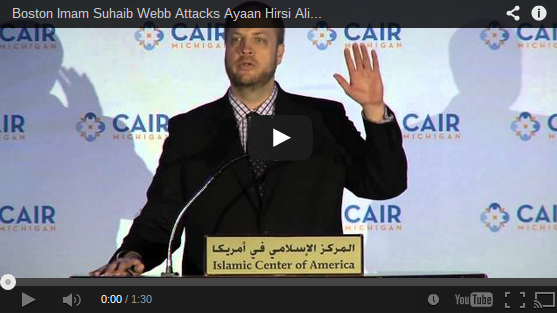
Suhaib Webb, an Imam with ties to former Al Qaeda mastermind Anwar al-Awlaki, had also previously been the leader of the Islamic Society of Greater Oklahoma City, which had been attended by Alton Nolen — the man who on Thursday beheaded a former coworker after recently converting to Islam, Breitbart News has learned. Webb now serves as Imam of the sister organization of the mosque attended by Boston Marathon bombers Dzhokhar and Tamerlan Tsarnaev.

Imam Suhaib Webb has a history of ties to radicalism. FBI surveillance documents found that he was a known confidant of Al Qaeda mastermind Anwar al-Awlaki. Just two days before the September 11, 2001 attacks on America, Webb spoke at a fundraiser with Awlaki with hopes to raise funds for Atlanta-based H. Rap Brown, a man that shot and killed two police officers. The FBI documents also found that “Webb and Awlaki may be associated with the Muslim American Society,” which is a group described by the Investigative Project on Terrorism as being “founded as the United States Chapter of the Muslim Brotherhood.”

Nolen took a picture of himself (above) September 5th, just three weeks before he brutally murdered an innocent woman, standing in front of the gates of the Islamic Society of Greater Oklahoma City.

The caption read: “At The Masjid (Mosque)Today For Jumar 9/5/2014 & Peforming Wudu!!!”

Imam Webb’s bio from his new place of employment, the Islamic Society of Boston, states:

While pursuing his bachelors degree Imam Webb studied privately with a renowned Muslim Scholar of Senegalese descent. After intense private training in various Islamic sciences, Imam Webb was hired as the Imam at the Islamic Society of Greater Oklahoma City, where he not only provided Khutbas (Sermons) and religious classes but also counseled families and young people.

The Islamic Society of Boston, which was attended by the Tsarnaev brothers during his tenure as Imam, has several within their ranks who have been charged with committing acts of Islamic Radicalism. The founder of the Mosque, Abdulrahman Alamoudi, was sentenced to 23 years in prison for his role for financing terror.

After the Boston Marathon bombings, Webb had initially been invited to an interfaith memorial at the Holy Cross Cathedral, where president Obama was scheduled to speak. Imam Webb’s invitation was then rescinded under mysterious circumstances at the last minute, according to reports.

Writing in the Jewish Advocate last year, columnist Charles Jacobs described Imam Webb as someone who “teaches vicious hatred and calls for young Muslims to engage in Jihad against non-Muslims in order to establish a global Islamic state.”

Additionally, a video from October showed Webb at a Council for American Islamic Relations (CAIR) fundraiser calling for an Islamic State. The Islamic organization, a group that originally had secretly called itself the “Palestine Committee of the Muslim Brotherhood,” was charged as an unindicted co-conspirator in the largest terrorism financing case in American history, known as the Holy Land Foundation Trial.

U.S. Suspects More Direct Threats Beyond ISIS

21 Sep

OBAMA VIEWED AS SLUGGISH ON TERROR THREATS

By MARK MAZZETTI, MICHAEL S. SCHMIDT and BEN HUBBARD

SEPT. 20, 2014

ISLAMIC STATE IN BLACK

WEARY TRAVELERS Thousands of people journey daily between Iraqi Kurdistan and territory controlled by the Islamic State. Credit Andrea Bruce for The New York Times

WASHINGTON — As the United States begins what could be a lengthy military campaign against the Islamic State, intelligence and law enforcement officials said another Syrian group, led by a shadowy figure who was once among Osama bin Laden’s inner circle, posed a more direct threat to America and Europe.

American officials said that the group called Khorasan had emerged in the past year as the cell in Syria that may be the most intent on hitting the United States or its installations overseas with a terror attack. The officials said that the group is led by Muhsin al-Fadhli, a senior Qaeda operative who, according to the State Department, was so close to Bin Laden that he was among a small group of people who knew about the Sept. 11, 2001, attacks before they were launched.

There is almost no public information about the Khorasan group, which was described by several intelligence, law enforcement and military officials as being made up of Qaeda operatives from across the Middle East, South Asia and North Africa. Members of the cell are said to be particularly interested in devising terror plots using concealed explosives. It is unclear who, besides Mr. Fadhli, is part of the Khorasan group.

JAME CLAPPER

The director of national intelligence, James R. Clapper Jr., said on Thursday that “in terms of threat to the homeland, Khorasan may pose as much of a danger as the Islamic State.”

Some American officials and national security experts said the intense focus on the Islamic State had distorted the picture of the terrorism threat that has emerged from the chaos of Syria’s civil war, and that the more immediate threats still come from traditional terror groups like Khorasan and the Nusra Front, which is Al Qaeda’s designated affiliate in Syria.

Mr. Fadhli, 33, has been tracked by American intelligence agencies for at least a decade. According to the State Department, before Mr. Fadhli arrived in Syria, he had been living in Iran as part of a small group of Qaeda operatives who had fled to the country from Afghanistan after the Sept. 11 attacks. Iran’s government said the group was living under house arrest, but the exact circumstances of the Qaeda operatives were disputed for years, and many members of the group ultimately left Iran for Pakistan, Syria and other countries.

OBAMA FOREIGN POLICY

In 2012, the State Department identified Mr. Fadhli as Al Qaeda’s leader in Iran, directing “the movement of funds and operatives” through the country. A $7 million reward was offered for information leading to his capture. The same State Department release said he was working with wealthy “jihadist donors” in Kuwait, his native country, to raise money for Qaeda-allied rebels in Syria.

In a speech in Brussels in 2005, President George W. Bush referred to Mr. Fadhli as he thanked European countries for their counterterrorism assistance, noting that Mr. Fadhli had assisted terrorists who bombed a French oil tanker in 2002 off the coast of Yemen. That attack killed one and spilled 50,000 barrels of oil that stretched across 45 miles of coastline.

The Islamic State, also known as ISIS or ISIL, is viewed as more focused on consolidating territory it has amassed in Syria and Iraq than on attacking the West. Some even caution that military strikes against the Islamic State could antagonize that group into planning attacks on Western targets, and even benefit other militant organizations if more moderate factions of the rebellion are not ready to take power on the ground.

James R. Clapper Jr., the director of national intelligence, identified the group called Khorasan as a danger “to the homeland.” Credit T.J. Kirkpatrick/Getty Images

The Islamic State’s recent statements, including a video using a British captive as a spokesman, have sought to deter American action against the group and threatened attacks only as revenge for American strikes.

At the same time, the rise of the Islamic State has blunted the momentum of its rival groups in Syria, including the Nusra Front, once considered to be among the most capable in the array of Syrian rebel groups. The Islamic State’s expansion across northern Iraq and in oil-rich regions of eastern Syria has sapped some of the Nusra Front’s resources and siphoned some of its fighters — who are drawn by the Islamic State’s battlefield successes and declaration of a caliphate, the longtime dream of many jihadists.

It is difficult to assess the seriousness and scope of any terror plots that Khorasan, the Nusra Front or other groups in Syria might be planning. In several instances in the past year, Nusra and the Islamic State have used Americans who have joined their ranks to carry out attacks inside Syria — including at least one suicide bombing — rather than returning them to the United States to strike there.

Beyond the militant groups fighting for control of territory, Syria has become a magnet for Islamic extremists from other nations who have used parts of the country as a sanctuary to plot attacks.

“What you have is a growing body of extremists from around the world who are coming in and taking advantage of the ungoverned areas and creating informal ad hoc groups that are not directly aligned with ISIS or Nusra,” a former senior law enforcement official said.

isis

Spokesmen for the C.I.A. and the White House declined to comment for this article.

The grinding war in Syria, well into its fourth year, has led to a constant shifting of alliances among the hard-line rebel groups.

Ayman al-Zawahiri, the head of Al Qaeda, anointed the Nusra Front as its official branch in Syria and cut ties with the Islamic State early this year after it refused to follow his orders to fight only in Iraq. Officials said that Khorasan was an offshoot of the Nusra Front. According to fight only in Iraq. Officials said that Khorasan was an offshoot of the Nusra Front. According to a new report by the Bipartisan Policy Center, a nonprofit research and analysis organization, the rifts among these various groups “threaten to create a conflict throughout the jihadist movement that is no longer confined to Syria and Iraq.”

While Nusra has been weakened, it remains one of the few rebel organizations that has active branches throughout Syria. Analysts view the organization as well placed to benefit from American strikes that might weaken the Islamic State.

Jennifer Cafarella, a Syria analyst with the Institute for the Study of War in Washington, said that American strikes could benefit the Nusra Front if the United States did not ensure that there was another force ready to take power on the ground.

“There is definitely a threat that, if not conducted as a component of a properly tailored strategy within Syria, the American strikes would allow the Nusra Front to fill a vacuum in eastern Syria,” she said.

She noted that the Nusra Front had been the primary force in the eastern province of Deir al-Zour before it was pushed out by the Islamic State earlier this year, and that the group had maintained better relationships with the local tribes than ISIS had. This could make it easier for the group to return if ISIS is chased out by American airstrikes.

MILITARY AIR

While the Nusra Front does not openly call for attacks on the West, it remains loyal to Mr. Zawahiri, whose clout among jihadists has waned with the rise of the Islamic State.

A great deal remains uncertain about the Nusra Front’s ultimate aims inside Syria. Hamza al-Shimali, the head of the American-backed rebel group the Hazm Movement, said that he and his allies did not trust the Nusra Front. He said he feared that one day he would have to fight the Nusra Front in addition to the Syrian government and the Islamic State.

American intelligence officials estimate that since the Syrian conflict began, about 15,000 foreigners, including more than 100 Americans and 2,000 Europeans, have traveled to the country to fight alongside rebel groups. Syria’s porous borders make it relatively easy to get in and out of the country, raising concerns among Western officials that without markings on their passports they could slip back undetected into Europe or the United States.

isis 2

Mark Mazzetti and Michael S. Schmidt reported from Washington, and Ben Hubbard from Gaziantep, Turkey. Eric Schmitt contributed reporting from Washington.